


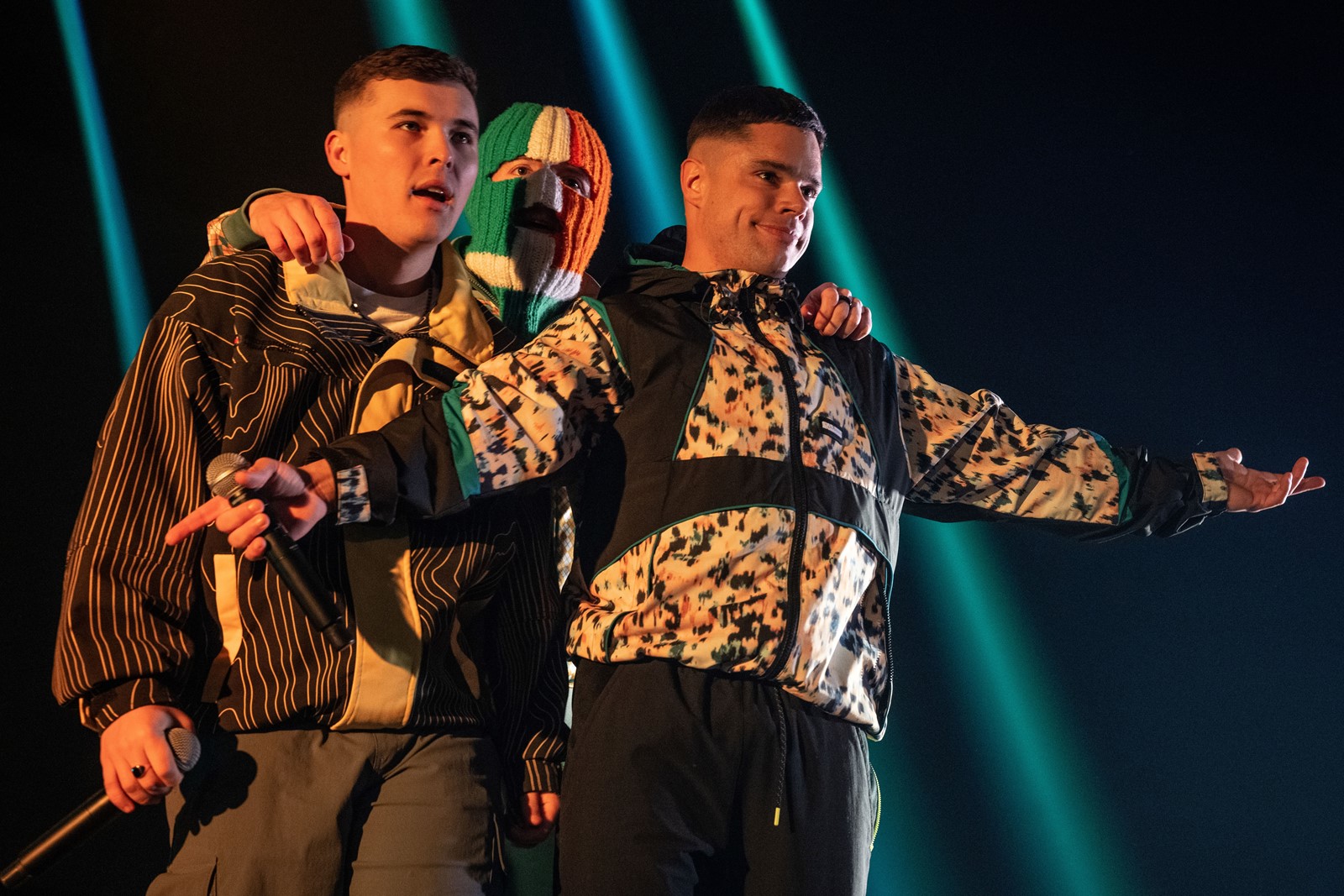


When director Rich Peppiatt first approached the three members of Kneecap, a Belfast, Northern Ireland, hip-hip trio that raps in the Irish language, they weren’t sure what to make of his completely unsolicited pitch to make a feature film about them.
“We were very hesitant,” says rapper Naoise Ó Cairealláin. “At first because, well, No. 1 he’s English, and that’s enough for us to be quite skeptical because for a long time the English would profit off the Irish labor.
“Also, we’re the band; we’re Kneecap,” he says as bandmate JJ Ó Dochartaigh looks on. “We’re a real-life band, not a mythical made-up band. And if we made a film that was cringy, everybody else would move on to the next film. We’d still be Kneecap, and if the film was crap, it would be very detrimental to our music careers, I could imagine.
“But thankfully, I think it paid off.”
“Kneecap,” Peppiatt’s biopic of the band, won the Next Audience Award at the Sundance Film Festival in January.
In addition to having the band members, the cast includes the internationally known Irish actor Michael Fassbender as Ó Cairealláin’s father, as well as the familiar faces of Irish actors such as Simone Kirby and Josie Walker.
Recently, Ó Cairealláin, Ó Dochartaigh and Peppiatt came to Los Angeles for a few days to talk about the movie before it opens in theaters today. (Third member Liam Óg Ó Hannaidh, was delayed leaving Northern Ireland after he contracted COVID-19.)
“We have a WhatsApp group that I set up in December 2019,” Peppiatt says. “It’s called ‘Kneecap Go to Hollywood,’ at the time as a joke. That was when I first met them. And flying over, I looked at the group and the date and I was like, ‘That’s crazy. We’re flying to L.A. with the film all this time later.’
“So yeah, that was quite nice at the moment,” he says. “We had a little cheers to that.”
‘That punk energy’
Peppiatt might never have stumbled onto Kneecap, the movie never made, but for going a little stir-crazy at home in Belfast a few weeks after the birth of his second daughter.
“I needed to get out of the house and have a drink for an hour,” he says from a table on a terrace at the London West Hollywood hotel. “I was wandering down the street and saw a sign for Irish hip-hop playing that night and I went.
“I was just blown away by their charisma, their stage presence,” Peppiatt says. “It reminded me of my favorite band growing up, Rage Against the Machine, which felt like a political act.
“Often in music, the politics have gone out of it in a way today. Everything was so PR-ed and managed, and it was all career-driven.
“And the idea of having these three lads onstage who were throwing fake bags of drugs into the crowd and pulling their trousers down with ‘Brits Out’ ” written on their butts, Peppiatt continued. “They didn’t care. It was just that punk energy about that that just connected with me.
Peppiatt, who had previously made documentaries and worked in television, knew that the obvious move was to do a documentary on Kneecap, but neither he nor the band wanted to be obvious.
“They were interested in the idea of a narrative feature,” he says. “But they’re also very skeptical. Because when somebody approaches you and goes, ‘I want to make a film about you, and you’re going to play yourselves in it’ you kind of go, ‘Uh, really? OK, whatever you say, mate.’ ”
Of course, the idea of making a biopic about a band almost nobody knew outside of Belfast, and maybe just West Belfast at that, might not have been the smartest idea either.
“It made no sense in a way to be making a biopic about a band that’d never released an album, weren’t signed to a record label, rapping in a language that no one spoke,” Peppiatt says. “Why the hell would you make a biopic about these guys?
“But it was so illogical, so stupid and foolhardy that it actually in its own way came out the other side and was like, ‘Well, that is the very reason to make it, because it’s never been done, right?’ ” he says.
“The minute you go, ‘It’s never been done,’ it’s going to be a disaster or it could be cool.”
For the ‘craic’
Kneecap’s name has roots in The Troubles, those three decades of violence between those who wanted the British out of Northern Ireland and those who wanted to maintain British rule. Kneecapping — shooting someone in the knee — was a punishment administered by members of the Irish Republican Army for a range of perceived infractions, such as selling and using drugs, as Ó Cairealláin and Ó Hannaidh are seen doing in the movie.
Growing up with that history, the members of Kneecap developed a sharp political edge to their songs and performances. As part of the post-Troubles generation, they also sought to be a new voice in Northern Irish youth culture too, the band members say.
“We met organizing contemporary Irish language festivals in Belfast,” says Ó Cairealláin, whose stage name, Móglaí Bap, is a reference to a boyhood haircut that resembled that of Mowgli from “The Jungle Book.” “JJ used to play pop music in Irish before he embarked on this journey. And Liam Óg used to come as a young fellow to the festivals and help us organize them.
“There was a subculture of young people growing up in Belfast who spoke Irish, and we all kind of found each other,” he says. “We would go partying together all the time on the weekends, and we noticed that a lot of the terms that exist in English didn’t exist in Irish. Youth culture terms, like terms for drugs and that there.”
So they created their own translations, says Ó Dochartaigh, who performs wearing a balaclava in the tricolors of the Irish flag and goes by DJ Próvai, a reference to the Provisional IRA, which fought to end British rule of Northern Ireland.
“And it was from that tiny subculture, that tiny movement, that Kneecap was born,” he says. “We wanted to let people know that we exist. Because I figured out people probably didn’t know that, No. 1, Irish language isn’t just a funny accent in English; No. 2, that there are young people who speak it.”
Kneecap goes Hollywood
After several months of wooing, Kneecap told Peppiatt they were in.
“We became friendly,” Ó Cairealláin says. “He bought us some Guinness, which is the way to any Irishman’s heart. And we just kind of realized he was serious, and he had a plan for us.”
Peppiatt, who signed up for Irish language classes the day after that first night of Guinness, went to work immediately, hunting down development funds and signing up the three rappers — and himself — for six months of acting classes.
“It was a very complicated script,” he says. “Lots of different themes. It’s tri-protagonist. I remember realizing that and going, ‘I’m going to watch all tri-protagonist films to get a grasp on how structurally people pull it off.’ Then you realize there aren’t really any, and you go, ‘Oh, that’s a bit ominous.’ ”
To be clear, he’s joking about the difficulty of working with his three-headed protagonist, partly in awe of just how quickly they learned their way around filmmaking.
“The one thing that did annoy me about them was that they had such an innate grasp of story, something that they really understood, where the beats of a story were as if they’d been involved in scripts for years,” Peppiatt says, laughing. “And that really grated on me, because I’ve spent years trying to be able to do that.”
The film traces the anarchic rise of Kneecap from the banned single and the first sparsely attended pub gig through scrapes with police, politicians and paramilitary. The trio’s unvarnished narrative includes plenty of drugs, dealt and consumed, while also deftly pairing the rise of Kneecap’s popularity with the long, hard-fought political campaign that in 2022 led to the recognition of Irish as an official language in Northern Ireland.
All flashing before their eyes
The first time the director and cast saw the finished film was when “Kneecap” screened at Sundance. Suddenly, what had seemed their little project was splashed across the big screen before an audience of Hollywood movers and shakers.
When that screening ended and the positive reviews poured in, the reality of what they’d done sank in, Ó Cairealláin says.
 PREVIOUS ARTICLE

