


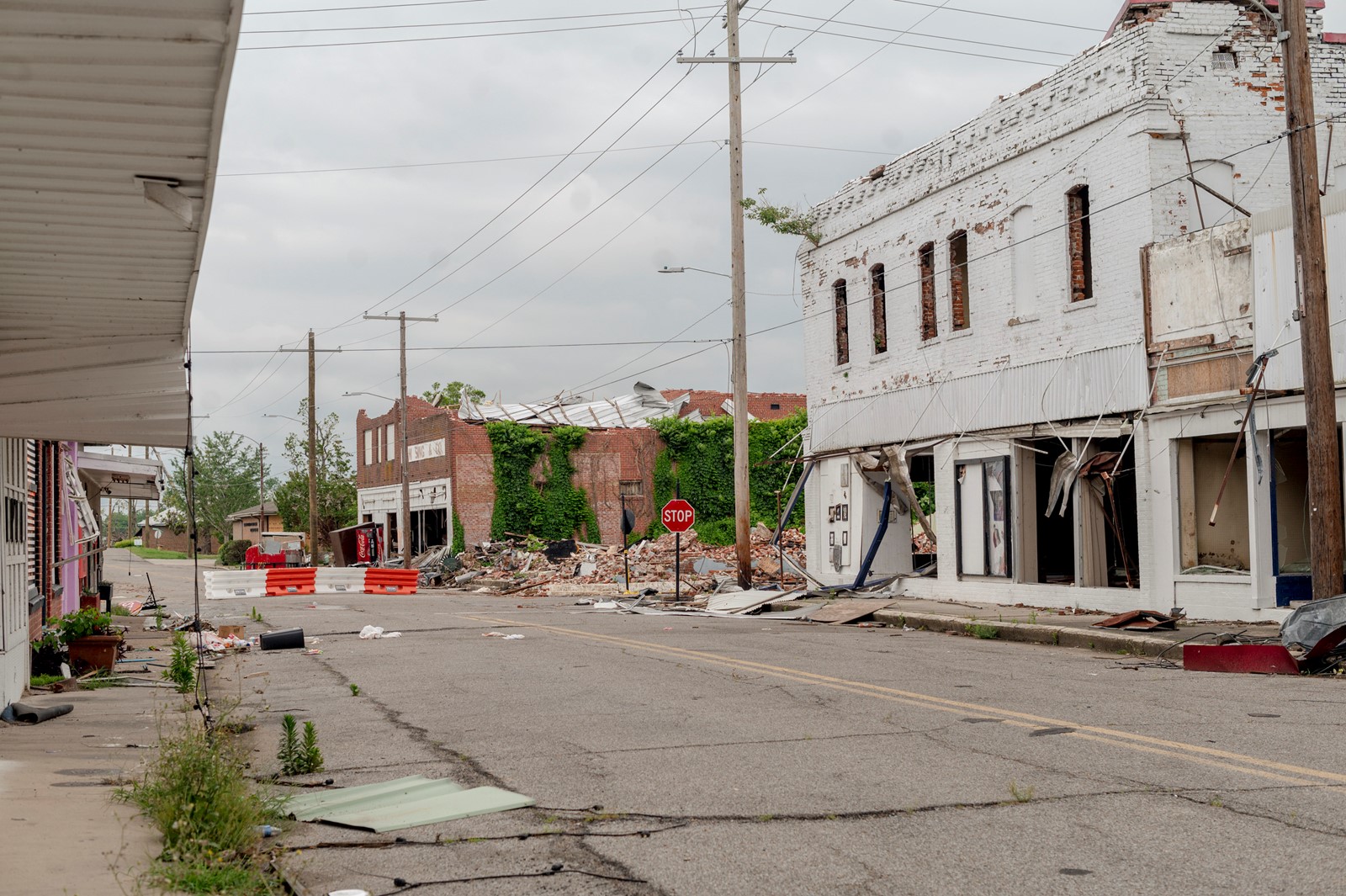


ROLLING FORK, Miss. >> Two years into their marriage, Talia and Malissa Williams were working diligently to lay the groundwork for the rest of their lives together. Both were taking online college classes that could lead to stable careers. They had taken tentative steps toward adopting a child.
The couple had talked about settling permanently in Rolling Fork, the tiny Mississippi Delta hometown that Malissa Williams had followed Talia back to a few years earlier. But the medical billing and coding jobs they’d been studying for weren’t likely to be found within an hour’s drive. Their older wooden house — essentially their least worst option in a town with a limited supply of rental housing — gave them nothing but problems.
Then came the tornado.
The house, gone. Their possessions — cars, clothes, computers — eviscerated in winds that reached 170 mph as the storm, the deadliest to hit Mississippi in more than a decade, tore through on the night of March 24.
Gone, too, was any incentive for them to stay.
“My heart is in Rolling Fork; it will always be there,” Talia Williams, 42, said as she stood outside the motel room, a 45-minute drive away, that is serving as the couple’s temporary home. “But now (that) this has happened, we have an opportunity.”
As powerful storms raked across the Southeast on that night in March, Rolling Fork was shredded. Sixteen people were killed in the area. Dozens of families were forced into the same position as Talia and Malissa Williams: Their homes were mangled, their lives upended in an instant.
But just like Talia and Malissa Williams, many people in the community already had been navigating a slower-motion crisis for years, one that has swept the whole of the Mississippi Delta over decades of disinvestment and decline.
The devastation of this other disaster is manifest in the decaying homes and abandoned storefronts in the few areas of Rolling Fork left unscathed by the tornado, as well as in the city’s neglected infrastructure, entrenched poverty, struggling schools and troubling health statistics. The population of about 1,700 has been shrinking steadily for as long as most residents can remember.
The Delta — a pancake-flat expanse wedged between the Mississippi and Yazoo rivers in the northwestern part of the state — long has been defined by a contradiction. It is known for having some of the most fertile soil in the world, sustaining cotton, soybean and corn crops that for generations have been distributed around the world. But the bounty rarely has been shared in any meaningful way with the African American families who make up much of the population in the impoverished, hollowed-out communities that speckle the region, like Rolling Fork.
“You still see the vestiges of racial segregation, of economic segregation,” said Rolando Herts, the director of the Delta Center for Culture and Learning at Delta State University, in Cleveland, Mississippi. “We’re inheriting the decisions that were made years and years, decades and decades ago.”
The most viable solution for many Delta residents has been to leave. That was the case during the Great Migration, the mass exodus from the South of African Americans fleeing racist oppression and poverty during the 20th century. The population drain continued as increased mechanization of farming reduced the need for farm laborers and other types of industry fled the region.
Annie Lee Reed, 69, spent most of her life in Rolling Fork, but she was relieved when her children left town. The distance was difficult, but the alternative was worse. If they stayed, she said, “I knew they weren’t going to do nothing or make nothing.”
There are those who believe the tornado was not a nudge to flee, but an opportunity for Rolling Fork. In the immediate aftermath, Mayor Eldridge Walker assured the community that the city would “come back bigger and better than ever before.”
His argument was that the storm had drawn attention — and the prospect of investment — to the town. If not for the tornado, President Joe Biden would never have flown in and promised the support of his administration. “Good Morning America” never would have broadcast live from Rolling Fork or solicited donations for the town from viewers.
As clear-eyed as Hall Williams was about what ailed Rolling Fork, she was among those who saw promise in the town. “It’s coming back,” she said confidently. Her home was severely damaged by the storm, leaving Hall Williams and her husband to stay in a motel outside of town. But she was sketching out plans to open a restaurant serving her favorites: macaroni and cheese, catfish, brisket. She would be an employer, someone helping Rolling Fork survive, giving others incentive and resources to stay put.
“I’m not giving up,” Hall Williams said.
Henry Hood was far less sanguine. Two months after the tornado, the attention to the town had already faded. Assurances from elected officials were followed by a formal process for seeking government assistance that was so thick with bureaucratic and other hurdles that even the best of intentions were no match.
So far, he and Reed, his wife, had gotten $650 in federal emergency aid to fix a damaged car and $1,200 from a church to repair their house, which had been handed down from Reed’s parents.
“It’s just going to be patched back up, little by little,” Hood said of his home. “There’s not going to be a remodeling and all that.”
His prediction: The same would be true for Rolling Fork.
The community was daunted by a bleak catalog of destruction: City Hall, the post office, the police department, both laundromats, the Family Dollar store, the convenience store that also had a decent menu of hot food.
There were also things that, while not essential to a functioning community, held deep value as the landmarks of home. Domonique Smith, who grew up in Rolling Fork, noticed the loss of the pear tree in the yard of a woman known as Miss Louise, which had long been harvested by neighborhood children.
Smith’s mother’s house had seemingly vaporized, its contents spread across the neighborhood. She found a single photograph of her father, who died when she was so young that she had no memories of him.
Now 35, she lives in Jackson, the state capital, almost 90 minutes away. But she said she always had found comfort in knowing her mother’s house, a haven, was there for her in Rolling Fork.
She returned to Rolling Fork on a recent Sunday because her family, at last, had something to celebrate. Her cousin, Ja’kiya Powell, had just graduated from high school, third in her class. The family gathered in another relative’s front yard, boasting of Powell’s accomplishment with a banner hanging from the front of the house.
Almost a year ago, Powell’s mother had moved to Texas, but Powell stayed behind, living with relatives. She wanted a normal senior year with her friends, something different from her school experience during the pandemic. The tornado hit the town just before her prom.
She was preparing to follow her mother and cousin out of Rolling Fork, starting at the University of Mississippi in the fall.
“There was a little taste of something before the tornado,” Powell, 18, said of her hometown. “Ain’t nothing now.”
 PREVIOUS ARTICLE

