


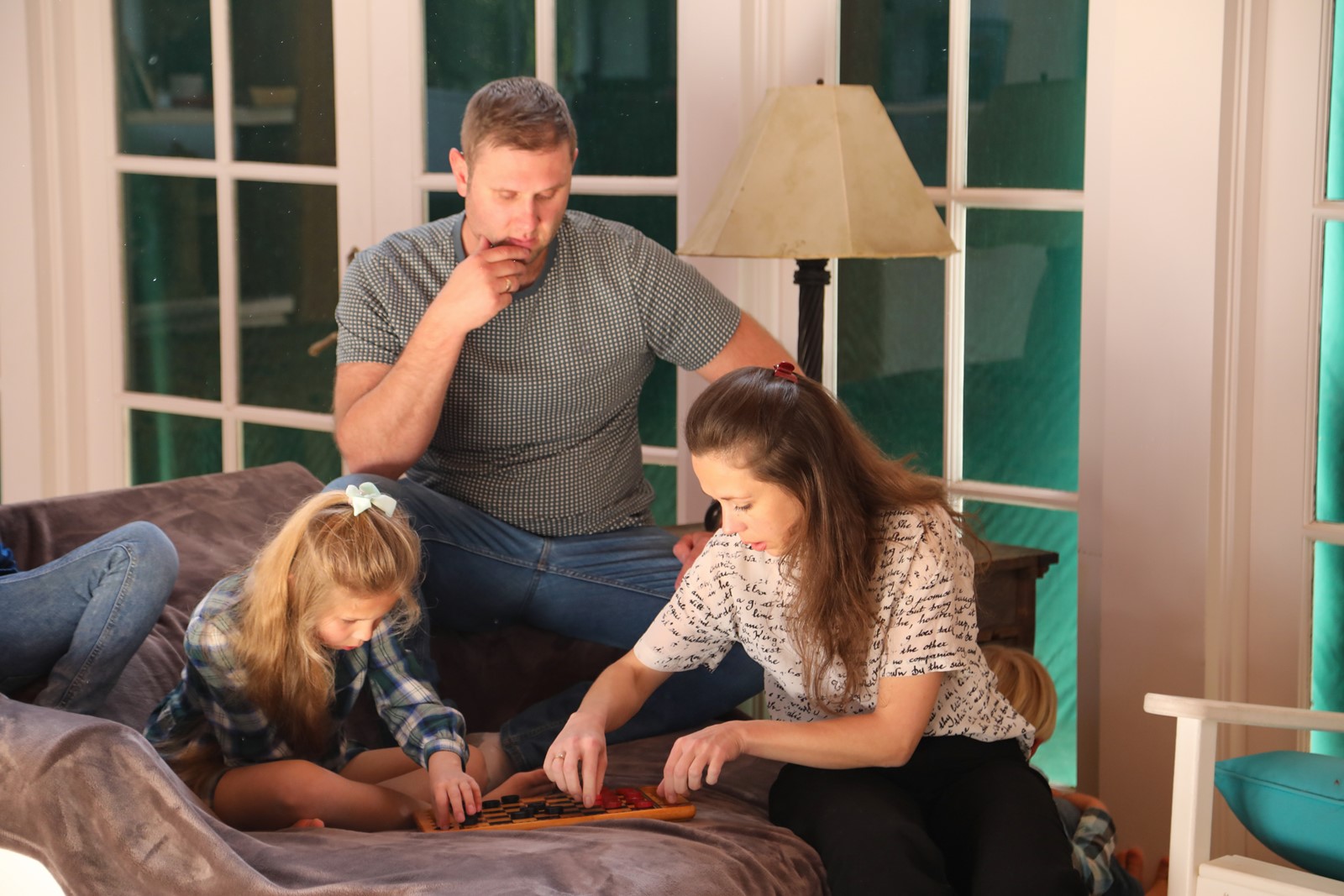


Meet the Kovalchuks
One such Ukrainian family is headed by Petro and Olga Kovalchuk.
Before the Russian invasion, the couple, both physicians in their mid-30s, had the professional payoff that comes from years of study and sacrifice.
After medical school, internships and residencies in their specialties of ear, nose and throat, they were “young doctors trying to find our way,” Petro said.
They built their family during this time, which now includes Bohdana, 8, Mykolo, 7, and Ivan, 5.
With the pandemic raging, Petro and Olga moved from Kyiv to a smaller town of Cherkasy, where Petro’s father had a thriving, but tiny ENT practice. Everyone in the town of 300,000 knew Dr. Mykola Kovalchuk, Petro said. Patients came from all over Ukraine to be treated.
His father’s dream and his dream: open a larger clinic. The trio pooled their talents and opened Doctor Kovalchuk Family Clinic. The 10-room space complete with a surgery center and a full waiting room operated for just six months.
Then, on Feb. 24, 2022, the Russians invaded Ukraine and everything changed for the Kovalchuks.
Those initial days of the invasion were horrifying, Petro said. Olga insisted the family sleep in their 2-foot by 10-foot basement during the nighttime bombings. It was very humid and very cold, Petro said.
“It was a challenge for me,” Petro said, “because I like comfort.”
The children didn’t really understand at first what was happening. They laughed, they smiled at this underground adventure. All the while, Olga and Petro frantically searched their phones for news reports, trying to discern what was happening to their country.
After the fourth night sleeping on cement, Petro said he’d had enough.
“I said no. It’s better for me to die,” he said. “I don’t want to sleep on the ground.”
Many factors went into the decision to leave after that, Petro said. Their home wasn’t prepared for this. Whose is?
There was dust from nearby bombings; there was mold. Both Petro and Ivan felt sick from the allergens. At the clinic, things were slowing down. A couple of days after the invasion, there were still people to treat, Petro said. Then, things trickled off and after awhile there were no patients and no phone calls.
Petro asked a political expert friend: How long before Russians arrived in Cherkasy? Seven days was the reply. There were rumors of civilians being raided, being raped.
It was March 1. It was time.
“The safety of our family was more important than business or money,” Petro said as he recounted the difficult decision to leave behind the comfortable life the couple had built.
The Kovalchuks journey to safety is similar to other refugees’ stories.
They headed for the Romanian border with only the most necessary clothing and documents. The five of them were joined by his father, stepmom, their two children, Petro’s sister and her three children. Along the way, they saw explosions, missiles flying through the air. At every little town, there were checkpoints. And lots and lots of traffic. The typical six-hour trip took two days.
The three-family caravan went from Romania to Prague to Mexico City to Tijuana before eventually crossing the border into the U.S.
Immigration numbers
Just how many Ukrainians have crossed the Mexican border into California over the past year is unclear. And there’s good reason for that, said Artur Kiulian, founder of Ukraine Now. That’s because this extraordinary period of migration hasn’t really been accounted for yet.
“No one has any clue to be honest,” Kiulian said, “It’s so crazy to say that.”
During the initial months of the exodus, when Ukraine Now was crowd-sourcing drivers and buses to help Ukrainians flee, Kiulian estimates that 20,000 crossed from Mexico into California.
It was a humanitarian crisis, Kiulian said, with thousands upon thousands trying to get through. And as Petro and his group learned, the process for getting a Mexican visa was free for Ukrainians and took only about 15 minutes.
Petro relays his story of hiring a driver near Tijuana who advised the families to “pray for luck” and go the border by foot. After being driven close to the entry point, Petro and his cohort waited for days in Tijuana for the right moment. It came at 4 a.m. one day. There were 13 of them and it was March 13. It’s his lucky number, he said.
The young doctor believes it was the large number of children they traveled with that helped them get across.
“Officers were very surprised,” Petro recalled. “They looked at us. How many? I said 13. They collected all the passports. And then they said, ‘Let’s enter.’ ”
The relief of refugees finally reaching their destination is short-lived, Kiulian said. His nonprofit, launched specifically to help with the Ukrainian crisis, gathers volunteers from around the world to help — both for those in the U.S. and for those left behind.
“It was pretty brutal for the first few months,” Kiulian said of the exodus from Ukraine. The key, he said, is to have a sponsor here who will bring you into the country.
The federal government’s United for Ukraine program gives those fleeing the war a temporary two-year period in which to stay. While the program is renewable at the end of those two years, it is not a pathway to citizenship.
Kiulian lauds the program, saying it offers a great way for Ukrainians to get into the U.S. and connect them with relief agencies at the county level, such as CalFresh for food support. But, what’s missing is housing support, he said — something especially difficult and almost impossible for those relocating to pricey Southern California.
Jump-starting life
As the Kovalchuks found, sponsorship and continued support from newfound California neighbors have been crucial in their family’s assimilation.
The family of five lives rent-free in a four-bedroom home in Santa Monica. They have, Petro thinks, until the end of the school year to reside there.
As he and Olga study for an exam that will allow them to practice medicine in the U.S., the children are attending a public school, and making crucial friends.
Ivan, the kindergartner, has become buddies with Rothko Hinchman, whose mother, Tamara, has launched a GoFundMe to raise money so the Ukrainian family can perhaps purchase a car, saving on the more than $1,000 per month in car rental fees.
It’s been difficult accepting that help, said Petro, who had to be convinced to make his story public.
“I need help,” Petro said. “Maybe I don’t know how to ask for help, but I need help.”
Petro, sadly, said the donated help still doesn’t alleviate the anguish he feels at not being able to practice his profession or provide readily for his family as he did in Ukraine.
“People think if I get help, I will be happy,” he said, adding that with the war still near to so many of his friends back home, he is stressed.
On the giving end, it took a while for Tamara Hinchman to figure out how to help her new friends, but she is now glad that she did.
“I think how much this family’s life has changed in a year,” Hinchman said. “This is a very fortunate community that I love and there are now people here who have escaped a war. Be generous, be welcoming.”
The future
So, what does the future hold for Petro Kovalchuck, his wife, their children, his once-famous ENT father?
Mykola Kovalchuk, who lived for a time with Petro and family, now lives in an apartment in Los Angeles with his family. He tired of sitting around, Petro said, so he’s got a job at a Ralph’s supermarket making minimum wage.
And that’s been gut-wrenching for Petro, to see the man who he looked to once as the epitome of success, working for low pay.
“Life has to continue,” Petro said. “I don’t think only about one way about my future.”
He said he wants to be in control and that perhaps he and Olga can take their newly studied skills back to Ukraine and practice on English-speaking patients there.
Meanwhile, the Doctor Kovalchuk Family Clinic sits vacant in Cherkasy. People back home have offered to open it up, to run it for him, Petro said. But, he’s unsure it’s wise to turn over his father’s dream to someone else, even temporarily.
But one thing is for certain, he said. He wants to be back home in Ukraine, ideally.
“My heart is with my country,” Petro said. “If I will be helpful here I will stay here and I will do what I can.”
To that end, Petro is working with area plastic surgeons on a project to reconstruct a 23-year-old Ukrainian’s soldier’s face. The young man was badly burned in the war and needs specialty care and it’s a difficult case, Petro said.
Petro’s desire to return, to help rebuild, is a common one among displaced Ukrainians, Kiulian said.
In fact, the nonprofit founder said the majority of Ukrainians want to go back home and in that way, this humanitarian crisis is like no other.
Kiulian estimates that perhaps as many as half of the 20,000 who came to California a year ago have already left the state. Many have gone to Europe, he said, to be closer to Ukraine, so at least the women and children can visit relatives.
Others have gone to other more Ukrainian-centric city centers, such as in Chicago or Seattle, some even to Canada.
And what will Ukrainians find when they return?
Petro is not certain.
“It will not be the same life as before the war,” he said. “If the war stops now, it will be a troublesome economic time, for sure.”
As interest in Ukraine wanes, fundraising efforts to support eventual rebuilding and continued refugee support has been difficult to maintain, Kiulian said. He’s concerned that after this blip of media interest in the one-year anniversary of the country’s plight, people will forget.
“I want to make sure the people who support Ukraine never miss an opportunity to speak about it,” Kiulian said. “Don’t be shy. Donate or host a family.”
It’s by example, he said, that others might follow suit an empathize with what it means to lose everything and flee the land you love.
Tamara Hinchman said her experience meeting and assisting the Kovalchucks has changed her.
“I could really see myself in them,” Hinchman said. “Their old life felt safe. They never imagined war would come. They donated to other causes. They never thought it would be them, crossing the border, rationing food to their children.”
No matter how safe you feel, Hinchman said, disaster can strike anyone.
 PREVIOUS ARTICLE
