


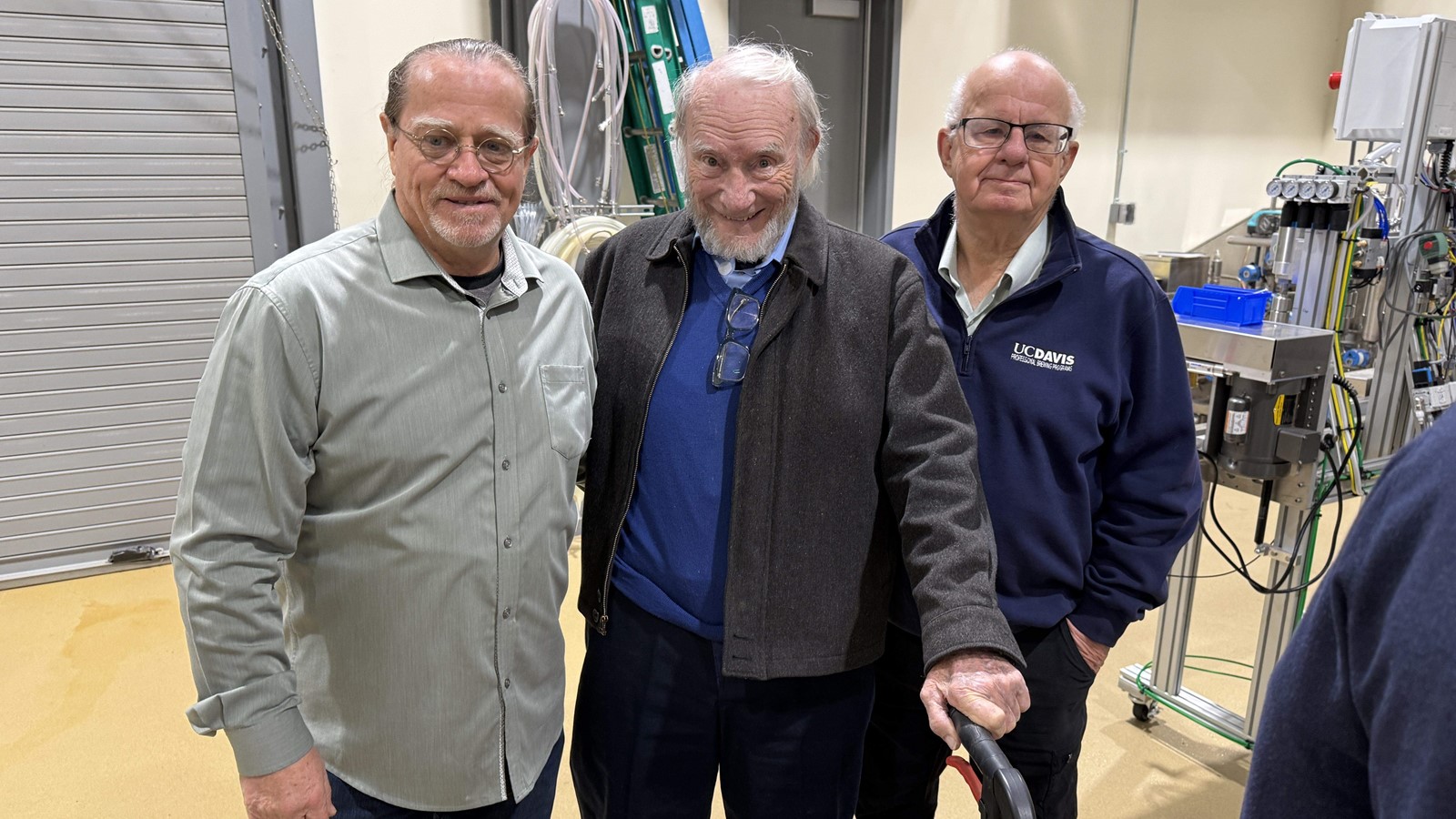


In the UC Davis pilot brewery, steam curled from stainless steel kettles and the smell of grain hung in the air as faculty, alumni and former professors returned to do what brought them together in the first place — brew beer.
It was a reunion of sorts for the Master Brewers Certificate Program, which has shaped generations of craft beer professionals. Teams clustered around three cauldrons, coaxing different worts to temperature in preparation for fermentation.
The gathering took place earlier this month, on Dec. 11, in celebration of Michael Lewis, the program’s founder.
For more than half a century, Master Brewers program has quietly trained the people behind some of the world’s most recognizable beers. Founded by Lewis in 1964, the program has grown into a powerhouse of brewing science, turning out brewers who balance craft and chemistry — and shaping an industry that continues to evolve with new tastes, new technology and global competition.
Lewis launched the program 61 years ago as a set of courses in the food science and technology department. With its creation, he became the first professor of brewing in the United States.
Lewis, now 88, speaks with a crisp British accent and a wry sense of humor — unmistakably sharp but modest about what he and others have brewed off campus at Sudwerk Brewing Co.
“It was very popular, because students of that age always want to drink something, and coffee doesn’t hack it,” he said.
In 1976, he began teaching home brewing through what was then UC Davis Extension. Among those students was Ken Grossman, who home-brewed his first batch of what would later become Sierra Nevada Pale Ale and who would go on to found Sierra Nevada Brewing Co.
Lewis retired in 1995 and was succeeded by fellow Brit Charlie Bamforth. Under Bamforth’s leadership, the program expanded from a single fermenter to a full pilot brewery.
Bamforth raised $5 million to match a donation from Anheuser-Busch, secured with help from alumnus and former company vice president Doug Muhlman.
“So we have got fantastic facilities. I don’t think there’s any brewing program anywhere in the world that is so well equipped as this,” Bamforth said.
Each instructor in the program does more than make beer. All are published scientists, committed to the study of brewing. In Bamforth’s case, he became best known for his work on beer foam.
“So there’s supposed to be nobody in the world that knows more about how to put a foam on beer than I do. Isn’t that sad?” he said.
Bamforth commented on the rise of diverse, unconventional ingredients in craft brewing.
“I still prefer the beers that celebrate malt, hops, yeast and water, and I’m not a big fan of strange ingredients in beer,” he said. “I sure as heck wouldn’t have ever predicted a beer with Rocky Mountain oysters in it.”
Bamforth retired in 2018. The following year, Glen Fox took over the program.
Fox kept the emphasis on science and craft but added an advanced brewing class to better prepare students for the scale and complexity of commercial brewing.
Fox also focuses on improving the efficiency and sustainability of beer production.
“Everyone is wanting to become more efficient, either with their raw materials or their process,” he said. “They’re always asking, is there something you can do different in the brewery that will make the process more efficient without impacting quality and flavor?”
“We’re looking at making the industry more sustainable.”
Efficiency is vital in a market facing shifting tastes and increasing economic pressures, Fox said.
“There is more competition, not from breweries but from other beverages like hard seltzers and kombucha growing in popularity,” he said. “The only current growth segment is nonalcoholic beer.”
This is in part due to perceived health risks from alcohol consumption, but there are studies supporting the healthful properties of moderate consumption of beer. Lewis still has a beer every day.
“You can tell by my slenderness and my happy face and no pimples to speak of,” he said.
The UC Davis program — which costs $16,000 for tuition, books and materials, and can be done in person or online — has grown into a key talent pipeline for the brewing industry.
“We think 99% of students go into the industry,” Fox said. “These people typically get positions as brewers.”
 PREVIOUS ARTICLE
