


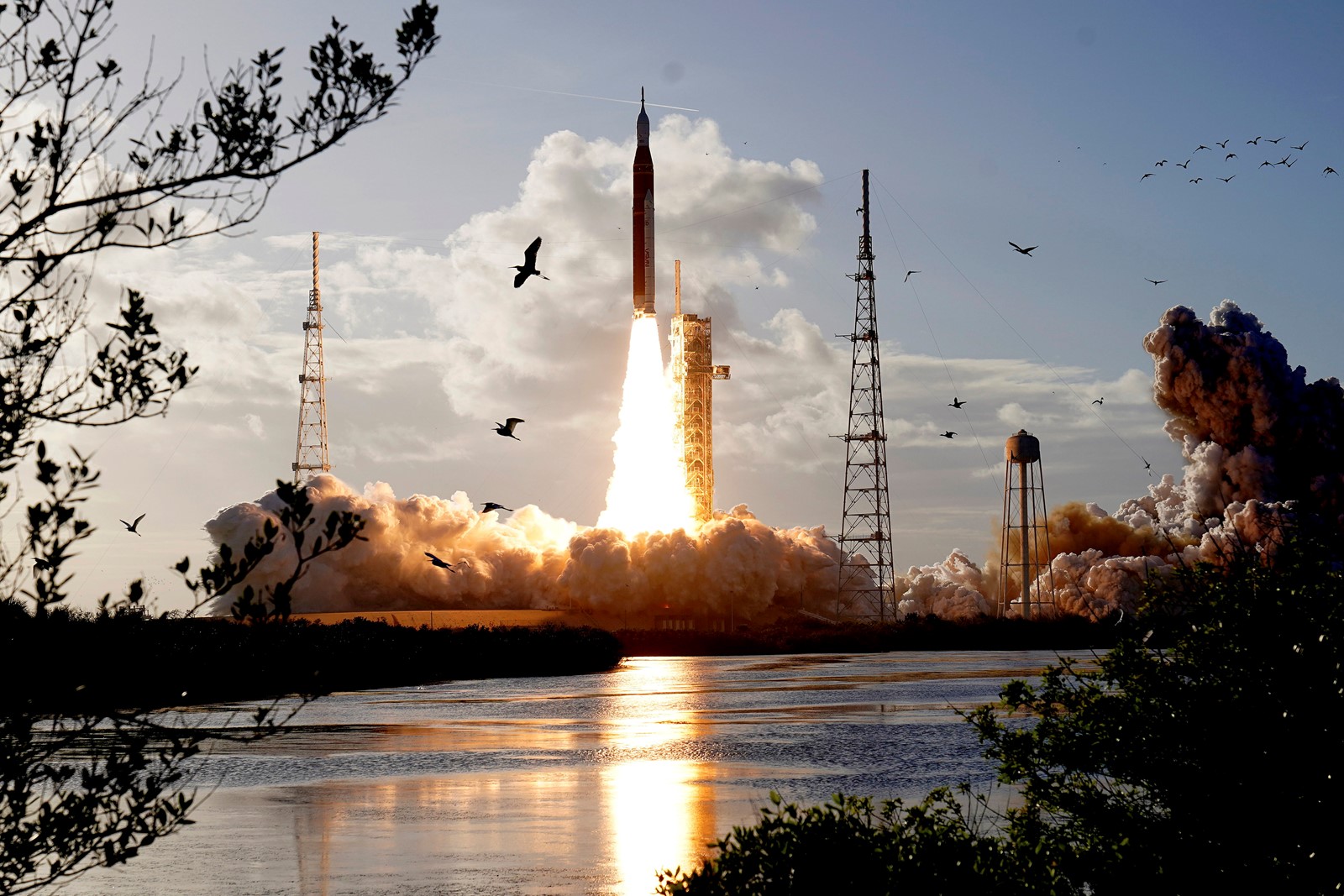


CAPE CANAVERAL, Fla.>> NASA’s Artemis II astronauts fired their engines and blazed toward the moon Thursday night, breaking free of the chains that have trapped humanity in shallow laps around Earth in the decades since Apollo.
The so-called translunar ignition came 25 hours after liftoff, putting the three Americans and a Canadian on course for a lunar fly-around early next week. Their Orion capsule bolted out of orbit around Earth right on cue and chased after the moon nearly 250,000 miles away.
It was the first such engine firing for a space crew since Apollo 17 set out on that era’s final moonshot on Dec. 7, 1972. NASA said that preliminary reports indicate it went well.
NASA had the Artemis II crew stick close to home for a day to test their capsule’s life-support systems before clearing them for lunar departure.
Now committed to the moon, the Artemis II test flight is the opening act for NASA’s grand plans for a moon base and sustained lunar living.
Cmdr. Reid Wiseman, pilot Victor Glover, Christina Koch and Jeremy Hansen will dash past the moon, hang a U-turn, and zip straight home without stopping to land.
It will be the farthest humans have ever traveled from Earth, breaking the Apollo 13 distance record set in 1970. They also may become the fastest during their reentry at flight’s end on April 10.
Glover, Koch and Hansen already have made history as the first Black person, the first woman and the first non-U.S. citizen to launch to the moon. Apollo’s 24 lunar travelers were all white men.
To set the mood for the day’s main event, Mission Control woke up the crew with John Legend’s “Green Light” featuring Andre 3000 and a medley of NASA teams cheering them.
“We are ready to go,” Glover said.
Mission Control gave the final go-ahead minutes before the critical engine firing, telling the astronauts that they were embarking on “humanity’s lunar homecoming arc” to bring them back to Earth.
Koch replied: “With this burn to the moon, we do not leave Earth. We choose it.”
The next major milestone will be Monday’s lunar flyby.
— The Associated Press
 PREVIOUS ARTICLE

