


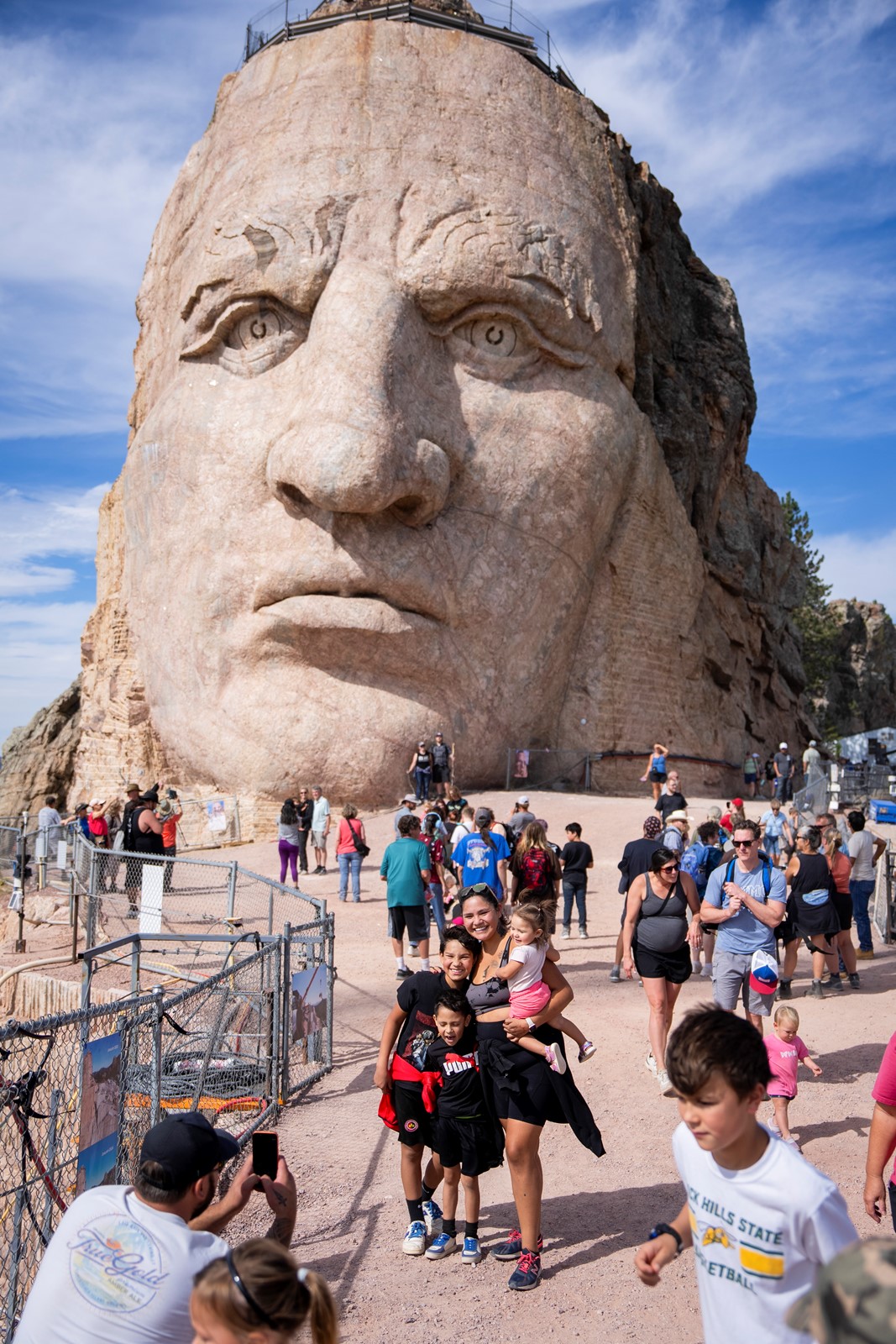


CUSTER, S.D. >> Under dark skies at 6 o’clock on a recent morning, headlights began streaming into the Crazy Horse Memorial complex near Custer, South Dakota. Once the sun was above the Black Hills, the first wave of hikers, more than 1,000 people, strode past a welcome banner.
As they wended toward the summit of Thunderhead Mountain, they paused now and then to gaze up at the enormous face carved into the granite more than 6,000 feet above sea level.
Emerging from that same rock was a gigantic left hand, with a 29-foot, 6-inch index finger pointing across the mountains and toward the Pine Ridge Native American Reservation, a longtime home of the Oglala Lakota tribe.
The face and hand are part of a colossal carving now in its 77th year of construction. If and when the work is completed, it will depict the Oglala Lakota chief Crazy Horse astride a fast-galloping stallion. At 563 feet high and 642 feet long, it will be the world’s largest sculpture, nearly 10 times as tall and three times as long as the Great Sphinx of Giza.
“You can really see they’re ramping up progress,” said Jeff Tuschen, 63, a retired farmer from Salem, South Dakota, who was making his 12th visit.
The summit is closed to the public all but two days of the year, when the operators of the Crazy Horse Memorial allow visitors to walk a 3-mile or 6-mile loop and view the sculpture-in-progress up close. The recent hike, on Sept. 28, drew 5,170 people, according to the organizers.
Josh Buczynski, a 50-year-old produce manager, made the trip from Billings, Montana, with his wife and son. “I’ve been to Crazy Horse maybe 10 times over 30 years,” he said early in the hike, “and I notice a big improvement in the hand.”
Crazy Horse was born around 1840, when the nearby plains teemed with millions of buffalo. He earned the name Tasunke Witko (translated as Crazy Horse or His Horse Is Wild) after proving himself in combat. He became known to the wider American public in 1876, when he helped defeat Gen. George Custer and the 7th Cavalry at the Battle of Little Bighorn. Crazy Horse was killed four months after that.
The monument in his honor came about in response to that other great American rock sculpture, Mount Rushmore, which lies about 17 miles away. Opened to the public in 1941, the smaller Mount Rushmore took 14 years to complete.
The memorial’s origins can be traced to 1939, when Lakota elder Henry Standing Bear wrote to Korczak Ziolkowski, a Boston-born sculptor, proposing a monument meant to show “that the red man had great heroes, too.”Ziolkowski said yes and made South Dakota his home. He oversaw the blasting of millions of tons of rock while devoting half his life to the project. Since his death in 1982, his second wife, his 10 children and many of his grandchildren have carried on his work. The 88-foot-high face of Crazy Horse was not completed until June 3, 1998.
Gene Tierney and Laurel Spence, both 70 and retired, said they had listened to an audiobook, “The Journey of Crazy Horse: A Lakota History” by Joseph M. Marshall III, on the drive from Minnesota. “For me, the story of this place operates on so many levels,” said Tierney, who was making his 10th visit. “The white man is not the hero of this story, and it’s good to be reminded of that.”
Derek Thunder Hawk, an Oglala Lakota tribe member, was on his sixth Crazy Horse hike. He likes to run to the summit, where he burns sage and says a prayer. “A lot of people think we are wiped out,” he said. “When you see something like this, or someone like me, well, it’s a reminder of who the people of this land are, and that we are not dead.”
“I know a lot of people have different opinions about this,” Thunder Hawk, 37, continued, gesturing toward the sculpture. “But it’s about the only thing we have got.”
He was referring to the debates that have surrounded the monument for many years. The detractors say it is a desecration, given that it has required the blasting and reshaping of a peak in the Black Hills, a mountain range considered sacred by the Lakota. Critics also argue that the privately funded Crazy Horse Memorial, which raises money through donations and admissions fees, has eaten millions of dollars that might have gone toward people living on reservations.
And then there is the more practical concern of what Crazy Horse looked like. He was never photographed, and so the face is the result of an educated guess.
Joseph Cross, a retired military veteran who, like Crazy Horse, is an Oglala Lakota, was walking through a thicket of birches with his wife, Doris Cross. What did they think Crazy Horse himself might think of the memorial?
“I think he would like this,” Doris Cross, 63, said. “I just want more Lakota and more people to come up and see it.”
Joseph Cross, 65, was a little more skeptical. “There are a lot of homeless natives out there,” he said. “I think what he would do is take all the energy and resources being put into this and apply it to the people.”
Days before the hike, the plight of the Lakota was in the news because of an announcement made by Defense Secretary Pete Hegseth. In a video post, Hegseth said that the Medals of Honor awarded to soldiers who carried out the 1890 killings of more than 300 Native Americans, including unarmed women and children, near the Wounded Knee Creek on the Pine Ridge Reservation would not be revoked.
In 2019, Democratic lawmakers introduced legislation to revoke the medals given to 20 U.S. Army soldiers involved in the massacre. That led to a review by a board of retired military officers. The initiative was in keeping with the formal apology issued by Congress in 1990 to the descendants of the people killed at Wounded Knee. In his Sept. 25 video, Hegseth said the soldiers “will keep their medals,” adding that they “deserved those medals.”
“I’m a military man myself,” Joseph Cross said during the hike, “and everything that Hegseth said I disagree with. That was a massacre, a crime against humanity, the slaughter of my people. They should be awarding the Great Sioux men who protected those women and children at Wounded Knee with medals.”
At the summit, the hikers were jubilant. The face of Crazy Horse, its eyes larger than SUVs, seemed to dwarf the crowd. Amid the throng stood two of Ziolkowski’s grandchildren, brothers Caleb and Vaughn, who are among the family members carrying on the sculptor’s project.
“My grandfather passed away before I was born, but I hope he would like what we’re doing here,” said Caleb, 41, who returned to South Dakota after earning a doctorate and finding himself on a career path in academia. “This is a piece of art that, when finished, will last for thousands of years. Who wouldn’t want to be a part of that?”
For the brothers, the biannual group hikes represent a chance for the public to connect with the project up close. “My grandmother knew we had to finish the face first,” Caleb said, “because it’s easier to understand the vision when the vision starts staring back at you.”
Tiffany Taylor, a cosmetologist, had traveled from Minnesota with a friend. At the top of the mountain, they embraced. “My dad is Lakota,” Taylor, 53, said, “and this is one of my bucket list things to do. It’s my first time hiking.”
Nearby, Joseph Cross, the Lakota military veteran, touched the face of Crazy Horse. Then he closed his eyes. “I pray for my people,” he said. “I pray for this country. I’m praying that things get better for everybody.”
 PREVIOUS ARTICLE
