


Dunes banding program gives rare glimpse at shy birds


The tiny bird with big yellow eyes sat there for a couple of minutes, backlit with Cassidy, 7, by the lights in the center’s parking lot.
Brad Bumgardner, executive director of the Indiana Audubon Society and a former interpretive naturalist with Indiana Dunes State Park, perched the owl on his finger and then it was off into the night, captured by the parking lot’s lights as it flew away.
The bird was the 451st saw-whet owl captured, measured banded and released since Bumgardner, then still with the state park, started the program in 2009.
Starting in mid-October and for around four weeks, nets to capture the migrating birds are set up at dusk around the state park, Indiana Dunes National Park and, starting last year, on two properties under the purview of the Shirley Heinze Land Trust.
Bumgardner — who has a master permit to collect, band and release the birds — and other trained volunteers check the nets every hour for the birds for a few hours into the night.
The nets, he said, captured one saw-whet owl on Oct. 14, the night they went up, and didn’t catch another owl until Thursday.
“Our best year we had 116 owls in four weeks,” Cookie Ferguson, an interpretive naturalist with the Audubon Society, said during a program at the visitor center before she received a text alerting her that Bumgardner had one of the owls.
The program netted 60 owls last year and 38 in 2017, she said, adding sometimes owls banded in previous years make a return trip and one year, the same owl got caught three times.
Because the owls are small, secretive and night travelers, they are difficult to learn about, Ferguson added, making the banding program a valuable way to gather data on the owls’ migration patterns and habitat, and determine how best to maintain or grow the species’ population.
The band number, as well as the birds’ weight, beak size and other measurements, is recorded before each bird is released and later submitted on www.projectowlnet.org before the owl is released. People also can “adopt” a banded owl through the project, Ferguson said, with the funds helping support the project, and text message alerts when the owl is captured somewhere.
“We banded an owl that showed up at Arcadia National Park in Maine,” Ferguson said.
Owl banders in the dunes, she said, capture more females than males because males are less likely to want to give up their territory. The birds eat mice, and their main predators are other owls, she added, and grow to be about 7 inches in size.
Around 30 people attended the program, including Leslie Hansen of Los Alamos, N.M., who was in the area on a work trip and extended her visit by a couple of days to check out the dunes and Lake Michigan, which she hadn’t seen before.
Interested in wildlife and birding, she decided to attend the saw-whet owl program.
“I have observed some bird banding before but never owl banding,” she said.
Before long, Bumgardner arrived carrying a small white cloth sack with something moving inside. Other people also showed up at the visitor center auditorium to take a look at the owl, including Cassidy and her dad, Rob Hallock, who live nearby and got a text alert about the capture as well.
Ferguson jotted down details about temperature, cloud cover and wind speed in the log while Bumgardner talked about the clicking sound coming from the sack.
“That’s his or her bill snapping. It’s not very happy. It’s our 451st owl and a real fighter,” he said.
As he pulled the owl out of the sack, a collective “Oh!” filled the room. “Look how tiny!” one man said. Cellphone and traditional cameras focused on the small grayish-brown bird that, once out of the bag, appeared remarkably tame.
The bird, Bumgardner said, was full grown, even though it likely hatched in May. Because saw-whet owls are from the North Woods that stretch into Canada, they don’t see a lot of humans.
Bumgardner tipped the bird head-first into a can sitting on a digital scale to weigh it, and said it weighed 88.4 grams, “about half the weight of an iPhone.”
Males weigh in at 85 grams or less, Bumgardner said, adding the bird was likely “a chunky male” but he couldn’t be certain.
He put a tiny band on the owl’s featured leg, giving the band a quick twist to make sure it wasn’t caught in its features, then use a card with different shades of yellow on it, similar to paint chips, to record the color of the owl’s eyes.
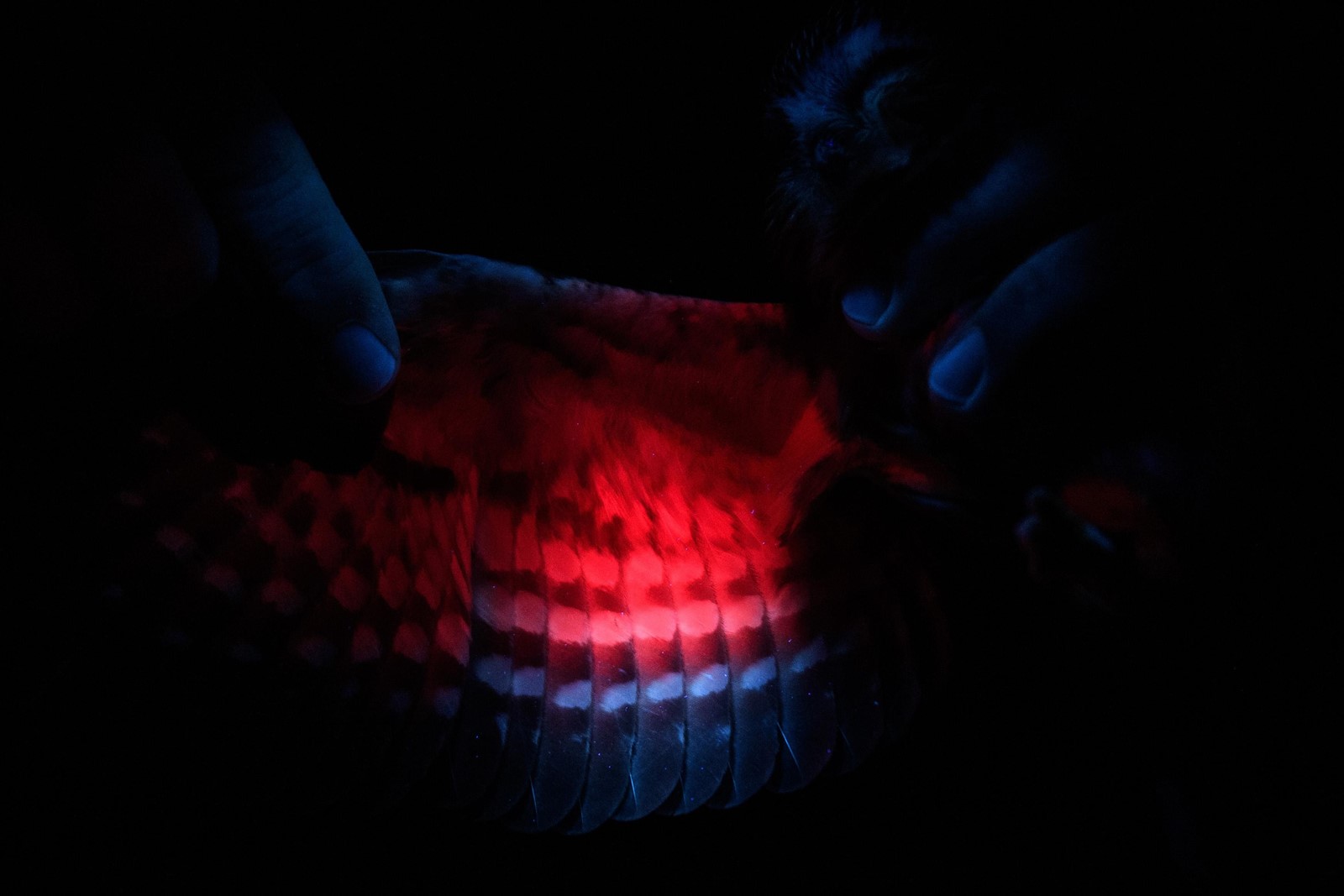
Then volunteers flicked the lights off and Bumgardner held a flashlight to the underside of the owl’s wings, which glowed a pinkish red thanks to a chemical called porphyrin found in new feathers and destroyed by sunlight.
After taking the owl around the auditorium for people to pet its soft, downy feathers, Bumgardner took the owl behind the visitor center to release it, and the crowd followed along.
That’s when Bumgardner placed the owl atop Cassidy’s head and explained it needed a perch.
Back inside after the owl flew off, Rob Hallock said he and Cassidy have come to the program around six times over the past couple of years, actually getting to see an owl about half of the time.
Cassidy said she liked “everything” about the owl, and it wasn’t particularly heavy when it perched on her hoodie.
“I was scared it was going to take its claws out and hurt me,” but it didn’t, she said.
 PREVIOUS ARTICLE
