




The 1890s regulator clock at Oak Street’s Saratoga Elementary School shows 12 noon on the day of my visit while my iPhone clock flashes 2:57 p.m. Time does stand still in the quaint town of Saratoga, especially when you’re on a self-guided historic walk through its thoroughfares.
In all, the walk takes us through 26 stops, each showing us how Saratoga, nestled in the foothills of the Santa Cruz Mountains, has preserved its character while evolving with the times.
Over a hundred years ago, it was a resort town focused on health: Mineral springs were discovered a mile and a half from the village in 1850. Two San Francisco businessmen built a wellness-focused resort on 720 acres around the springs and opened it in the summer of 1866. After the hotel was destroyed in a 1903 fire, the acreage became a lush picnic spot on the Valley of Heart’s Delight tour.
In the early 20th century, the breathtaking natural beauty surrounding Saratoga drew tourists seeking to escape the bustle of nearby cities like San Francisco and Berkeley. During the springtime, the Peninsular Railway’s 65-mile Blossom Trolley Trip brought thousands of visitors, wrote the late Willys Peck, a Mercury News copy editor and Saratoga historian, for “the line afforded passengers an unequaled opportunity to view — and inhale — the matchless phenomenon of mile after mile of trees in fragrant bloom.”
Saratoga’s fruit orchards (prunes, apricots and cherries), vineyards and wineries were so magical that when Impressionist painter Theodore Wores first set eyes on the rows of orchards and the hills beyond in 1924, his decision was made.
“We have reached the end of our journey,” the artist said to his wife. He acquired a second home and studio in Saratoga (now Bell Tower Bistro) where he painted until 1938, a year before his death. Today, some of Wores’ landscapes are part of the White House collection.
Saratoga’s street names tell its stories. A major road leading us into the town, De Anza Boulevard, takes its name from a moment 250 years ago. In March 1776, under the orders of the Spanish king, Capt. Juan Bautista de Anza trudged north from the Imperial Valley towards San Francisco in the first overland immigration route into California. His entourage stopped at a creek in the vicinity of Saratoga.
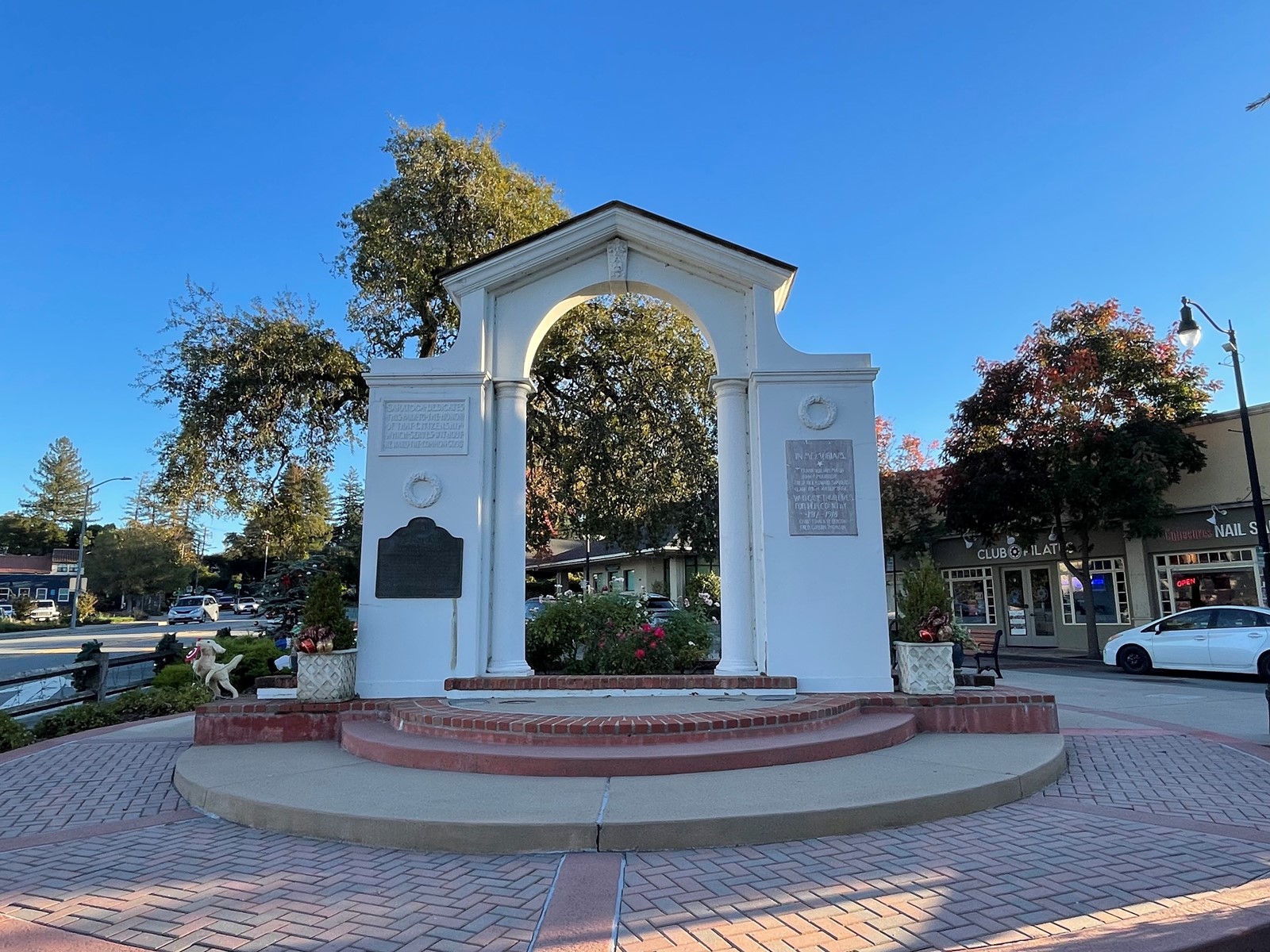
A historical plaque in honor of the enterprising de Anza is nailed to the World War I memorial arch at the intersection of Saratoga Avenue, Saratoga-Los Gatos Road and Big Basin Way, at the entry point into its downtown. Facing this 1918 arch is the village downtown with its current eclectic row of restaurants and coffee shops.
A few hundred feet away from the arch is the Saratoga Historical Park Museum with a Western false front, one of the oldest commercial buildings in Santa Clara County. Inside are many artifacts from settlements of the Indigenous Ohlone people. Adjacent to this meticulous record keeper of the area’s history is McWilliams House, dating back to the 1850s. Built by blacksmith Henry Jarboe, this single-wall construction has no studs, a detail that will appeal to those who love carpentry and masonry.
In a span of 18 years, Saratoga underwent five name changes as the wheels of history turned: Campbell’s Gap, named after William Campbell who built a saw mill to cater to the needs of the growing lumber industry of the area; Toll Gate, for the road that businessman Martin McCarty built; McCartysville after McCarty himself; Bank Mills, after Charles Maclay who built a water wheel for local industries; and, finally, “Saratoga,” following the discovery of mineral content in the local creek that evoked the waters at New York’s Saratoga Springs.
In the 1880s, Saratoga resembled a frontier town with seven saloons and opium dens as well as “sawmills and lumbering back in the mountains,” according to the late historian Florence Cunningham, author of “Saratoga’s First Hundred Years” (1967). Drunken brawls, some murders, a few disappearances and ghost sightings were reported along its main drag.
Despite the wild image at the turn of the 19th century, the town was also known for its industrious citizens who worked at its furniture factory, paper mills, flour mills and more.
The blacksmith exhibit in a cottage in the back of the history museum is a primer on 19th century life.
The exhibit covers the history of blacksmithing in Saratoga, including a list of blacksmiths who worked in the town and ledgers, or day books, with their service charges.
The display includes a forge, anvil, bellows and a variety of other tools — for repairing wagons, carts and plows, for shoeing horses and for the manufacture of household items like latches, keys and tongs of every conceivable size.
This stop alone makes the day trip fun and enlightening, especially for those of us who cannot tell a saw from a nail.
On the walk, you’ll run into the works of pioneering American architect, Julia Morgan (1872-1957), whose sculpted face looks out at us from the entrance to Saratoga Foothill Club.
The first female admitted to the École Nationale Supérieure des Beaux-Arts in Paris as well as the first licensed female architect in California, Morgan designed the club, Saratoga Federated Church, and several homes around town.
Her other notable works around the Bay Area and California include Berkeley City Club, the Chapel of the Chimes in Oakland and the Hearst Castle in San Luis Obispo County.
Speaking of icons, you must visit the village library on historic Oak Street. Captured in two iconic photographs by Ansel Adams, this first Saratoga library is an early example of 20th-century civic architecture designed by the renowned Eldridge Spencer.
Finished with cinder block and built to ward off fire, the library is listed in the National Register of Historic Places.
Today, the mills are long gone and the mineral springs are closed off by the San Jose Water Company, but Saratoga still has a more rural aesthetic.
In its older residential enclaves, electrical wires run above houses and backyards. Street lighting is not ubiquitous, and many of its roadways do not have sidewalks.
This antediluvian town knows — and that, too, is part of its multimillion-dollar charm — that in a world of rapidly upgrading software and all-subsuming artificial intelligence, natural wisdom must be nurtured and celebrated.
 PREVIOUS ARTICLE
