


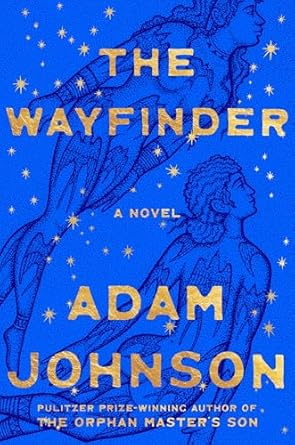


What makes novelist Adam Johnson’s writing distinctive is not its sameness but rather its range and variety. “The Orphan Master’s Son,” which won a Pulitzer Prize in 2013, follows a North Korean man struggling to survive amid the cruelty and madness of a “Fortune Smiles” includes stories set in East Germany, Seoul, Louisiana and a near-future Silicon Valley. Now, in his hugely ambitious new novel, “The Wayfinder,” Johnson takes the reader to the scattered islands of the South Pacific to tell the story of an ancient Tongan maritime empire and its discontents.
At the center of his tale are two radically different communities. The novel opens on Manumotu, a remote and environmentally degraded island where the inhabitants are struggling to feed themselves after decades of overhunting and overfishing. Although their culture has strong ethical values — emphasizing nonviolence and a willingness to talk through any problem — the people of Manumotu are beset by self-doubt and inertia. They know they need to move elsewhere but lack the self-confidence and know-how to build a suitable craft or navigate to a new home.
The other group is the Tongan royal family and their entourage, based on the island of Tongatapu and led by an ailing king known as the Tu‘itonga, a man who possesses immense military and political power. He compels his subjects and the inhabitants of other islands to pay regular tribute in the form of food and other resources. As a result of this long-running extortion racket, the Tongan royal family is extremely wealthy but also widely hated. The Tongans maintain their status by waging an endless bloody war with their Fisian (or Fijian) neighbors, while cultivating, closer to home, a reputation for brutality and ruthlessness.
In the first chapter of “The Wayfinder,” these two very different ways of thinking and living collide when the people of Manumotu, a place so isolated that most of them have forgotten the word for “stranger,” are astonished by the arrival of two of the Tongan king’s three sons — the Wayfinder of the novel’s title and Finau, his younger brother. After this meeting, and the mutual misunderstandings that it provokes, the novel divides.
One story line, narrated by Korero, a teenage girl who is as close as we get to a protagonist, describes the consequences of Finau and the Wayfinder’s unexpected appearance on Manumotu. A second story line goes back to earlier events on Tongatapu in order to explain why the brothers had to leave their homeland.
Johnson’s writing is lavishly detailed and sharply intelligent, nuanced and lyrical but also funny and sometimes surreal.
Although he often addresses extreme violence and suffering, his work is rarely somber or morbid, treating even the worst atrocities with a brisk, leavening wit.
All of those impressive qualities are present in “The Wayfinder,” which is a thoroughly surprising and enjoyable read.
It’s a sprawling novel that combines myth, poetry and magical realism into a great roiling, oceanic mass; the narrative may lack focus and a clear direction at times but never wants for inventiveness or energy. Its world is one where the souls of the dying can be extracted and then stored in coconut shells to be consulted in times of crisis, where lonesome parrots recite epic poetry, where corpses can be brought to life with a magic fan. Certainly when placed next to “The Orphan Master’s Son,” “The Wayfinder” feels like a less weighty and urgent novel, but it is, nevertheless, quite clearly the work of an enormously talented and admirably adventurous writer.
 PREVIOUS ARTICLE
