


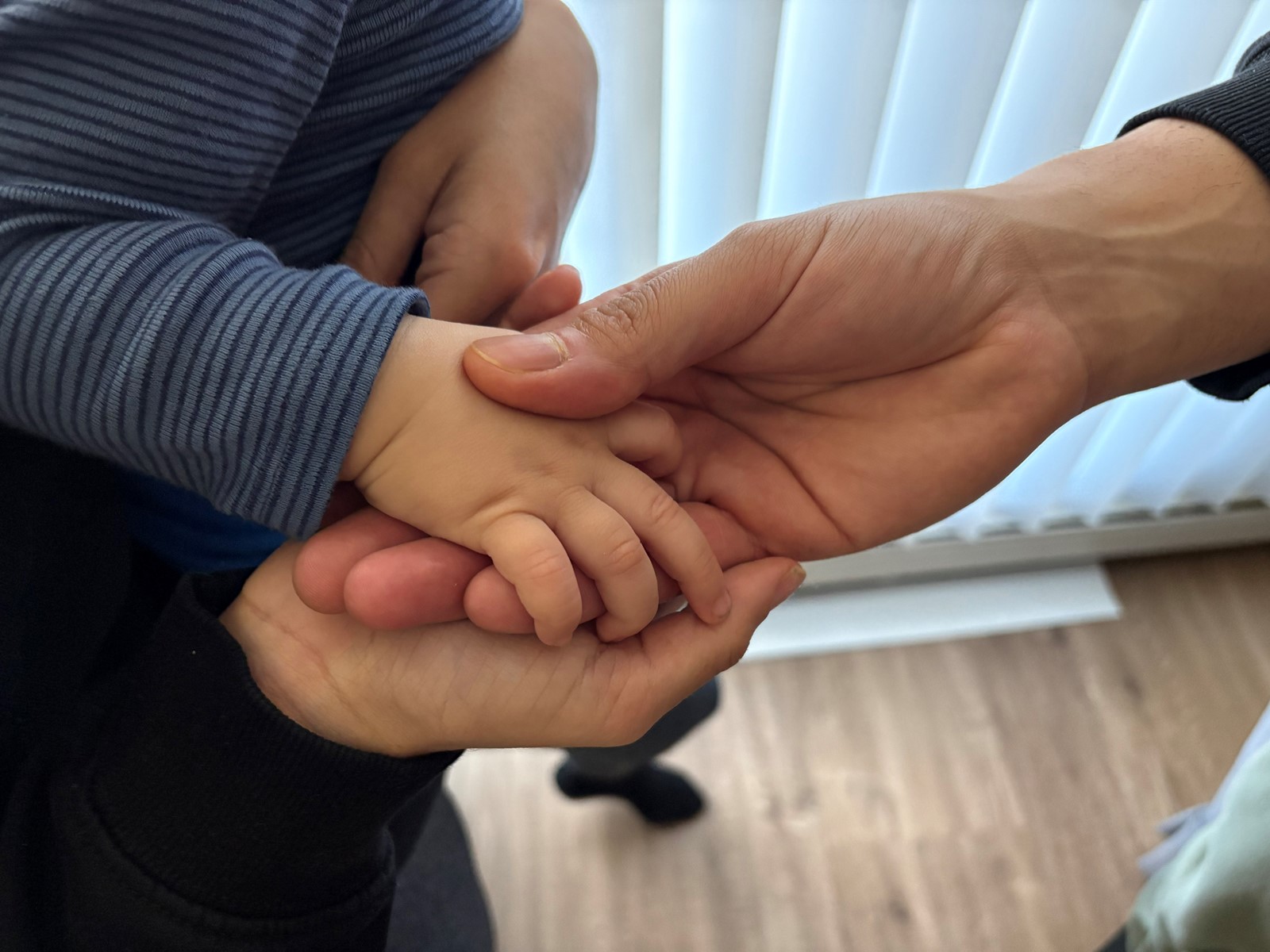


Gabi has big brown eyes, pigtails, and a genetic condition that makes her bones brittle. They fracture easily, leaving the 2-year-old in such pain that her mother quit her job cleaning offices to stay home and cradle her in the one-bedroom apartment they share with six relatives.
When federal immigration agents descended on their Minnesota city, officers deported Gabi’s father and detained her aunt.
Gabi was born in the U.S. and is an American citizen. Her best chance to stand, or even walk, someday is a complex surgery on her legs and feet that was scheduled for January. But her mother, too terrified to take out the garbage let alone venture through the city to a hospital, canceled the procedure. KFF Health News agreed to only partially identify the patients and their families in this article because they fear becoming targets of President Donald Trump’s immigration crackdown.
“I want more than anything for my baby to walk,” her mother said in Spanish, as Gabi cooed and wriggled in her arms, a feeding tube snaking from her stomach to an IV pole. “But with the situation that’s happening, I canceled the surgery and all the physical therapy appointments” that would have followed. “Because I’m afraid to leave.”
The Department of Homeland Security has declared an end to what it called Operation Metro Surge. Even so, health care workers say, immigration agents are still camping out in hospital parking lots. And drones fly overhead in agricultural areas beyond Minneapolis-St. Paul, where Somali and Latino immigrants have settled in recent years.
The Minnesota crackdown revealed the sweep of the surveillance and capture system the Trump administration is using to uproot immigrant communities in the United States, and the effect of its powerful brake on the medical system.
Similar health crises surfaced wherever immigration officers massed in the past year. In Dallas, public health clinics administered about 6,000 vaccinations to Latinos last August, half as many as during a similar program a year earlier. In Chicago, doctors rerouted patients daily from clinic to clinic depending on ICE activity. Across the country, crackdowns suppressed immigrants’ health care visits.
In Minnesota, medical systems have reported cancellation and no-show rates of up to 60% since December.
While Minnesotans rose up to oppose the surge in the streets, doctors and nurses have quietly operated informal, underground medical networks, dodging detection to care for patients at home.
“I used to look somebody in the eyes and say, with good faith, ‘You will be fine at the hospital,’” said Emily Carroll, a nurse practitioner at HealthFinders Collaborative, a community clinic in Faribault, some 50 miles south of the Twin Cities. “But now, I can’t make that guarantee.”
On the first day of his second term, President Donald Trump rescinded a 2011 policy that prohibited immigration enforcement in “sensitive locations” such as schools, hospitals, and churches.
As thousands of federal agents move on from Minnesota, other communities need to prepare, said Democratic state Sen. Alice Mann, a physician.
“I know it sounds crazy,” she said, but health care providers “need to start an underground network of how to get people care in their homes. Because letting people die at home or come close to death because they are terrified to go into the hospital, in 2026, is outrageous.”
Home visits, clinicians say, may be the only way to reach those who still feel under siege.
Many of Minnesota’s large health institutions have relied on telemedicine and only dabbled in home care.
Not Munira Maalimisaq, co-founder of Inspire Change Clinic in Minneapolis’ Ventura Village neighborhood. After about one-third of her patients stopped showing up for appointments, “I was like, ‘We have to do something,’” the nurse practitioner said. So she called a physician friend. What if they just started seeing patients at home?
“And she’s like, ‘You know what? Let’s do it.’”
They now have about 150 doctors — a volunteer “rapid response” team that has made more than 135 home visits. The first call was a woman whose husband had been deported. She was home with her children, was 39 weeks pregnant, and was in labor. Maalimisaq called an obstetrician volunteer, and they rushed to the patient’s house.
“She was 8 centimeters dilated,” Maalimisaq said, “and did not want us to call an ambulance. She says, ‘Can I have the baby here?’”
The woman was not a good candidate for a home birth, Maalimisaq said. They persuaded her to ride to the hospital in Maalimisaq’s car, a “small Tesla, white seats. Everything that could go wrong was there.”
But they made it to the hospital in time, and the woman had a safe, healthy delivery. “If we were not there, I can only imagine what would have happened.”
Maalimisaq’s caregiving follows a Hippocratic logic: “Someone was in need. I cannot just do nothing. And we cannot call an ambulance against her will and have her shoved in there. We had no choice but to do something, and that was the only thing that we could do safely.”
In other visits, she has seen “people so stressed out they pulled the hair out of their skull.” She said she met a mother who’d been rationing her child’s seizure medicine despite the child having experienced “one seizure after another.”
In Minneapolis, nurse-midwife Fernanda Honebrink spends most of her daylight hours calling, coordinating, and shuttling between a ballooning group of fearful people stuck in their homes. She prefers not to call it a medical underground.
“It’s more like, that’s how we function in Minnesota,” said Honebrink, a U.S. citizen who emigrated from Ecuador 23 years ago. “We’re nice to each other.”
Honebrink spent a recent afternoon at the home of a family with a baby boy. His parents, Alex and Isa, desperately want him to receive vaccinations and blood tests at his one-year well-child appointment.
But they haven’t left their apartment for more than a month. “You don’t know what is most important: whether to go out for his well-being, or to go out and think that you might not come back,” Alex said.
The couple, who were interviewed in Spanish, entered the U.S. legally from Venezuela in 2024 under a program called Humanitarian Parole, which Trump ended in May. Since then, federal agents have detained and deported workers at a company where Alex, a mechanical engineer by training, worked in construction.
Alex and Isa have seen government vehicles outside their home. They knew of a man, they said, who had legitimate work papers but was picked up while walking to church one Sunday, flown to Texas, then put on a plane to Venezuela. It was a terrifying prospect for those who’ve fled that country’s dictatorship and economic chaos.
“It feels like a psychological attack,” Alex said. “The possibility of being separated from your family.”
Isa, a lawyer back in Venezuela, has endured postpartum depression, cooped up for weeks in their apartment. The state program that provided health insurance to all immigrants ended Jan. 1. A therapist checks in occasionally by phone, free of charge.
She has tried to keep the family afloat by selling homemade cakes and necklaces, and baby-sitting.
Her worst fear is being separated from her son, who was born in the U.S. and is a citizen. The possibility hadn’t occurred to her until an acquaintance urged her to sign a form to designate someone to have temporary custody if she were deported.
“It was something I never imagined,” said Isa, who sobbed as she recalled the moment. “He’s my baby! He’s not someone else’s! What? My baby would remain here with someone?’’
Honebrink suddenly piped up: “I will guarantee him. I’ll sign the form.”
She later told a reporter, “I told my husband I wouldn’t do that. I’ve already signed as a sponsor for four kids.”
As soon as she left the apartment, Honebrink jumped back on the phone and traded favors with local pediatricians, clinic schedulers, and volunteers. Within hours, she’d set up a new well-child visit for the baby and found a vetted driver to transport the family.
“A white person,” Honebrink explained.
Two days later, Honebrink sent a picture of her small victory: Alex and Isa’s baby boy with a Band-Aid on his legs. “He got his vaccines,” she said via text. “I’m so happy.”
But other medical needs cannot be as swiftly addressed. One February evening, Honebrink greeted Gabi and her mother with a trunk full of donated baby wipes, diapers, and toys.
Gabi’s surgery is rescheduled for August. Her mother said she hoped by then it would be safe to leave home.
 PREVIOUS ARTICLE
