


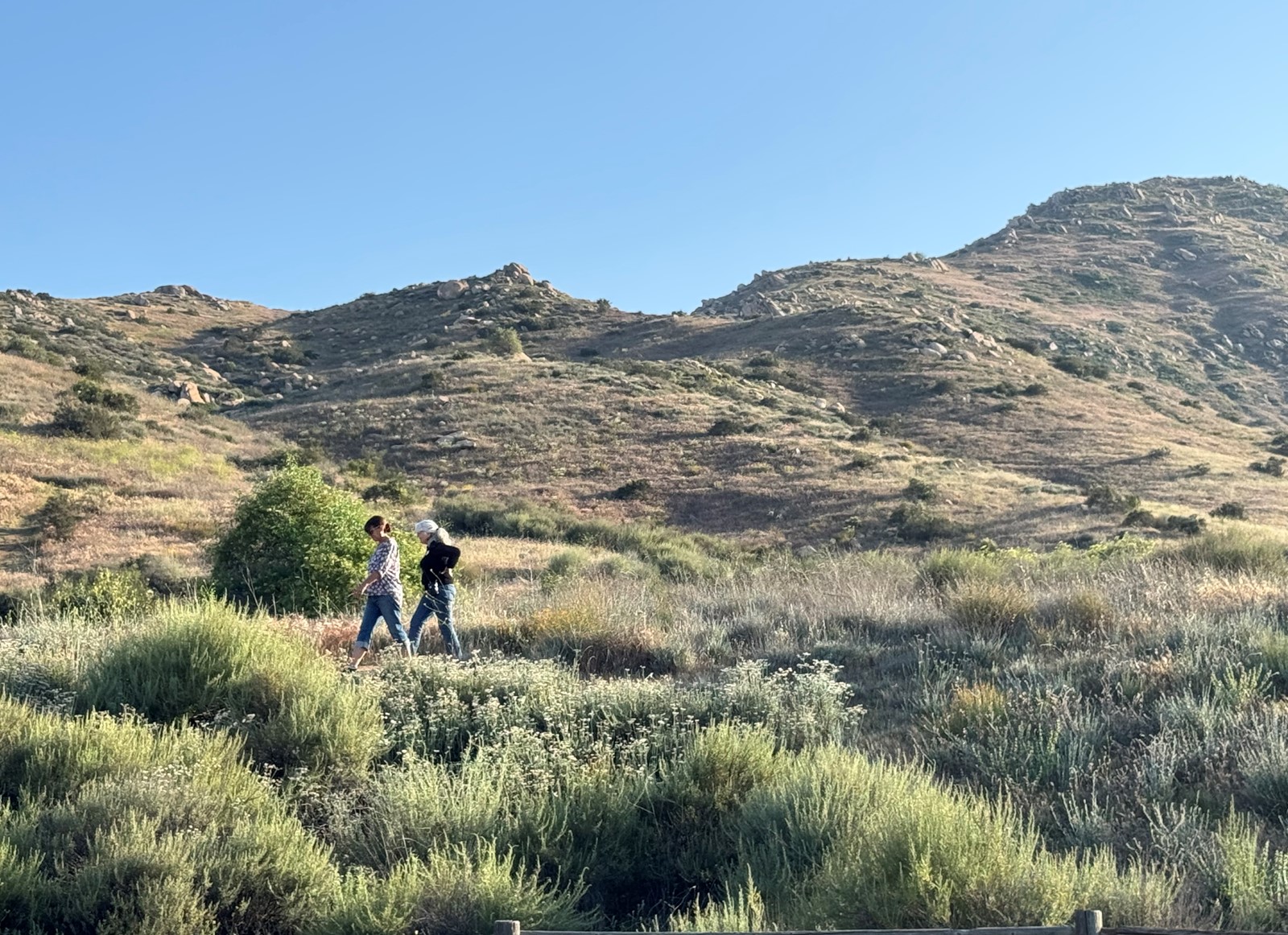


Box Springs Mountain Reserve sees the second-highest use of any Riverside County-operated park. But the 3,400 acres of open space might well have become a sprawling subdivision instead.
That it didn’t is partly due to a Riverside man’s fortuitously timed hike one day in 1972. Or perhaps a developer’s poorly timed visit.
Richard Block was heading up Two Trees Canyon behind his house when he ran into a stranger and got into a conversation. The man, Bruce Winship, explained that he’d recently bought 300 acres on Box Mountain off Pigeon Pass Road, intending to subdivide it for large-lot homes.
Upon his return, Block, a UC Riverside mathematics professor, huddled with his wife, Jane.
They knew the county had the idea — the concept of a plan, if you will — for an open-space park one day at Box Mountain. But with the land in private ownership, that might never happen, especially if by then 300 acres, or more, had already been developed into estates.
The Blocks and neighbor Mary Cassina lobbied county officials, circulated petitions and persuaded the Board of Supervisors to not only reject Winship’s plans but to seize his land under eminent domain. Fending off Winship’s lawsuit, the board met his asking price and snapped up enough other land for a 2,200-acre park.
Box Springs Mountain Park was dedicated April 5, 1975.
And on Sunday, nearly 50 of us gathered at the Hidden Springs Trailhead to celebrate the park’s 50th anniversary.
Kyla Brown, the county’s parks director, was there. Richard Block had emailed her a few weeks ago to ask how the county planned to commemorate the milestone.
“He actually reminded me it was the 50th anniversary,” Brown told me with a chuckle, “and helped us put this together. He is definitely still an advocate.”
Opening day 50 years ago saw music, dancing and horseback riding in a mountain meadow along the far loop of Skyline Trail.
A parks commissioner, Nick Barth, showed off two photos from that day provided by Block. In one, 40 or so people of all ages are holding hands in a big circle in a meadow. It’s as if they were preparing to announce their plans to buy the world a Coke.
“It looks like they’re forming a love circle,” Barth said dryly. “It was the hippie era.”
Joked Brown: “We thought about re-enacting the love circle today.”
There is not enough hand sanitizer in the world to pull that off in 2025.
Box Springs Mountain Reserve, as it’s now known, has 3,400 acres, with another 600 or so in a conservancy. The park is largely in unincorporated Riverside County and overlooks Riverside and Moreno Valley.
How many people use it? Some 8,000 people a month, making Box Springs second to only the Santa Rosa Plateau’s 15,000 users among Riverside County parks, according to Robert Williams, the department’s bureau chief. (Trail sensors, installed last year, provide the counts.)
Box Springs has six multi-use trails, most of them relatively easy, Williams said. The tough one is the M Trail, which leads to the Big M, a giant manmade letter on a hillside to denote Moreno Valley.
The park is also home to the Big C, a second giant manmade letter, on a hillside above UC Riverside. As a man with a keen professional interest in the alphabet, I applaud these efforts.
Coyotes, bobcats, mountain lions, deer, burros, 19 species of reptiles — including rattlesnakes — call the park home, as do more than 85 bird species. And it’s filled with rock outcroppings and coastal sage scrub, although less of the latter after wildfires.
Barth had promoted the anniversary via park signs that had a QR code. He matched up those who responded for joint activities.
“Two Trees was full,” Barth told the assemblage. “I saw some very intrepid people trail running this morning at 5:30.” Others were hiking or rock climbing.
“I went paragliding,” Barth added. “We had a lot of people out here enjoying Box Springs.”
In her own remarks, Brown gave the credit for the park to the Blocks, to other UC Riverside employees of the era and to then-county parks director Pete Dangermond, later the state’s parks director.
“Without their advocacy,” said Brown, the park’s pristine hills rising behind her, “you’d be looking at houses and backyards and roads. And those 8,000 people a month wouldn’t have access to these trails.”
Richard Block, who sat with wife Jane and son Charles, rose to take the microphone. He uses a cane and walks with a stoop. Jane, who uses a walker, stood as well, hanging onto a pole of the canopy tent for support.
Richard spoke confidently, and without notes, to tell a capsule version of the park’s founding 50 years earlier.
One key moment, he said, came when Jane contacted a Press-Enterprise reporter. As Richard remembers it, the resulting story was headlined “Battle Brewing Over Box Springs Mountain” and contained what he says were “choice quotes” from Winship, the would-be developer.
Among them, Block said, was this one: “I think people in Riverside would rather look up at the mountain and see nice homes instead of a bunch of dead rocks.” Winship had inadvertently given a boost to the opposition.
Block lauded county leaders, including then-Supervisor Norton Younglove, for stepping up.
“People said, ‘They’d never use eminent domain for a park’ — but they did,” Block said.
Younglove, by the way, died Jan. 17 at age 95 at Riverside Community Hospital, an institution his grandfather had helped found in 1903. Dangermond was invited to Sunday’s ceremony but was unable to attend.
But Richard and Jane Block, frail but healthy, were there to attest to the park’s origins and remind us of its importance, a half-century on.
“We’re in our mid-90s,” Richard remarked. “I never thought we’d live to see this day.”
— David Allen writes Wednesday, Friday and Sunday, three days worth living to see. Email dallen@scng.com, phone 909-483-9339, and follow davidallencolumnist on Facebook, @davidallen909 on X or @davidallen909.bsky.social on Bluesky.
 PREVIOUS ARTICLE
