


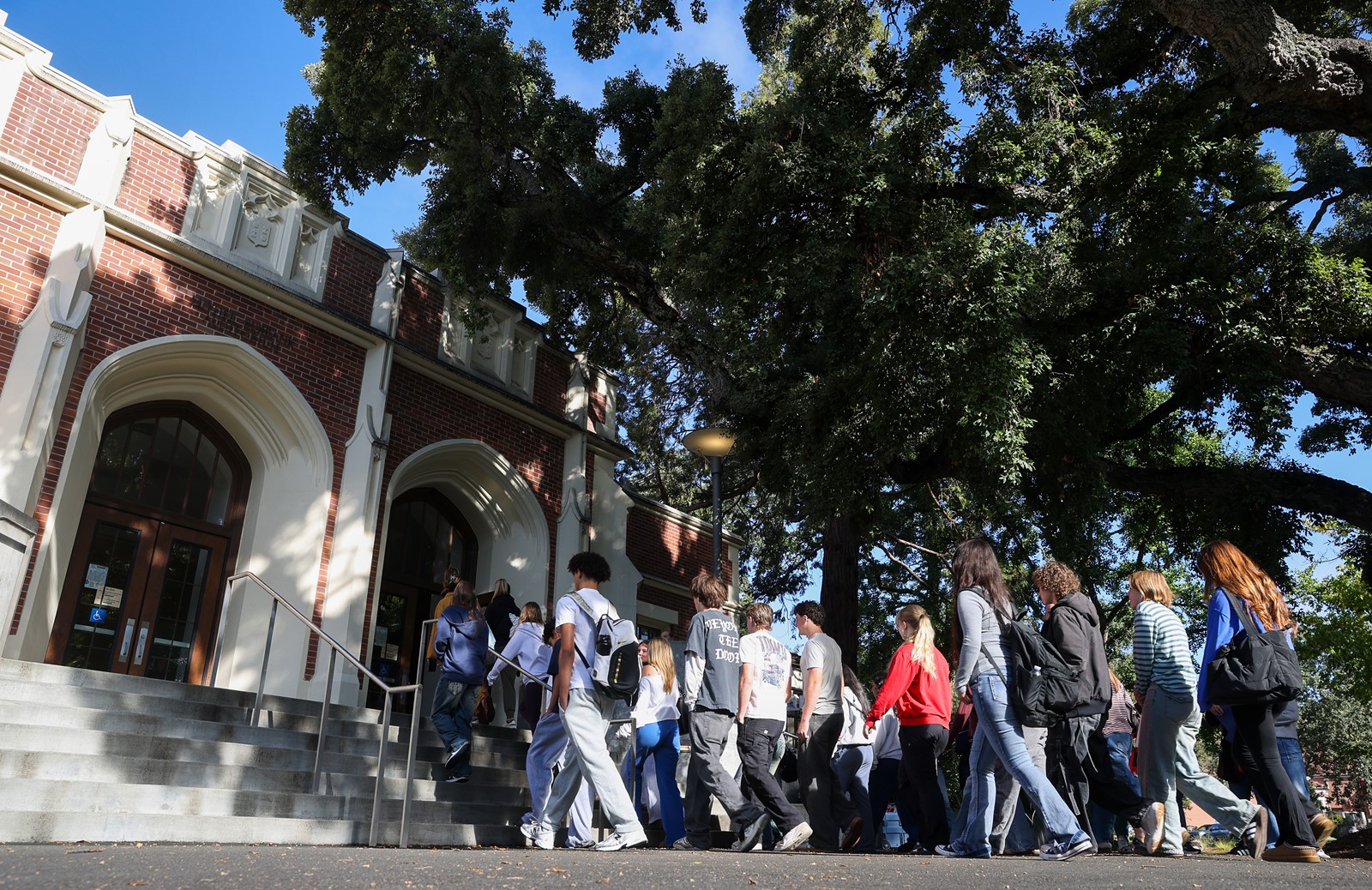
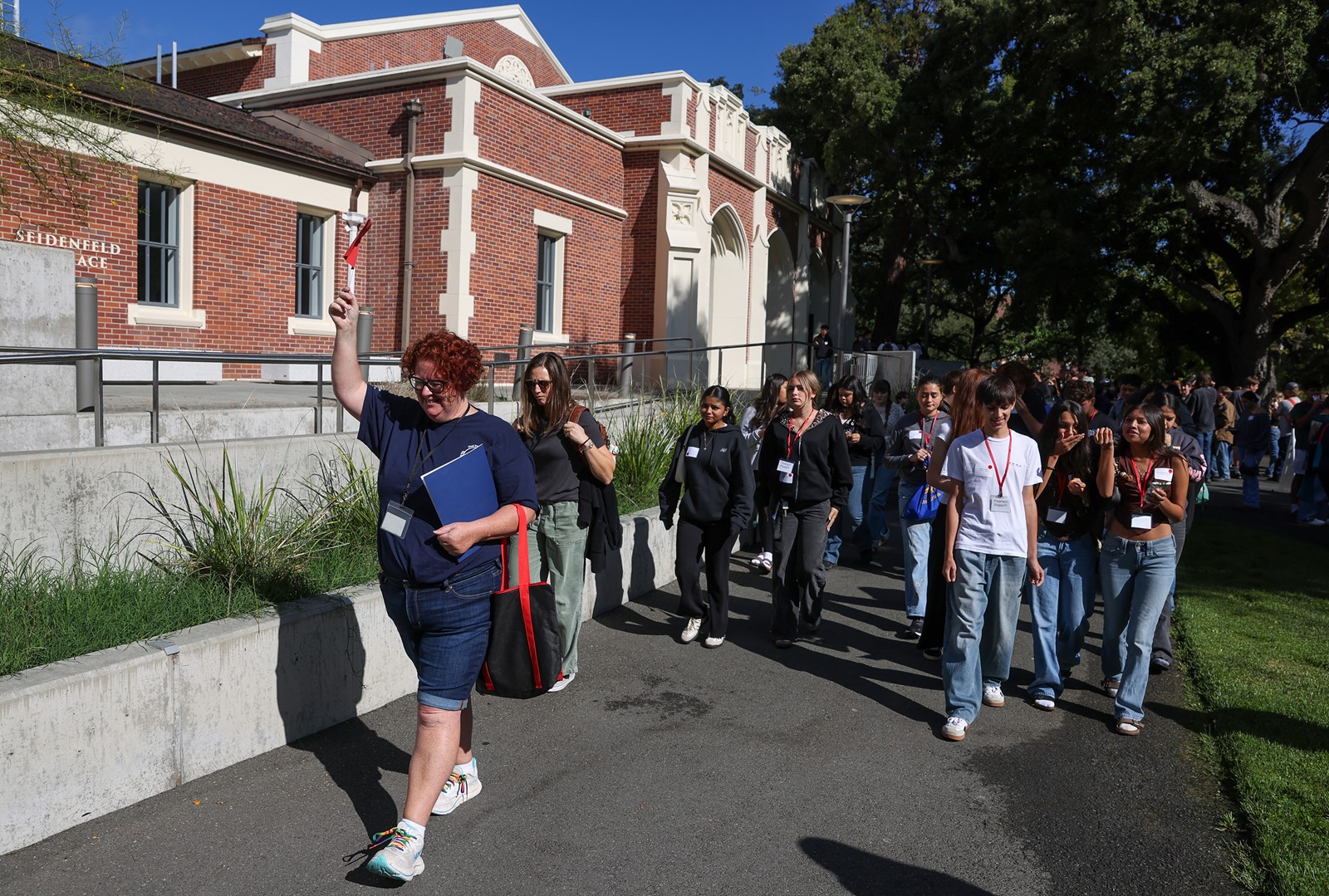


More than 280 students from nine Sonoma County high schools gathered Friday at Santa Rosa Junior College for their first college orientation. The students, part of the local College and Career Access Program, are dually enrolled in SRJC courses that count toward both high school graduation requirements and college completion.
“As a CCAP-enrolled student, you are among just about 22,000 students that are currently enrolled in a class at Santa Rosa Junior College,” Dr. Angélica Garcia, SRJC president, told students as she kicked off CCAP Success Day. “If this is your first time in a CCAP course, welcome. … You are getting exposed to college curriculum right now. You have high school teachers and counselors who have done work with college teachers and counselors and the staff to make this pathway make sense for you. And the bottom line is no one can make you do it except for you.”
The program brings college classes to the high school campus during the bell schedule, encouraging greater participation from a wider array of students than may otherwise be reached by traditional college-level courses.
“A big access block is transportation, so by bringing the college credits onto the high school campus, everyone can participate,” Sharon Ferrer, director of college and career readiness at the Sonoma County Office of Education, said. Scheduling around extracurriculars can also be an obstacle. “Cost is a barrier, so these are all completely free, including the books. And then there’s the barrier of not believing in yourself.”
Dual enrollment, in which students take college courses on their own time, has long been available, with a major push for enrollment in 2015. This year, 10 high schools in the county are participating in CCAP. There are 438 students enrolled for the fall, up from 267 in 2024-25, enrolled in 15 courses.
Robert Holcomb, vice president of academic affairs and assistant superintendent for SRJC, said CCAP “really took off” in 2023, coinciding with the arrival of president Dr. Garcia. SRJC now offers dozens of CCAP courses during the bell schedule.
“She really had high school partnerships and early college credit and dual enrollment as a big priority,” Holcomb said. “Within a year, we were able to pilot our first group of CCAP offerings.”
Kelly Schmieg, project coordinator for early college credit with SCOE, works with the high schools in the K12 system and SRJC.
“CCAP, they’re really focused on pathways, so it’s not these one-off dual enrollments,” Schmieg said. “They’re really trying to make sure there’s a real intention around scheduling courses that are actually going to help the students to either graduate or get certificates or degrees.”
Nine of eleven high schools participated in the Friday orientation.
Ry Basham-Mintz, a counselor at Elsie Allen High School, said “having students be able to take a college class when they’re in high school and for them to have that experience, for them to see they can do well in a college class, is really important because then that access to college and that idea of going to college after high school seems so much more real and tangible. I see that as a really positive impact while they’re in high school.”
Ferrer was eager to see students’ reactions to being on the campus and exploring the different Career Technical Education (CTE) classrooms.
“They also have exposure to some student panels, which are extremely helpful because it paints the picture for them of what their first year might be like in a really positive way, and they learn all the resources that they get at the JC that they can use while they’re still in high school,” she said. “Watching them respond to all of the information is really fun.”
Maya Moeller, a junior at Maria Carrillo High School, is taking her first CCAP courses this year: Sports Medicine and Kinesiology.
“I’m really excited to be here and see everything and I’ve been waiting a long time to come here,” she said. “I do track and flag football, and I wanted to learn more about how to fix injuries and stuff like that, but I know there is more to it. I wanted to learn more about it because I may want to go into that pathway with my career.”
Holcomb feels the spectrum of academic and career pathways offered through CCAP gives students the chance to “start to think about bold educational goals for themselves and really see themselves gravitating toward a particular area of study.”
Basham-Mintz chaperoned 20 students for CCAP Success Day. This is the first year Elsie Allen has done the field trip to the SRJC campus.
“It’s a great, amazing opportunity for the students to be able to not only have the convenience of taking a college class on campus and not having to find transportation,” he said, but also “to create or develop that connective tissue with the JC.”
The program is open to all high school students. Local CCAP participation also contributes to Vision 2030, which is put out by the governor and the California Community Colleges Chancellor’s Office, to ensure all students who graduate from high school will leave with at least 12 early college credits.
SRJC data on concurrent enrollments showed that, during the 2024-25 school year, 53.18% of enrollments earned As, 20.72% earned Bs, and 9.63 % earned Cs.
High schools explore what courses students are interested in, what pathways they’re offering and what courses would fit into their schedules a year in advance of putting in their requests.
“The JC then evaluates those courses, if they’re a good fit for high school students, that they’re not too advanced,” Schmieg said. “Then it starts looking at staffing and we make sure we can staff these courses.”
SCOE and SRJC also hold a CCAP forum at the beginning of each year, bringing department deans, superintendents, administrators and teachers together. Ferrer said the forum “has been growing in success,” and that CCAP and its expansion are “following what needs to be done in order for education to evolve.”
“Figuring out how to make it all work together has been a huge challenge, and I feel like we’re doing a really, really good job,” she said. “All of the people who are working on this, on the K12, SCOE and community college side, are incredibly invested in students’ futures and students’ opportunities, and that is amazing.”
Staff Writer Hannah Harn can be reached at hannah.harn@pressdemocrat.com.

