


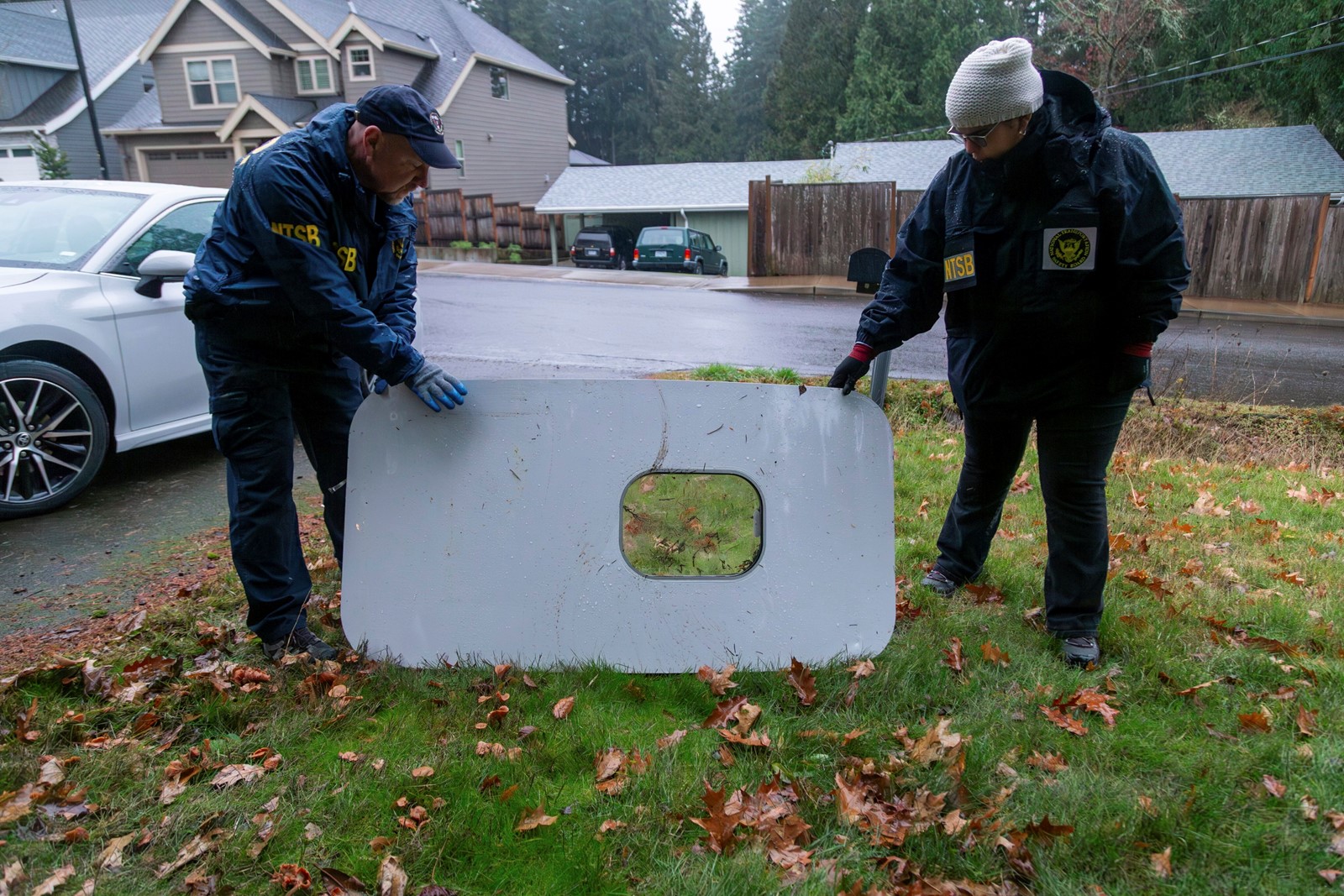


Bolts that helped secure a panel to the frame of a Boeing 737 Max 9 were missing before the panel blew off the Alaska Airlines plane last month, according to accident investigators.
The National Transportation Safety Board said Tuesday a preliminary report on the Jan. 5 incident that the lack of certain damage on the plane indicates that all four bolts were missing before the plane took off from Portland, Ore.
Without the bolts, nothing prevented the panel from sliding upward and detaching from “stop pads” that secured it to the airframe.
The Alaska Airlines pilots were forced to make a harrowing emergency landing with a hole in the side of the plane, but no serious injuries were reported.
The NTSB report included a photo from Boeing, which worked on the panel called a door plug, that showed that three of the four bolts that prevent the panel from moving upward are missing. The location of a fourth bolt is obscured by insulation.
The preliminary report said the plane arrived at Boeing’s factory near Seattle with five damaged rivets near the door plug, which had been installed by supplier Spirit AeroSystems. A Spirit crew replaced the rivets, which required removing the four bolts and opening the plug.
The report did not say who removed the bolts. It said that a text message between Boeing employees who finished working on the plane after the rivet job included the photo showing the plug with missing bolts.
Sen. Tammy Duckworth, D-Ill., was upset at Boeing’s lack of documentation about who did what and when the bolts went missing.
“They didn’t write any of this down,” she said in an interview. “It is very much Boeing’s responsibility, absolutely, but I’m concerned that we may have multiple points of failure here.”
The NTSB did not declare a probable cause for the accident — that will come at the end of an investigation that could last a year or longer.
“Whatever final conclusions are reached, Boeing is accountable for what happened,” CEO David Calhoun said in a statement. “An event like this must not happen on an airplane that leaves our factory. We simply must do better for our customers and their passengers.”
Investigators said they were still trying to determine who authorized the Boeing crew to open and reinstall the door plug.
Safety experts have said the accident could have been catastrophic if the Alaska jet had reached cruising altitude. The decompression in the cabin after the blowout would have been far stronger, and passengers and flight attendants might have been walking around instead of being belted into their seats.
When Alaska and United Airlines began inspecting their other Max 9s, they reported finding loose hardware including loose bolts in some of the door plugs. Boeing said none of the other Alaska and United Max 9s have been discovered to be missing the critical bolts.
The incident has added to questions about manufacturing quality at Boeing that started with the deadly crashes of two Max 8 jets in 2018 and 2019, killing 346 people. The Federal Aviation Administration is investigating whether Boeing and its suppliers followed proper safety procedures in manufacturing parts for the Max.
 PREVIOUS ARTICLE
