


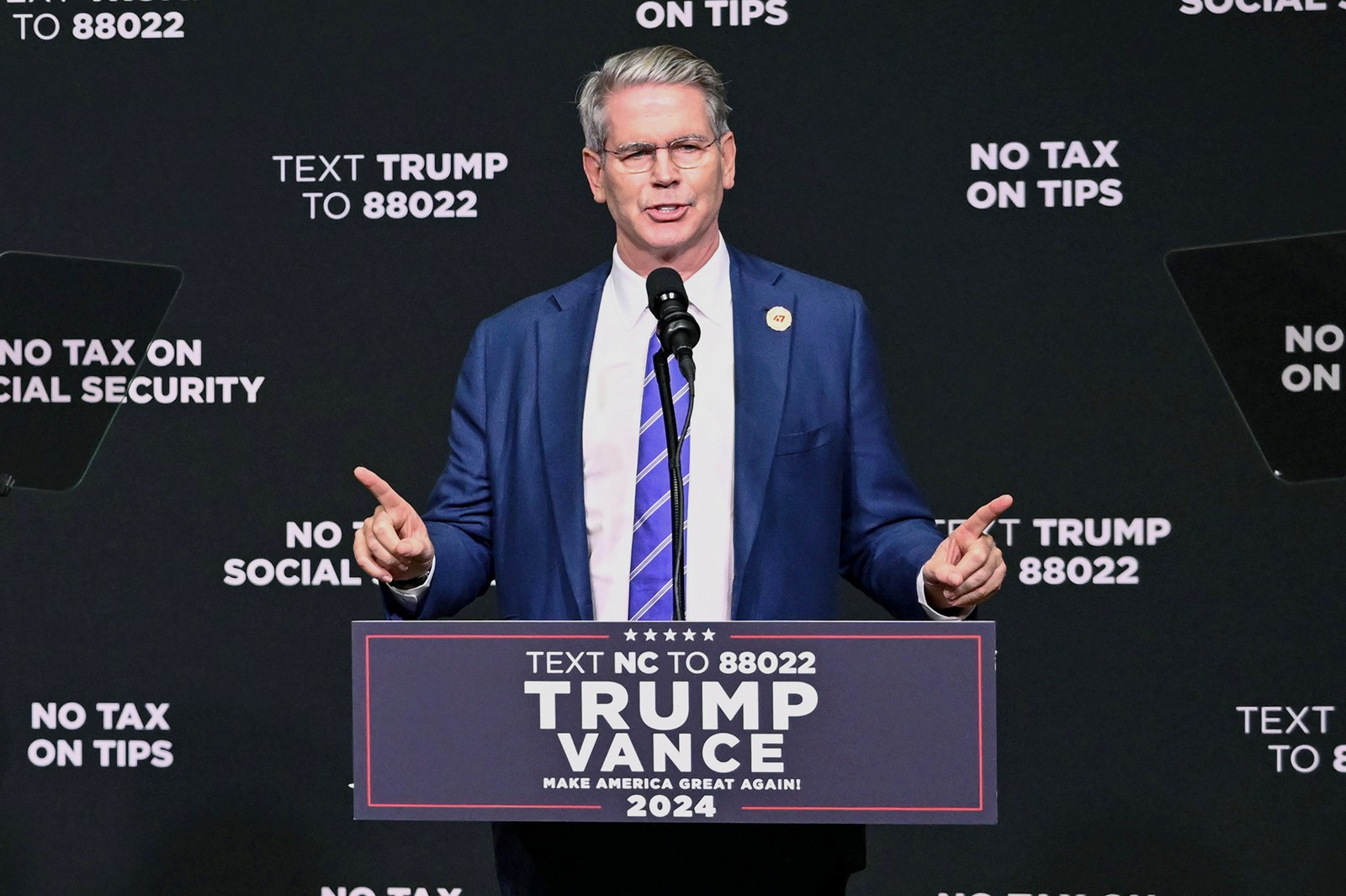


WASHINGTON >> In the heat of the 2000 presidential campaign, Vice President Al Gore took a break from barnstorming battleground states to attend a fundraiser for the Democratic National Committee in East Hampton, New York. Standing behind Gore onstage was Scott Bessent, a hedge fund manager and — at the time — a major donor to Democrats who co-hosted the event at his home.
On Friday evening, Bessent was tapped by President-elect Donald Trump to be his Treasury secretary. Having won the trust of Trump and his inner circle, Bessent would lead a Republican economic agenda of cutting taxes, culling federal regulations and enacting sweeping tariffs.
The selection caps an extraordinary career arc for an investor who was once a protégé of liberal billionaire philanthropist George Soros and who gave money to top Democrats including Hillary Clinton, John Kerry and Barack Obama.
“He was very supportive of the causes and the people that we supported,” said Will Trinkle, a Democrat who co-hosted the event with Gore. He noted that Bessent, who would be the first openly gay Treasury secretary, was a strong advocate for gay rights and marriage equality.
If confirmed by the Senate, Bessent would help Trump as he attempts to remake the U.S. economy. As Treasury secretary, Bessent would work to steer tax cuts through Congress, lead trade negotiations with China and help cull federal regulations that Trump believes are stifling the economy.
Bessent, 62, declined to be interviewed. But friends and former colleagues described him as driven by data and as intellectually curious, with an ability to work with people from across the ideological and political spectrum.
Raised in a fishing village in South Carolina, Bessent is the son of a real estate developer who experienced several of his own financial booms and busts. He went on to Yale University, where he was class treasurer, wrote for The Yale Daily News and was interested in becoming a journalist.
In college, Bessent reflected on the challenges of being a Southerner in New England, writing in the paper in 1981 that “I was the only one in the dorm who was heartbroken when George Wallace decided not to run for president.”
Bessent studied political science but ended up working in finance after getting an internship with Jim Rogers, an investor and business partner of Soros’. In the 1990s, he worked as a partner at Soros Fund Management, gaining notoriety by betting against the British pound and earning the firm $1 billion. After leaving to start his own fund, Bessent returned in 2011 to become Soros’ chief investment officer. By then, Bessent had become a major donor to Republican candidates. According to a summary of his donations provided by his office, Bessent has given about $15 million to political causes over the years and all but $300,000 has gone to Republicans. He gave $1 million to Trump’s inauguration in 2016.
Bessent was not part of Trump’s political orbit during his first campaign or term as president, but he has known the Trump family for decades and was close friends with the president-elect’s late brother, Robert.
This past spring, when many business leaders were hesitant to back Trump publicly as his legal troubles mounted, Bessent took a different view. He saw Trump as a “stock that goes up on bad news,” as he explained it to political analyst Mark Halperin last month, because every apparent setback appeared to strengthen his candidacy.
Concerned about the exploding national debt and the need to make changes to the international trading system, Bessent set up a meeting with Trump and started exchanging economic policy ideas.
In recent months, Bessent has pitched a “3-3-3” plan that would aim for 3% economic growth, reduce the budget deficit to 3% of gross domestic product and increase domestic oil production by 3 million barrels per day. He also came up with an idea that would allow the president to essentially sideline the chair of the Federal Reserve, although he has backed down from that proposal in the face of opposition.
In some policy areas, Bessent has demonstrated an inclination to temper Trump’s economic impulses. He suggested that Trump’s idea of assigning a 15% tax rate to companies that produce their products in the U.S. could run afoul of international trade laws. And he has described Trump’s plan for blanket tariffs as a “maximalist” negotiating strategy, suggesting that tariffs should be phased in to give markets time to adjust.
Bessent was chosen after an internal tussle among Trump’s aides over the job. Howard Lutnick, Trump’s transition team co-chair and CEO of Cantor Fitzgerald, made a late pitch to secure the Treasury secretary role for himself.
As Trump was making his decision, skeptics of Bessent’s raised concerns about his ties to Soros and suggested that he was not a true believer in tariffs. However, he won the public support of key advisers to Trump such as Larry Kudlow and Steve Bannon, who viewed him as the best choice.
The challenge now for Bessent will be remaining in Trump’s good graces as the president-elect once again looks to upend the international trading system and rewrite the tax code.
 PREVIOUS ARTICLE
