


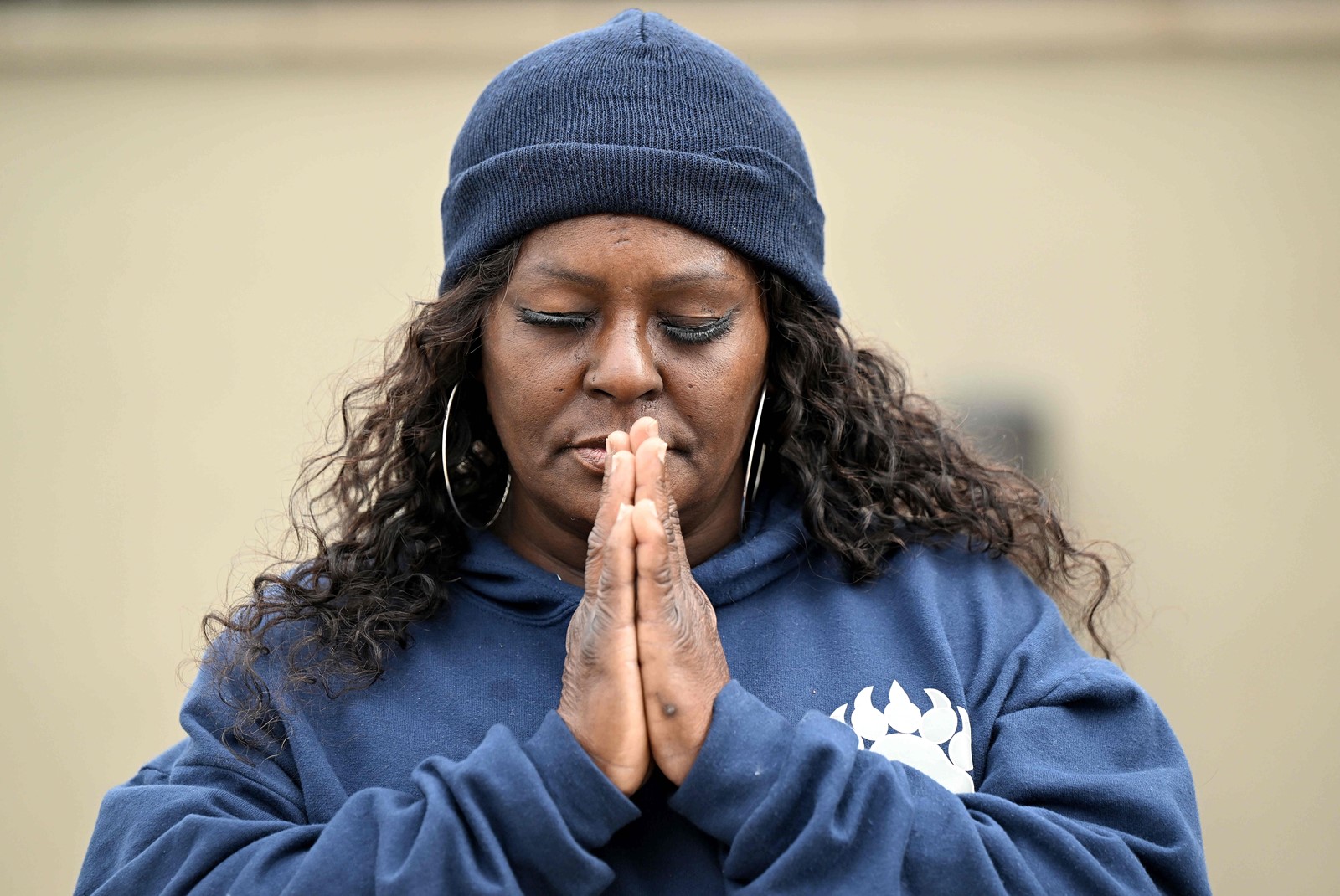


director of housing and homelessness.
Getting all participants to follow the rules is the challenge, she said.
“The responsibility has to be on that person,” she added. “They have to be ready, they have to be ready. And everybody’s not.”
Over the course of three days — Jan. 16, 17 and 18 — the city of San Bernardino removed some 115 people living in about 85 tents in Meadowbrook Park, according to city spokesperson Jeff Kraus. Park residents got a heads-up this was coming, he said.
“Outreach was done for at least a week in advance, with posting done at each campsite and other park locations,” Kraus wrote in an email.
Of the roughly 115 people living in the park, officials said, about 74 people accepted services offered by the city, San Bernardino County and the city’s primary outreach provider, the Salvation Army. The city entered into a contract with the nonprofit in December, paying up to $680,000 for homeless outreach services through the end of 2026.
“In some cases, hotel vouchers are issued for up to two weeks,” Kraus wrote. “During that time, the individuals meet with a case worker and a plan/pathway is developed. Additional hotel time can be arranged if the individual is following the plan and making progress.”
In other cases, Kraus said, the city provides bus or plane tickets to reunite displaced homeless residents with family members. Longer term housing may be arranged in some cases, he said, and the city and its partners may provide assistance with medication, identification, veterans or Social Security benefits.
That’s not exactly how it worked said Wright, who was one of the former Meadowbrook residents who received a hotel voucher.
“They basically just put us in the motel for a week, a week and a half, and then they just threw us out,” Wright said.
She said she complied with all of the rules attached to receiving the voucher, like having no visitors. But at a crucial moment, she apparently missed talking to a case worker.
“ ‘Well, we came to see you,’ ” Wright quoted officials as saying.
She has a cellphone with a text messaging plan.
“They didn’t tell me when they were coming,” she said.
She was using the hotel voucher as a chance to get back on her feet, she said.
“I was so happy to be inside and didn’t have to watch my bags, I started going out trying to find a job,” Wright said. “I was going out trying to get on aid, you know, welfare.”
According to Wright, she never had a case manager or other advocate assigned to her personally, as far as she knew.
According to city officials, everyone who participates in San Bernardino’s housing voucher program has to sign an agreement, which covers expected conduct, how the program works, what participants can do to extend their stay and more. Searcy said people in the housing voucher program also receive cards with their case worker’s contact information, a flyer that explains how participants can get needed paperwork for free, such as copies of their birth certificates, along with information on other available services.
Wright says she never received that paperwork during the sweep of Meadowbrook Park.
“I would have kept that paperwork,” she said.
Now, Wright said, she sleeps at various bus stops near places where she can hide the four bags that contain all she owns. The majority of the people she knew from Meadowbrook Park, she said, are back on the streets.
She pointed to a large metal trash bin on Fifth Street, where she said a 20-year-old homeless pregnant woman died. According to the San Bernardino Police Department, the woman’s body was found Jan. 21. Officers were told by the woman’s boyfriend that she had been diagnosed with a brain tumor before her death. Employees at a local business tear down the memorial Wright has erected to the woman, she said, whenever she replaces it.
Wright also knows people who’ve died of exposure and said she has had to intervene to stop other homeless women from being assaulted.
Some formerly homeless residents have successfully made their way into permanent shelter, however. Wright’s friend, Mike Driver, 66, received help from a program specifically targeting homeless veterans and is no longer homeless.
“They helped me a whole lot,” Driver said.
“The program he went through, it was awesome,” Wright added.
Nationally, efforts to help homeless veterans have experienced great success and experience less pushback from voters than other programs to house homeless people.
“But they put (Wright) in a hotel and started putting people out,” Driver said. “I just don’t know.”
According to Searcy, Wright and a male roommate each received individual two-week housing vouchers. But the roommate allegedly caused problems at the hotel, including making threats against staff.
“We don’t want to abuse our relationship with the motel owners,” Searcy said. “If they say they don’t want someone back, we don’t want to burn that bridge.”
Wright was offered solo accommodations, either at the same hotel or at a domestic shelter, but didn’t want to live apart from her roommate, according to the city. She’s still on the Salvation Army’s list of program participants, but is reportedly not asking for services.
Wright disagrees with the city’s version of events. She said her roommate broke the rules by inviting friends to use the shower at the motel, in violation of the agreement they both signed when they received the housing voucher. The two had argued about his decision to do that, but she wasn’t kicked out at that time.
“They split us up and gave me more time,” Wright said, but eventually she was asked to leave.
“I never had no understanding of why I was kicked out, and I had complied” with the rules, Wright said. “I never had no visitors. I tried to get up earlier in the morning and try to build my life up.”
According to the 2024 San Bernardino County point-in-time count of homeless people, the city had 1,417 homeless residents in January that year, more than any other in the county. That works out to about 633 of every 100,000 residents in the city of San Bernardino who don’t have a consistent place to live, nearly triple the county average. It’s also worse than the statewide average of 455 homeless people per 100,000 residents, and the national average of 195 people per 100,000 residents.
The Meadowbrook Park sweep came after Gov. Gavin Newsom’s July announcement that California cities had “no more excuses” when it comes to removing homelessness camps, after a June U.S. Supreme Court decision giving the green light to local governments to arrest people for sleeping in public, even when there are no shelter spaces available for them.
In September, the ACLU Foundation of Southern California reached a “first-of-its-kind” settlement with the city. San Bernardino agreed to adopt a new policy preventing the destruction of homeless people’s property during encampment sweeps and ensure reasonable accommodations for homeless residents with disabilities.
The city was previously barred from doing sweeps while the ACLU suit worked its way through the legal system.
And in October, Mayor Helen Tran announced the city would begin clearing homeless encampments and open two new shelters.
Since then, San Bernardino has cleaned up encampments of homeless residents living in public spaces, Kraus said, including camps at Perris Hill Park, Wildwood Park and Bobby Vega Park.
Encampments in an alley near D Street and Base Line Street, the underpass near Hunts Lane and Redlands Boulevard, and a site near Congress and F streets have also been cleared. More such cleanups are planned.
In February, the San Bernardino City Council voted to allocate $1.4 million to help house homeless people. Another $600,000 in funding will be coming before the council for a vote in March, according to Searcy.
“I guess I’m going to start going to City Council meetings” to advocate for homeless residents, Wright said.
Wright’s family moving to Texas led to her living on the streets of San Bernardino, she said, but she has no desire to be sent to Texas. She’d rather find the means to live in her hometown.
“I’m a citizen and I just need a little help,” Wright said. “They’ve got funding for it. Why do I have to move to Texas? Why not help me until I get on my feet?”
 PREVIOUS ARTICLE

