


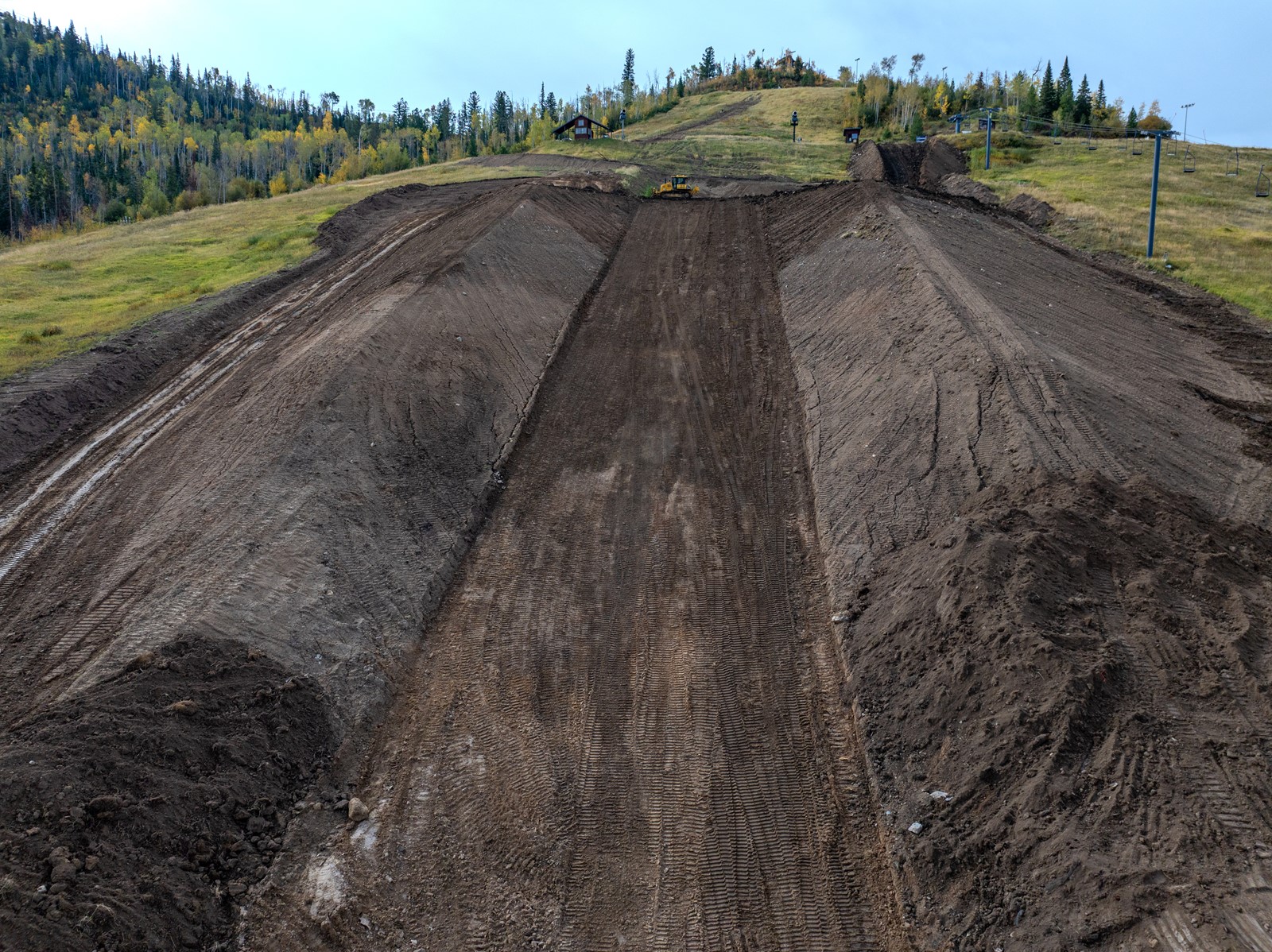


When Jake Ingle heard he could get his hands on 40,000 cubic yards of free dirt, he knew he couldn’t pass it up.
For someone like Ingle, the slope maintenance manager at Steamboat Ski Resort, that dirt meant he could add to or amend the existing mountain terrain beyond what his budget afforded this winter. And while Ingle considered doing rudimentary projects like grading trails in beginner-friendly areas, he ultimately decided to do something he’s really good at: Build an Olympic-sized halfpipe.
Folks who visit Steamboat Springs to ski this winter will find that Maverick’s Superpipe has grown longer and steeper thanks to dirt that was removed to build the foundation of the forthcoming Stockman hotel and repurposed in the terrain park.
Construction is expected to wrap this week on the dirt work, Ingle said, and he hopes it will be covered in snow and ready to shred by Christmas, weather permitting.
Crews have been moving dirt since the summer, but the project’s genesis dates back to last spring, when Ingle was approached by the development company working on the Stockman, a luxury hotel and residential property with 95 units within walking distance of the slopes. As he tells it, developers hoped to save some time and money by keeping the excavated dirt in town instead of hauling it off to a local quarry.
For Ingle, it was an unmissable opportunity. While many of the resort’s terrain park features are made from snow, using dirt for the base means this one will last for decades to come. The superpipe’s walls and structure will still be built from manmade snow, but Ingle expects he’ll need roughly half the resources compared to previous years.
“I’m never going to get another chance to have somebody say to me, ‘Hey, how about we give you 40,000 cubes of free dirt and we rent you some equipment? It’s gonna save us money and you get to build a halfpipe with it,’” said Ingle, who also designed the pipe with assistance from an engineering firm and his mentors in the industry. “It’s a once-in-a-lifetime thing.”
When it’s finished this season, Maverick’s Superpipe will be up to 500 feet long with walls 22 feet high on each side. The walls will be steeper than in the past at an 18.5-degree pitch, Ingle said, making it truly on par with Olympic-level designs. (Ingle would know, since he helped build those used in the PyeongChang 2018 Winter Olympics in South Korea.)
Even though the superpipe will be longer and steeper than years past, Ingle said it will require fewer snowmaking resources because of the extra dirt. There’s even the possibility to expand it up to 600 feet long in future seasons, he said.
“Last year, we built about a 400-foot-long pipe and we used about 1.4 million cubic feet of snow. And this winter, we’re going to be able to build a 500-foot-long pipe and use about 750,000 cubic feet of snow,” Ingle said.
Reducing the need for snowmaking is a good thing long term, as Colorado’s winters are expected to continue warming in the face of climate change. That’s especially pertinent at Steamboat Ski Resort, which sits at a lower elevation than many other resorts, with a base at 6,900 feet and its summit near 10,500 feet.
But it also benefits more casual skiers in the short term. The quicker crews can finish Maverick’s Superpipe, the sooner they can move on to snowmaking elsewhere on the mountain, Ingle said.
Given Steamboat Springs’ reputation as an incubator for Olympic talent, Ingle sees this new project as a win for the local community. Anyone is welcome to ride the pipe, which is accessible by a two- to three-minute ride on the Bashor chairlift, he added.
“It’s cool for something like this to come from a big development like that and for them to support it,” he said. “It’s huge for the athletes, so it’s awesome.”
Steamboat Ski Resort is currently scheduled to open Nov. 21.
 PREVIOUS ARTICLE

