


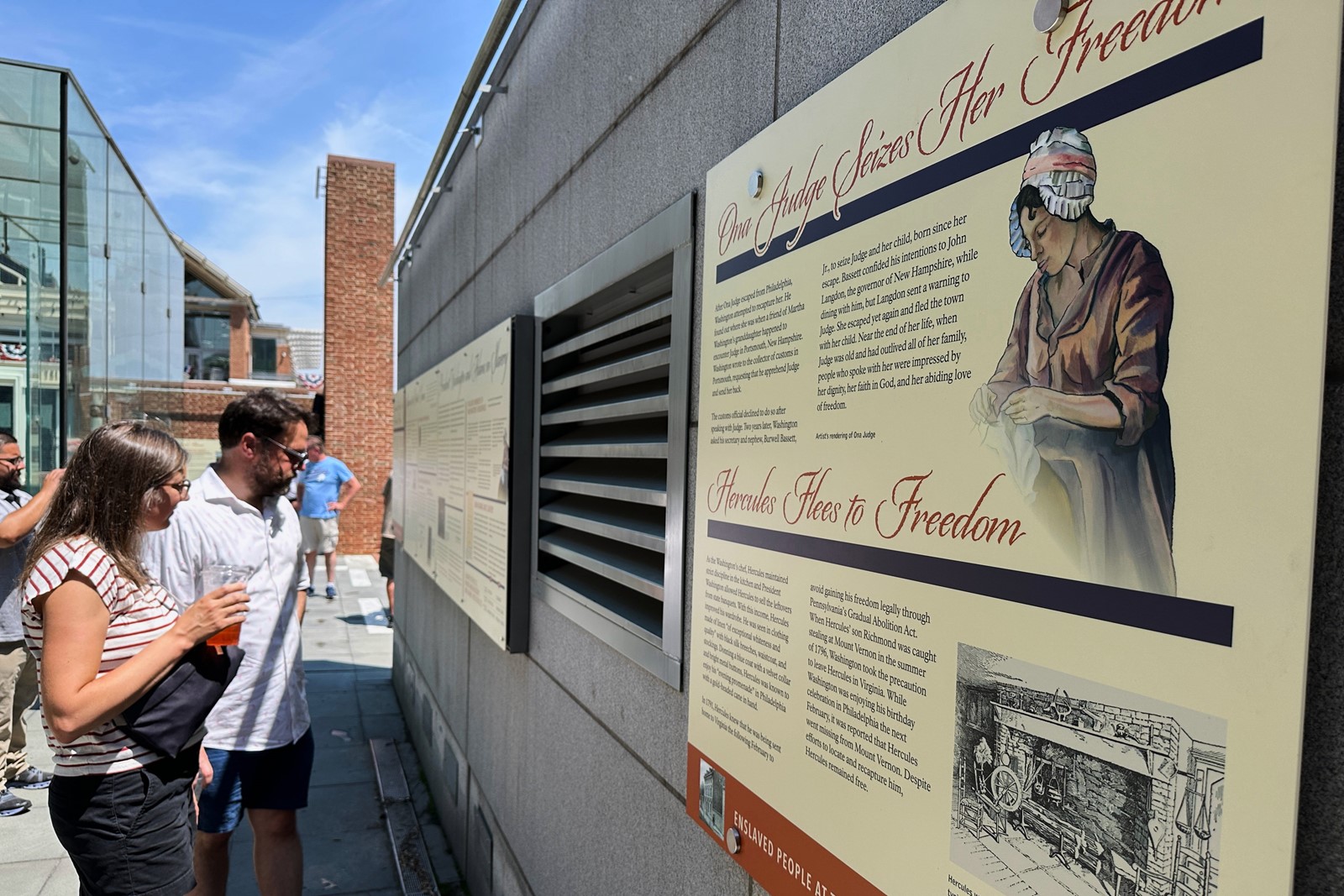


PHILADELPHIA — The Trump administration on Wednesday replaced an exhibit on slavery at the site of President George Washington’s home in Philadelphia with a version that historians say whitewashes the nation’s history.
The new exhibit was installed in the same area where the Declaration of Independence was adopted on July 4, 1776.
“Overnight, under the cover of darkness, the federal government removed panels at the President’s House that told a thorough history of Philadelphia,” Philadelphia Mayor Cherelle L. Parker said Wednesday. “It was allowed to do this by the decision of the federal court, but that it did so at night shows it understands this action is shameful, that it violates community trust.”
The changed exhibition comes as Trump has made dismantling diversity and inclusion initiatives a priority in an aggressive campaign to overhaul some of Washington’s most sacred cultural and historic institutions.
The original panels were put in place in 2010 and told the story of how nine slaves lived in the home along with George and Martha Washington in the 1790s, when Philadelphia was briefly the nation’s capital.
Those panels were updated after President Donald Trump issued an executive order in 2025 that called for federally owned or controlled historic sites to not display information to “disparage Americans past or living” and to focus on the “greatness of the achievements and progress of the American people.”
The directive has raised concerns about sanitizing and erasing dark sides of American history.
Trump has continued a broadside against culture he deems too liberal. In March, Trump revealed his intention to force changes at the Smithsonian Institution with an executive order that targeted funding for programs that advanced “divisive narratives” and “improper ideology.” He has also pressured organizations outside of the government, including universities, to take similar actions with the stated aim of eliminating what he says are discriminatory practices.
A lower court forced the federal government in February to remove the new panels after they already had been installed earlier this year. A three-judge panel of the U.S. 3rd Circuit of Appeals reversed that and ruled July 3 that the work could continue.
 PREVIOUS ARTICLE
