


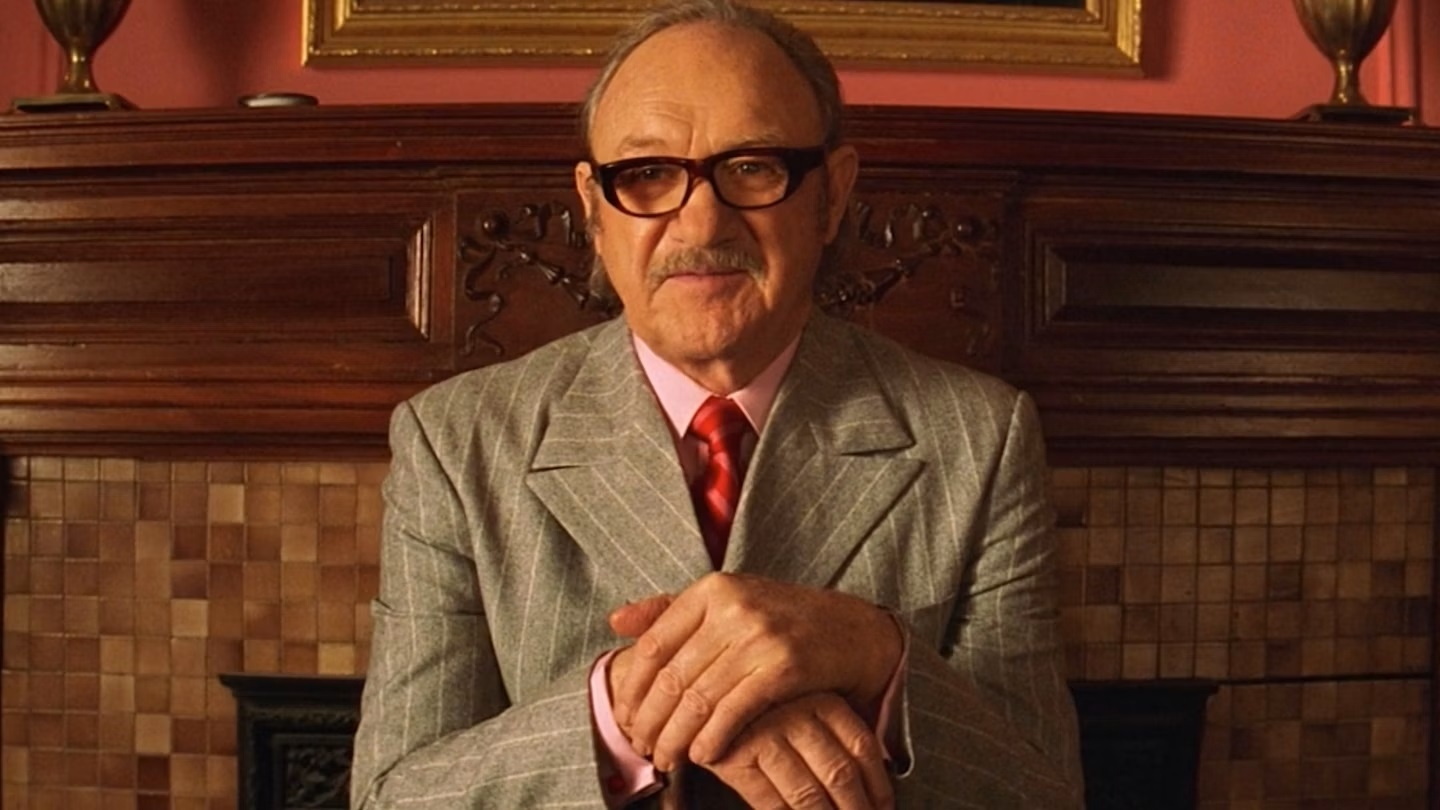


Looks-wise, he had a humbleness that allowed him to play cops, working men and the president of the United States. The voice could grumble and soar, scraping the deepest recesses of evil and reaching the high-pitched cajoling of a championship schemer. Gene Hackman dodged and weaved. He bounced through early triumphs “Bonnie and Clyde” and “The French Connection” and was just getting started. As suggestive as his quiet performance is in Francis Ford Coppola’s Nixonian 1974 thriller “The Conversation,” all of Hackman’s turns have a complexity that made them endlessly fascinating. His killers told jokes; his heroes slouched. His performances never failed to hold our attention and fascination.
Here are four that are particularly memorable to me and fellow staff writers.
‘The Royal Tenenbauns’
I have watched Wes Anderson’s “The Royal Tenenbaums” countless times over the years, and the ending of that movie never fails to get me. And that’s all Gene Hackman. Playing Royal, the family’s deeply flawed patriarch, Hackman makes this man — a father who abandoned his family and, even when he was around, acted like a jackass — into a charming rascal whom you root for as he attempts to make up for lost time and past sins. “Can’t somebody be a s— their whole life and try to repair the damage?” Royal asks. At first, it’s all an act. Literally. He says he’s dying from stomach cancer. Of course, he’s soon discovered to be lying. (His daily three-cheeseburger diet is a tipoff.) As he slinks off, Royal says that the past six days have been the best of his life. And he’s surprised because he means it. You see that astonishment on Hackman’s face, which sells Royal’s redemption and makes the movie’s tender denouement work.
Hackman didn’t want to make “The Royal Tenenbaums.” It was a lot of work, the pay was scale and Anderson wasn’t yet a brand-name director. Thankfully, Hackman’s agent sold him on doing it. So many scenes from this legend’s career are indelibly etched in my mind. But none brings me more joy than watching Royal and his two grandsons go-karting through the streets of New York to the sounds of Paul Simon’s “Me and Julio Down by the Schoolyard.” I’m smiling now just thinking about it.
— Glenn Whipp
‘Unforgiven’
David Webb Peoples wrote a legendary script in the late 1970s, a time when westerns could have running gags, cynical wisdom and big-time reversals of fortune. Right at its center is a two-scene knockout about the making (and unmaking) of reputations that only an actor of Hackman’s deftness could pull off. Both scenes take place in a jail; they’re built out of the same kind of conversational fireworks that Howard Hawks used to make “Rio Bravo.” In the first, Hackman’s local sheriff, Little Bill Daggett, already cemented in our brains as vicious, reveals himself to be a shrewd mocker of the written word as well. The “Duck of Death,” he insists on calling his prisoner, English Bob (Richard Harris), and it takes him only a couple of times before you realize he’s not mispronouncing the word duke. (A fawning biographer watches his book get torn to shreds in real time.) By the next scene, we see that Little Bill has grabbed the spotlight for himself, ballooning into a gasbag of self-importance. But watch those eyes widen when suddenly there’s a test of guts and his meanness flares again. Only Hackman could shift like that, from raconteur to angel of death. He lives rent-free in my head for these minutes of screen time alone.
— Joshua Rothkopf
‘Mississippi Burning’
“Mississippi Burning” was, for me, the ultimate Gene Hackman film. Not just because its story — the 1964 investigations into the murders of civil rights workers James Chaney, Andrew Goodman and Michael Schwerner — remains horrifically powerful and still (alas) resonant, but because Hackman’s role personifies just what made him one of the few leading men who remained unquestionably a character actor. Director Alan Parker’s 1988 film captures a time when many small Southern towns were tightly gripped by the violent racism of the KKK. After three civil rights workers go missing, two FBI agents are sent to investigate: Alan Ward (Willem Dafoe), a young, uptight Northerner who wears his anger on his sleeve, and Rupert Anderson (Hackman), a former Mississippi sheriff who understands that there is nothing to be gained, and much to be lost, by a full-frontal attack. Anderson’s ability to use neighborly charm to gain access and trust mirrors Hackman’s own talent for creating characters who, good or evil, were always deeply human — no matter the role, we followed him because we recognized him. The scene in which Anderson single-handedly faces down both the corrupt deputy and the Klan’s most murderous henchman is a master class in range. Hackman enters with a genial familiarity only to make it very clear that the Klan will underestimate him at its peril. In less than three minutes, we are reminded that the same was always true of Hackman himself.
— Mary McNamara
‘Superman’
At the tender age of 6, long before I saw Hackman in his more serious, nuanced roles, his iconic turn as Lex Luthor in Richard Donner’s “Superman” hit me like a superpowered punch. With his goofy, slightly pathetic wig and gleeful malevolence, Hackman’s Luthor was as absurd as he was menacing — a villain you couldn’t help but root for, even as he plotted to destroy California by triggering the San Andreas Fault with a missile detonation. Compared to the grim interpretations of later Lexes, like Jesse Eisenberg’s twitchy, unhinged take or Kevin Spacey’s cold, corporate villain, Hackman’s Luthor was more like a campy Bond villain, ridiculous, vain and irresistibly funny, reveling in his schemes with theatrical flair. With Ned Beatty serving as the perfect comic foil as his bumbling henchman Otis, Hackman’s playful brand of evil mastermindery would go on to set the template for future comic-book antagonists, from Jack Nicholson’s Joker to Tom Hiddleston’s Loki. As Hackman later said of the role, “It’s like a license to steal. Almost anything you do is going to be OK because he’s kind of flamboyant and deranged and all the things actors love to play. I wouldn’t play Superman for anything.”
— Josh Rottenberg
 PREVIOUS ARTICLE
