


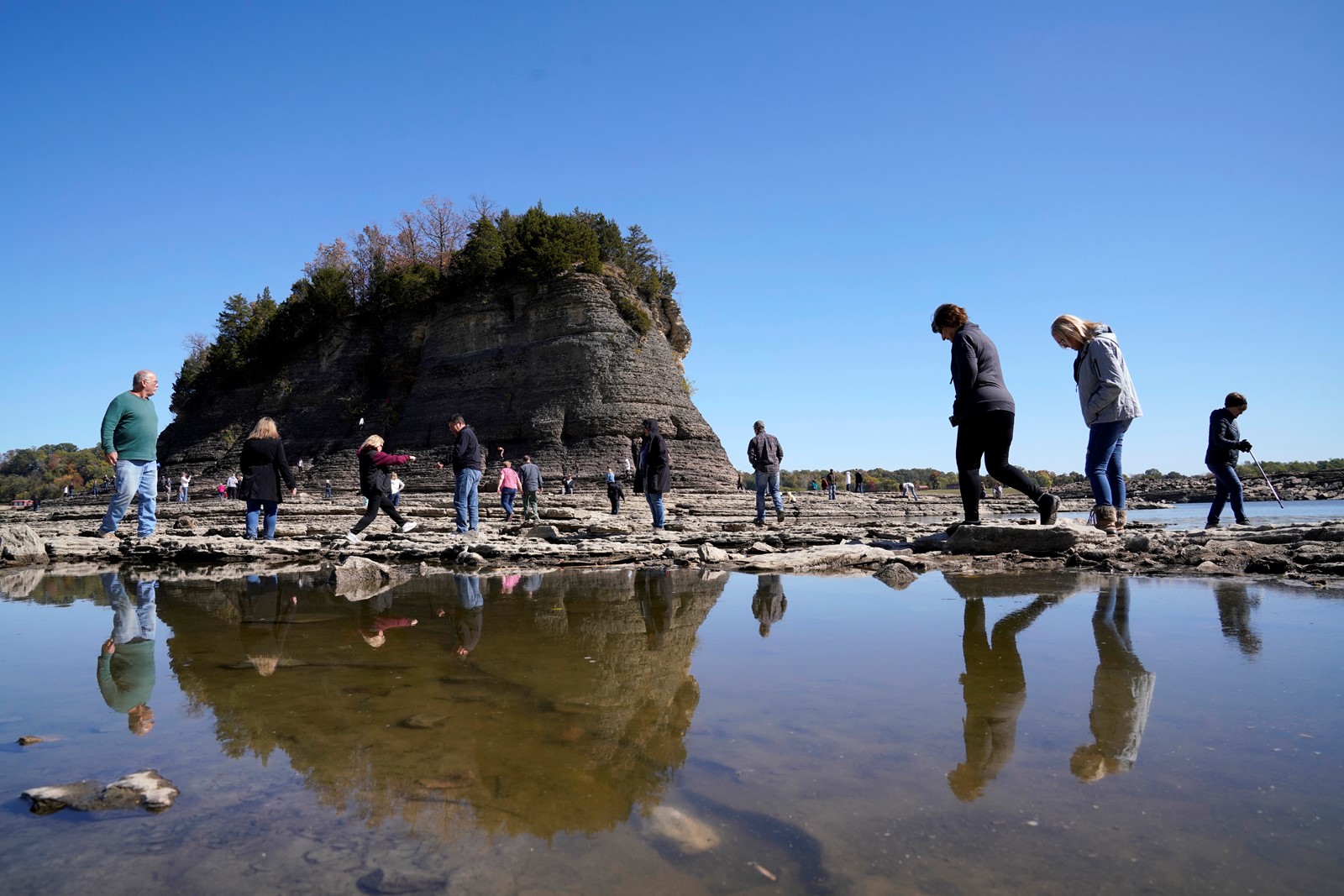


ALONG THE MISSISSIPPI RIVER — Adam Thomas starts harvesting soybeans on his Illinois farm when the dew burns off in the morning. This year dry weather accelerated the work, allowing him to start early. His problem was getting the soybeans to market.
About 60% of the Midwestern and northern Great Plains states are in a drought. Nearly the entire stretch of the Mississippi River — from Minnesota to the river’s mouth in Louisiana — has experienced below-average rainfall over the past two months.
As a result, water levels on the river have dropped to near-record lows, disrupting ship and barge traffic that is critical for moving recently harvested agricultural goods such as soybeans and corn downriver for export.
Although scientists say climate change is raising temperatures and making droughts more common and intense, a weather expert says this latest drought affecting the central United States is more likely a short-term weather phenomenon.
The lack of rain has seriously affected commerce. The river moves more than half of all U.S. grain exports, but the drought has reduced the flow of goods by about 45%, according to industry estimates cited by the federal government.
Prices for rail shipments, an alternative for sending goods by barge, are also up.
“It just means lower income, basically,” said Mike Doherty, a senior economist with the Illinois Farm Bureau.
Thomas farms at the confluence of the Ohio and Mississippi rivers and doesn’t own enough grain storage to wait out the high costs of shipping.
“I’ve had to take a price discount,” he said.
Barges are at risk of hitting bottom and getting stuck in the mud. Earlier this month, the U.S. Coast Guard said there had been at least eight such “groundings.”
Barges are cautioned to lighten their loads to prevent them from sinking too deep in the water, but that means they can carry fewer goods.
To ensure that vessels can travel safely, federal officials regularly meet, consider the depth of the river and talk to the shipping industry to determine local closures and traffic restrictions. When a stretch is temporarily closed, hundreds of barges may line up to wait.
“It’s very dynamic: Things are changing constantly,” said Eric Carrero, the Coast Guard’s director of western rivers and waterways. “Every day, when we are doing our surveys, we’re finding areas that are shallow and they need to dredge.”
After a closed-down section is dredged, officials mark a safe channel and barges can again pass through.
In some places, storage at barge terminals is filling up, preventing more goods from coming in, according to Mike Steenhoek, executive director of the Soy Transportation Coalition. High costs for farmers have led some to wait to ship their goods, he added.
Climate change is raising temperatures and making droughts more common and worse.
“The drier areas are going to continue to get drier, and the wetter areas are going to continue to get wetter,” said Jen Brady, a data analyst at Climate Central, a nonprofit group of scientists and researchers that reports on climate change.
But Brad Pugh, a meteorologist with the National Oceanic and Atmospheric Administration, said the current drought experienced in the Midwest is likely “driven by short-term weather patterns,” and he would not link it to climate change.
 PREVIOUS ARTICLE

