


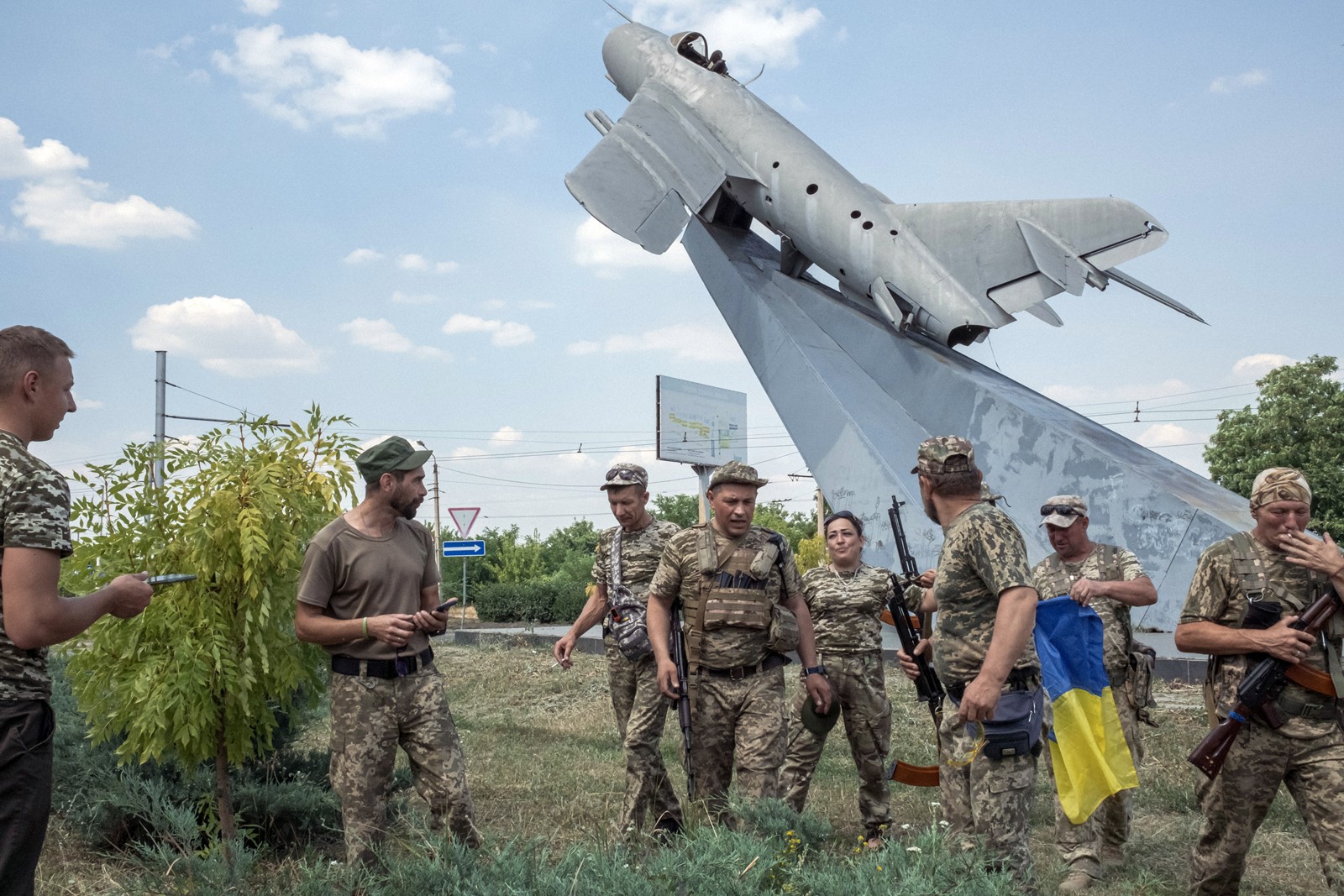


DONETSK PROVINCE, Ukraine — Red flames crackled in the golden wheat field, the target of Russian artillery just minutes earlier. Nearby, the commander of a Ukrainian front-line unit was finishing his lunch of pasta from a tin bowl. As more incoming shells exploded in the fields, his men took cover in their bunkers.
Life on the front lines in the eastern Donetsk region has seen little letup in recent weeks. Ukrainian soldiers serving there say they live under almost constant Russian artillery and aerial bombardment. The fields and hedgerows around them are charred and smoldering. Their days and nights are interspersed with the sharp bangs of outgoing Ukrainian artillery and the deeper, rumbling bursts of incoming fire.
“It’s tense,” said the commander, Samson, 55, who, like most members of the Ukrainian military, asked to be identified by only his code name in accord with military protocol. “There is daily mortar fire, airplanes, helicopters, ‘Grads.’ They have a lot of ammunition.” Grad, meaning hail, is from the Russian acronym for a commonly used multiple rocket launcher system.
After beginning an offensive against Ukraine’s east in April, Russia made progress at a steady if grueling pace. But since seizing control of Luhansk province two weeks ago, the Russians have lost some of that momentum. Ukrainian troops, forced to move to second- and third-line defensive positions, have mostly held their ground despite the onslaught of mortar shells and missiles.
The grinding battle in Donetsk comes amid ominous signs that Russia’s war in Ukraine is intensifying on other fronts.
After a series of deadly Russian missile attacks on civilian targets in recent days, Ukrainian President Volodymyr Zelenskyy is pleading with his people to heed air-raid sirens and seek shelter. In some cities, Ukrainians have become not just complacent about the danger but too weary of war to react to the threat of attacks.
Outnumbered and outgunned, the Ukrainians say the success or failure of their fight will depend on whether they receive more and better arms. But they say they are determined to try to hold every inch of what is still theirs in Donetsk province, despite heavy losses, and dismissed as ludicrous the suggestion that they cede territory or give up the fight.
They have the conviction of their cause, they said, while the Russians lack purpose.
“There is no choice,” said Serhii, 44, a career soldier with one unit. “We are protecting our country.”
Dug in in the woods and villages, Ukrainian troops fought off a Russian attack early this month, knocking out a group of tanks in a battle in the farming village of Verkhnokamianske, according to several accounts.
The blow stalled the Russian advance and brought a lull in places on the front lines, soldiers said. Military doctors said they saw a drop in casualties arriving from the front for several days last week after the battle.
Elsewhere, soldiers and officials recounted other successes. The Seversky Donetsk River and the swampy land to the north of the province remain a natural barrier. The deputy commander of a National Guard unit said his men prevented an attempted river crossing by Russian troops last week, destroying tanks and a pontoon bridge.
Another volunteer unit said they had stopped Russian tanks, already advancing south of the river, from also encroaching from the northwest.
Serhiy Haidai, head of the Ukrainian civil-military administration of neighboring Luhansk province, which is now in Russian hands, confirmed that the Russians had suffered several reverses on the battlefield in the past two weeks and in their rear bases from the added artillery systems, but said the fighting did not represent a tipping point in Ukraine’s favor.
“I do not think this is the moment,” he said. “We have Western artillery, and thank you for that, but it is not yet enough to turn the progress of events.”
Privately, Ukrainian officers serving in eastern Ukraine said they thought the West was intentionally supplying only enough assistance and materiel to slow the Russian offensive and not to defeat it.
Nevertheless, despite punishing battles and heavy casualties defending the last cities of Luhansk province through May and June, Ukrainian troops said they were holding their new positions and not ready to give up.
A unit that fought for 18 days in the city of Sievierodonetsk, which fell to the Russians near the end of June, was resting in a camp in the woods some miles back from the front line, recuperating since the troops were ordered to pull out of the city in the last week of June.
They were in rough shape when they came out, a press officer with the unit said. “They did not want to pull out, and the fighting was also tough,” he said. “They are doing better now.”
The men themselves seemed to have accepted their lot.
“We were ready to fight till the end,” said their commander, Serhii, 52. “But I did not feel bad leaving. It was better to save lives.”
 PREVIOUS ARTICLE
