


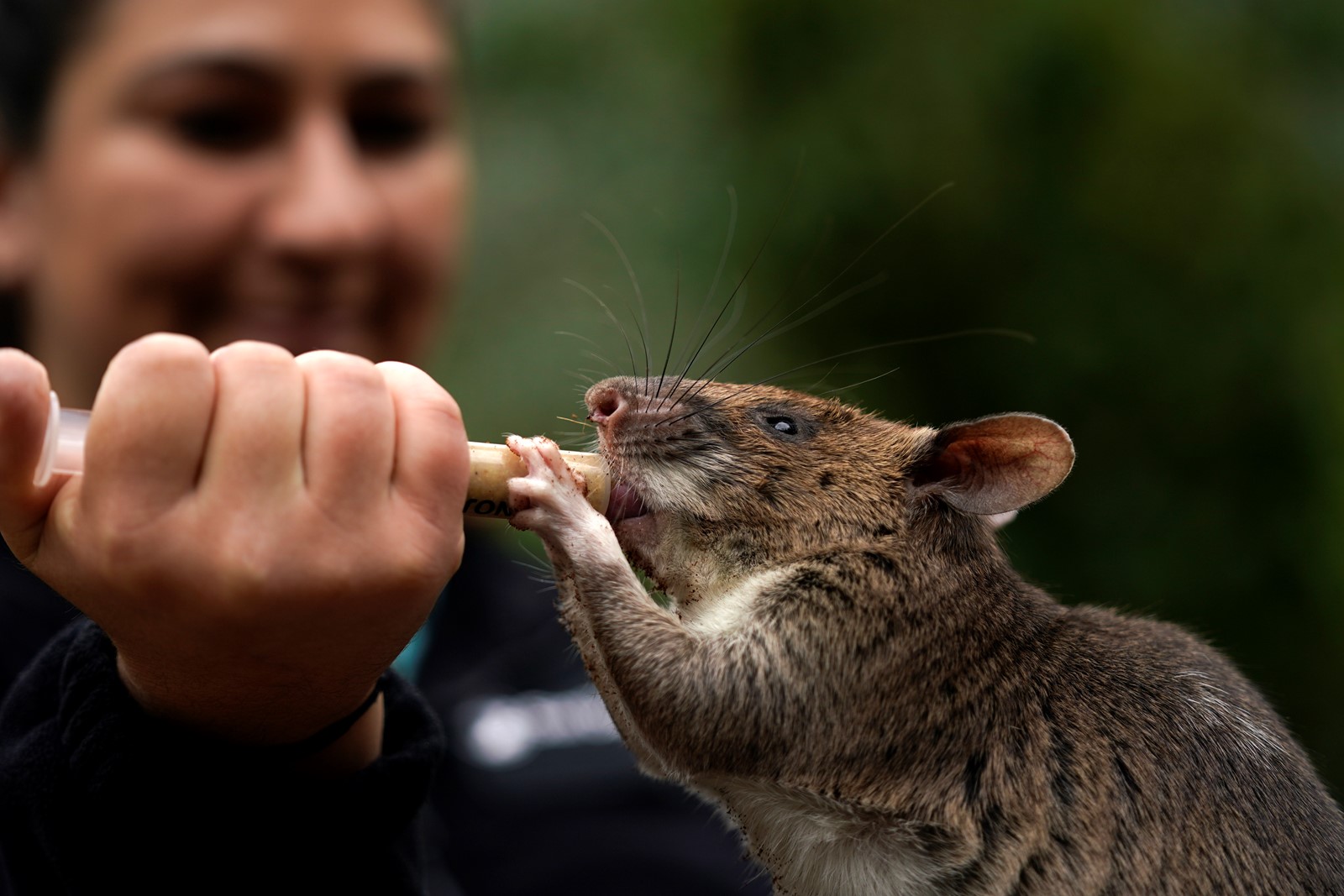


SAN DIEGO — As an ambassador for rats, it’s never easy to win over the public. There’s that hairless tail after all.
But Runa at the San Diego Zoo is doing her best to counter the bad press. She is one of a handful of ambassadors showing off the virtues of rats at three U.S. zoos. The rats were provided by a Tanzania-based organization that is training African giant pouched rats to combat wildlife trafficking, detect diseases and perform other useful tasks.
At least twice the size of the common brown rats found in cities, African giant pouched rats like Runa are best known for ferreting out land mines and other explosive material on old battlefields in Angola, Mozambique and Cambodia, earning them the nickname “hero-rats.” Efforts are underway to expand the use of their keen sense of smell to finding people trapped in collapsed buildings, detecting diseases in laboratory samples and alerting officials to illegal goods at ports and airports.
Six African rats completed their first trial working in the field in March, spending a month at a port in Tanzania where they were tasked with detecting smuggled goods, including Pangolins. The scaly anteater is coveted by poachers and is among the most trafficked animals in the world. Its meat is considered a delicacy in Vietnam and some parts of China, and its scales are used in traditional Chinese medicine.
Wildlife contraband is concealed in vast numbers of shipping containers that annually leave Dar es Salaam in Tanzania and other African ports.
Runa initially was trained to find land mines, but she often got distracted on the job. She has been excelling, however, as an ambassador, said Cari Inserra, lead wildlife care specialist at the San Diego Zoo.
On a recent day, her trainers hid small vessels of chamomile tea under the dirt in a box. As soon as she was let out of her cage, Runa’s tiny nose was twitching as she set out to work. Within seconds she had found all the vessels — and was racing over to suck on a syringe filled with a pellet-and-banana smoothie.
“One of the most fun things to see is how she changes the perceptions of people,” Inserra said.
Nicki Boyd, of the San Diego Zoo and Wildlife Alliance, said rats offer an important tool to combat wildlife trafficking, which the zoo wants to highlight since the illegal animal trade “is very destructive to the species that we are actively trying to save and protect in the wild.”
But rats still have a ways to go in winning over everyone. Last week, New York Mayor Eric Adams introduced Kathleen Corradi, a former elementary school teacher and anti-rat activist, as his new “rat czar” whose job is to battle potentially millions of rats lurking about the city.
Izzy Szott, a behavioral research scientist at the Tanzania-based organization APOPO, which is training the rats to work for governments, said she was not surprised to hear rats had been named enemy No. 1, but she wants people to know the full picture. Her hope is having ambassador rats at renowned zoos, like San Diego’s, will lead to more understanding and support for rat research.
African giant pouched rats have sniffed out more than 150,000 land mines to date, according to her organization. They’ve also helped health clinics in Africa diagnose people with tuberculosis, detecting the bacteria in the sputum samples of 25,000 patients.
At their facility in Morogoro, Tanzania, Szott and other researchers also are working on training the rats to someday aid in the detection of contaminated soil.
And Szott said she believes they could become a fixture at ports and airports, offering a cheaper option to drug-and-explosive-sniffing dogs.
New York’s common brown rats share the same nasal traits, but their shorter lifespan makes them unlikely candidates for such training, Szott said. African rats can live up to a decade whereas small brown rats only live for a few years.
 PREVIOUS ARTICLE
