


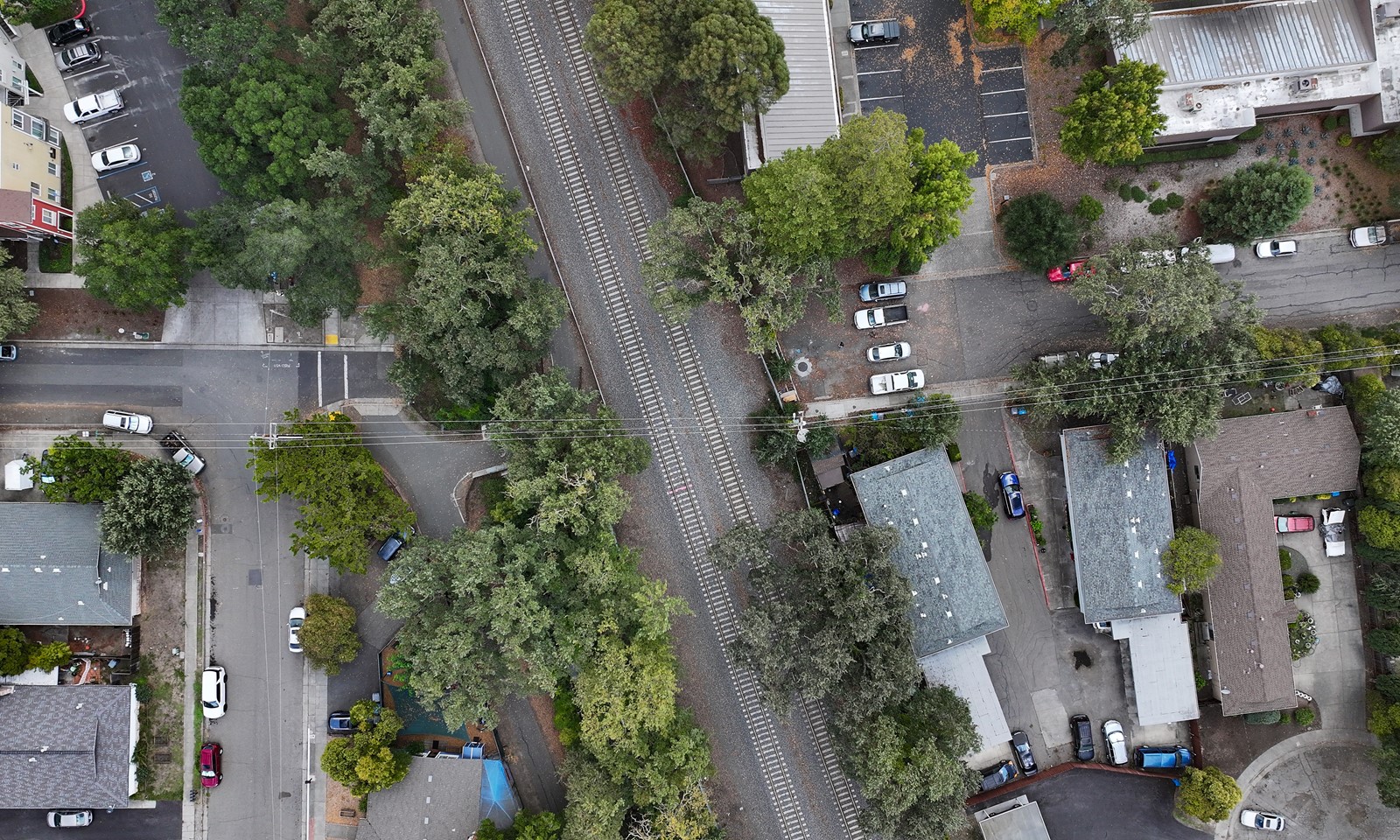


SMART’s resistance to an at-grade rail crossing at Jennings Avenue in Santa Rosa has become so exasperating that even otherwise staid administrative law judges are getting annoyed. It’s past time that SMART let pedestrians and bicyclists pass.
The standoff has dragged on for nearly a decade. SMART’s unreasonable demand for complete indemnification against accidents has stood in the way of tearing down the fences that divide a working-class neighborhood near Coddingtown Mall.
When SMART closed the Jennings crossing, it forced workers, schoolchildren and shoppers to take long detours to reach transit stops, schools, stores and other destinations. Their circuitous routes take them down busy arterial roads that are even more dangerous to pedestrians and cyclists than a typical rail crossing. Some of them instead cut fences and sneak across the tracks, surely far riskier when they have no warning of approaching trains.
Before consenting to a crossing, the rail authority wants the city of Santa Rosa to assume all liability if a train hits someone. The city would even have to cover damages if SMART itself were at fault and would have to pay any legal fees for defending the rail agency.
This kind of demand might make sense for a starting point in negotiations. Shoot for the moon and settle for something less. That is not what is going on here. SMART wants it all. Plenty of crossings exist without such controversy. What is it about this particular crossing that so vexes SMART? Rail officials might be surprised to learn that police, judges and juries are able to assess all the circumstances when determining culpability in an accident.
The city, for its part, has put forward compromise language and is willing to take on some liability.
Rail crossings create risk. Proof of that tragically came on Oct. 17 when a SMART train struck and killed a man near downtown Petaluma. But the tracks need to reach passengers, and that means passing through communities. They should not become impassable barriers that bifurcate neighborhoods.
The California Public Utilities Commission, the state’s regulatory body for rail safety, signed off on an at-grade crossing design in 2016 after an extensive safety review. The plan included gates and lights to block the crossing when a train was near. Previous ideas had included a bridge and a tunnel, but both proved cost-prohibitive.
Nine years later, everyone is tired of the delays, including the CPUC’s administrative judges. “At some point, my concern is this becomes defiance of the commission, and there are consequences to that,” a frustrated Judge W. Anthony Colbert said at a recent CPUC hearing on the impasse.
Judge Leah Goldberg, who was also at the hearing, ordered SMART and the city to settle things by December.
It’s about time someone issued an ultimatum. If SMART digs in its heels and refuses to strike a reasonable deal with Santa Rosa, the CPUC should be ready to use its enforcement authority. Firm deadlines and real consequences might just prompt action.
SMART risks eroding public opinion just as rail advocates prepare to put a sales tax renewal on the ballot next year. SMART’s last tax measure in 2020 failed in part because of concerns about transparency and accountability. The Jennings dispute threatens to reinforce those concerns.
Enough is enough. Build the crossing, protect it properly and stop making excuses.
 PREVIOUS ARTICLE
