


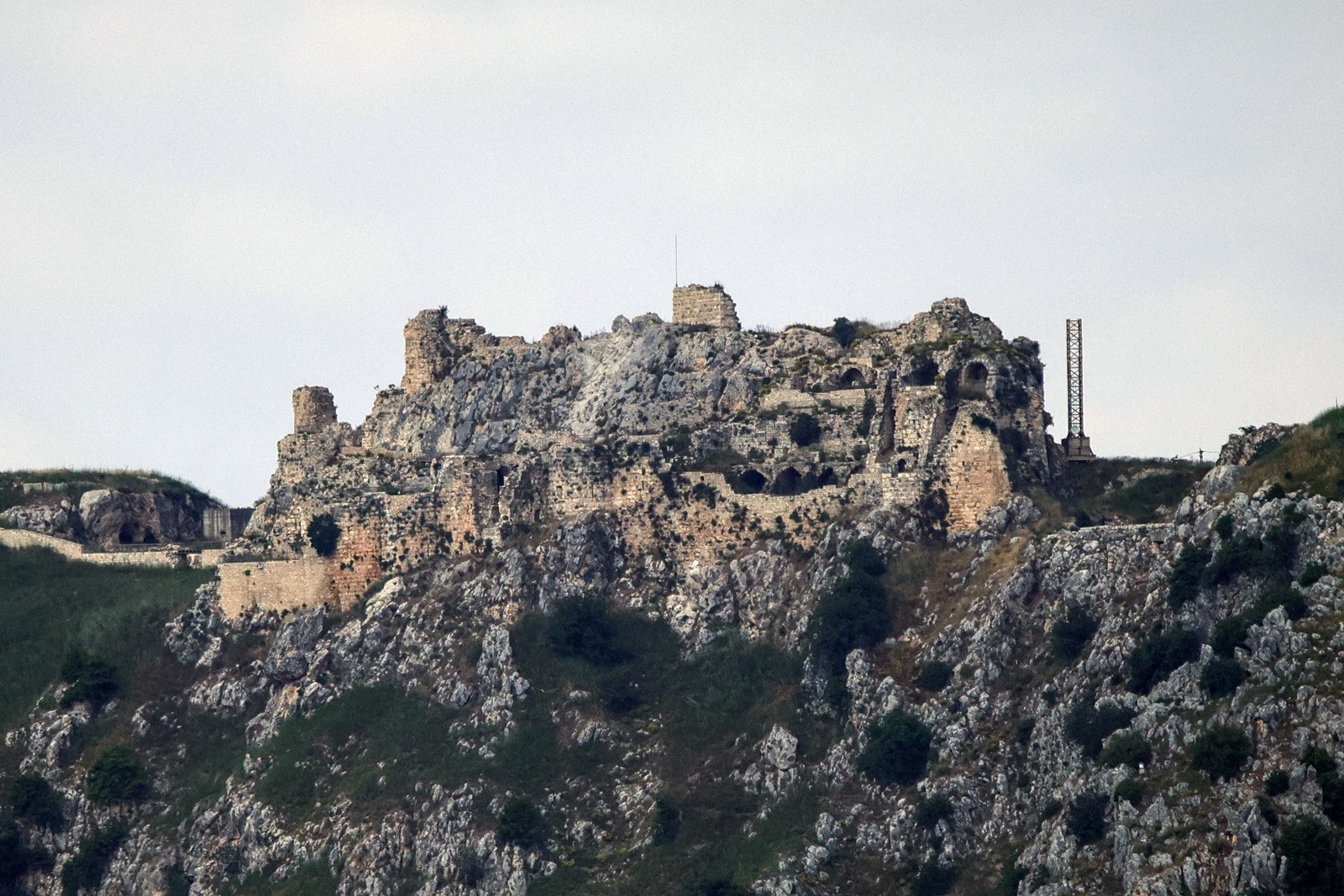


ADLOUN, Lebanon — Israeli air force and artillery strikes were reported on Saturday near the strategic mountain site of a Crusader-built castle in southern Lebanon as fighting raged in villages close to the city of Nabatiyeh.
Lebanon’s state-run National News Agency reported airstrikes and artillery shelling near the Crusader-built Beaufort castle that is about 9 miles from the Israeli border and overlooks wide parts of southern Lebanon. The strategic castle was held by Israeli troops for 18 years until they withdrew from Lebanon in May 2000.
Separately, an Israeli airstrike on the Gaza Strip killed a nurse, the latest death since last year’s shaky ceasefire.
Israel’s military issued evacuation warnings for more than a dozen villages in southern Lebanon, a day after Lebanese and Israeli military officials held their first direct talks in decades at the Pentagon.
The situation in southern Lebanon was discussed during a meeting on Saturday between Lebanon’s president and prime minister who later said in a statement that they will intensify their contacts to make Israel stop demolition and bulldozing of homes and historical sites as well as its evacuation warnings.
Later on Saturday, Prime Minister Nawaf Salam used a televised speech to criticize Israeli airstrikes and its invasion of Lebanon. He accused Israel of “implementing a policy of total destruction of cities and towns” and of carrying out mass displacements.
He said Israel is trying to “uproot Lebanon’s memory and erase the people’s history,” adding that the government will do all it can to achieve a ceasefire, an Israeli withdrawal from Lebanon and the return of displaced people to their homes.
Israel will not gain security and stability through the “scorched earth policy,” Salam said.
Israel and Hezbollah
Israeli troops have been advancing for days in villages close to Beaufort castle, including Yohmor and Zawtar al-Sharqieh, near the city of Nabatiyeh, after they crossed the strategic Litani River, which the Israeli military has used as a de facto boundary.
The incursion is the deepest by Israeli troops since the withdrawal from Lebanon in 2000.
Large areas to the south are under Israeli military control, despite an April 17, U.S.-brokered ceasefire.
The National News Agency reported airstrikes on different parts of southern Lebanon, including in the village of Ansar that killed three people. A drone strike on a road linking the village of Ebba with Nabatiyeh wounded two Lebanese soldiers, the army said in a statement.
Hezbollah, meanwhile, said its fighters fired rockets at northern Israel’s largest city, Kiryat Shmona, on the border with Lebanon. The group said its attack was in retaliation for airstrikes that killed civilians in Lebanon. Hezbollah later said it also fired rockets toward the northern city of Safed.
The latest Israel-Hezbollah war started on March 2, when Hezbollah fired rockets into northern Israel two days after Israel and the U.S. attacked Iran.
It has left 3,350 people dead in Lebanon and over 1 million people displaced.
In Gaza
In the Gaza Strip, a Palestinian nurse was killed in an Israeli strike on Saturday, hospital authorities said. The strike hit a Hamas-manned police point in the central city of Deir al-Balah. At least three other people were wounded, according to the city’s Al-Aqsa Martyrs hospital, which received the casualties.
The Israeli military did not respond to a request for comment.
The nurse was identified as Jamal Abu Aoun, who worked at Yafa Hospital in Deir al-Balah. His funeral was held at noon in the Al-Aqsa Martyrs hospital’s courtyard.
While the heaviest fighting has subsided, the shaky ceasefire has seen almost daily Israeli fire. Israeli forces have carried out repeated airstrikes and frequently fire on Palestinians near military-held zones, killing at least 929 Palestinians, according to Gaza’s health ministry.
 PREVIOUS ARTICLE

