




The COVID-19 pandemic dominated the last years of Donald Trump’s presidency, and the discontent it caused most likely contributed to his loss in 2020. But on the campaign trail this year, Trump rarely talks in depth about public health, dwelling instead on immigration, the economy and his grievances.
Still, Project 2025, the blueprint for a new Republican administration shaped by many former Trump staff members, lays out momentous changes to the Food and Drug Administration, the Centers for Disease Control and Prevention, and the National Institutes of Health.
And Trump’s embrace of Robert F. Kennedy Jr., a vaccine skeptic, and his campaign slogan, “Make America Healthy Again,” suggests there will be significant changes to the nation’s public health priorities should Trump regain the presidency.
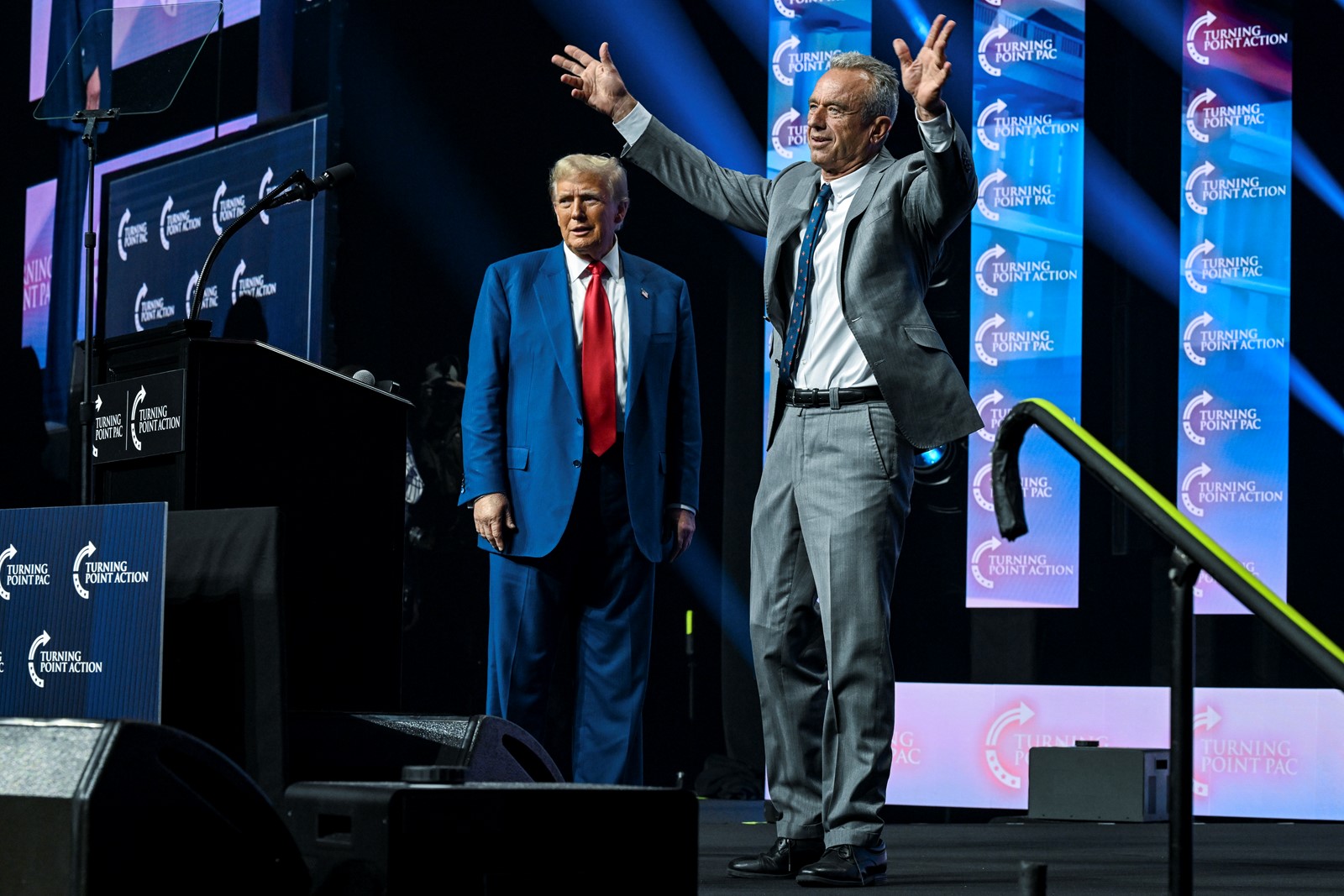
“I’m going to let him go wild on health,” Trump said of Kennedy at a rally in New York City on Sunday. “I’m going to let him go wild on the food. I’m going to let him go wild on medicines.”
Republican critics increasingly describe the health agencies as corrupt, riddled with conflicts of interest and staffed by myopic bureaucrats accountable to no one.
Trump echoed these themes at a rally in Wisconsin: “We’ll take on the corruption at the FDA, the CDC, World Health Organization and other institutions of public health that have dominated, and really are dominated by corporate power, and dominated really by China.”
In interviews with more than a dozen health experts, including six former Trump administration officials, virtually all foresaw reduced authority for public health agencies should Trump return to the White House, even as new diseases, like bird flu and mpox, threaten the United States.
Some experts allied with both parties worried about the nation’s response particularly to another potential pandemic in a second Trump presidency.
Handling of the coronavirus pandemic was disastrous, said Dr. Robert Kadlec, who led the Administration for Strategic Preparedness and Response under Trump: “It didn’t have to be that way.”
Before the pandemic, few presidents had much to say about the CDC beyond appointing its leader. But “the pandemic brought the CDC into the crosshairs,” said Dr. Anne Schuchat, a former principal deputy director of the agency, who retired in 2021.
Project 2025 describes the CDC as “perhaps the most incompetent and arrogant agency in the federal government” and calls for it to be divided into two entities.
One would be responsible only for publishing data gathered from states and other sources. The other would retain a “severely confined ability to make policy recommendations” under the auspices of political leaders.
“He’ll go down the path that he started, which is to fully politicize the CDC,” said Lawrence Gostin, the director of the WHO Collaborating Center on Global Health Law, referring to a second Trump administration.
A complete restructuring of the CDC may not be realistic, several observers noted. It would require approval from Congress and seems unlikely to win the support of Republican moderates. Yet many Republicans in Congress agree the CDC should be pared down, perhaps focused only on infectious diseases — a view at least partly shared by Dr. Scott Gottlieb, who led the FDA for two years under Trump.
“There are clearly some CDC functions related to its prevention work that could line up better inside other agencies,” he said in an interview.
Other experts predicted the CDC would most likely lose the authority to enact the few actions it is empowered to use in public emergencies, such as pausing housing evictions, limiting the movements of cruise ships and requiring masks on public transportation.
“There’s a false narrative here that CDC got distracted by these noncore issues and therefore had a bad pandemic, and every part of that narrative is wrong,” said Dr. Thomas Frieden, who led the agency under President Barack Obama and has criticized it for being slow to respond to COVID.
About two-thirds of the agency’s budget goes to state and local health departments, “not building some empire in Atlanta,” where the CDC has its headquarters, he added.
Slashing the CDC’s budget would constrict these state departments, which are already struggling. Last month, Frieden and seven other former CDC directors warned that shrinking the agency “would cost lives and damage the economy.”
Even without congressional support, Trump could significantly change the agency’s mission, scope and independence. His administration could suppress data collection for gun violence and gender identity, for example, or expand the agency’s tracking of abortions.
Vaccine requirements are likely to be a particular flashpoint for both the CDC and FDA, experts said. Project 2025 inveighs against vaccine and mask mandates, and Kennedy is perhaps the country’s most high-profile vaccine skeptic.
Trump is not personally opposed to masks or vaccines, except for some personal qualms about the MMR vaccine, according to officials who worked closely with him. But he has been critical of policies mandating their use.
All 50 states and the District of Columbia require certain vaccinations for schoolchildren, with varying criteria for religious or personal exemptions. Yet at dozens of rallies this year, Trump has said, “I will not give one penny to any school that has a vaccine mandate or a mask mandate.”
Vaccine policies are set at the state level, not by the federal government. But states look to the FDA to evaluate vaccine safety and to the CDC for guidance on which vaccines should be given and when.
A committee of external advisers to the CDC reviews the evidence for vaccines and recommends which shots people should get and when. An appointed CDC director could reject its advice and reshape the guidance.
The result would be a loss of expertise that doctors and state health officials rely on, some experts said.
“The number of questions that you would have the burden on a clinician to figure it all out, or even on a state body to figure it all out, would be pretty high,” Schuchat said.
 PREVIOUS ARTICLE
