


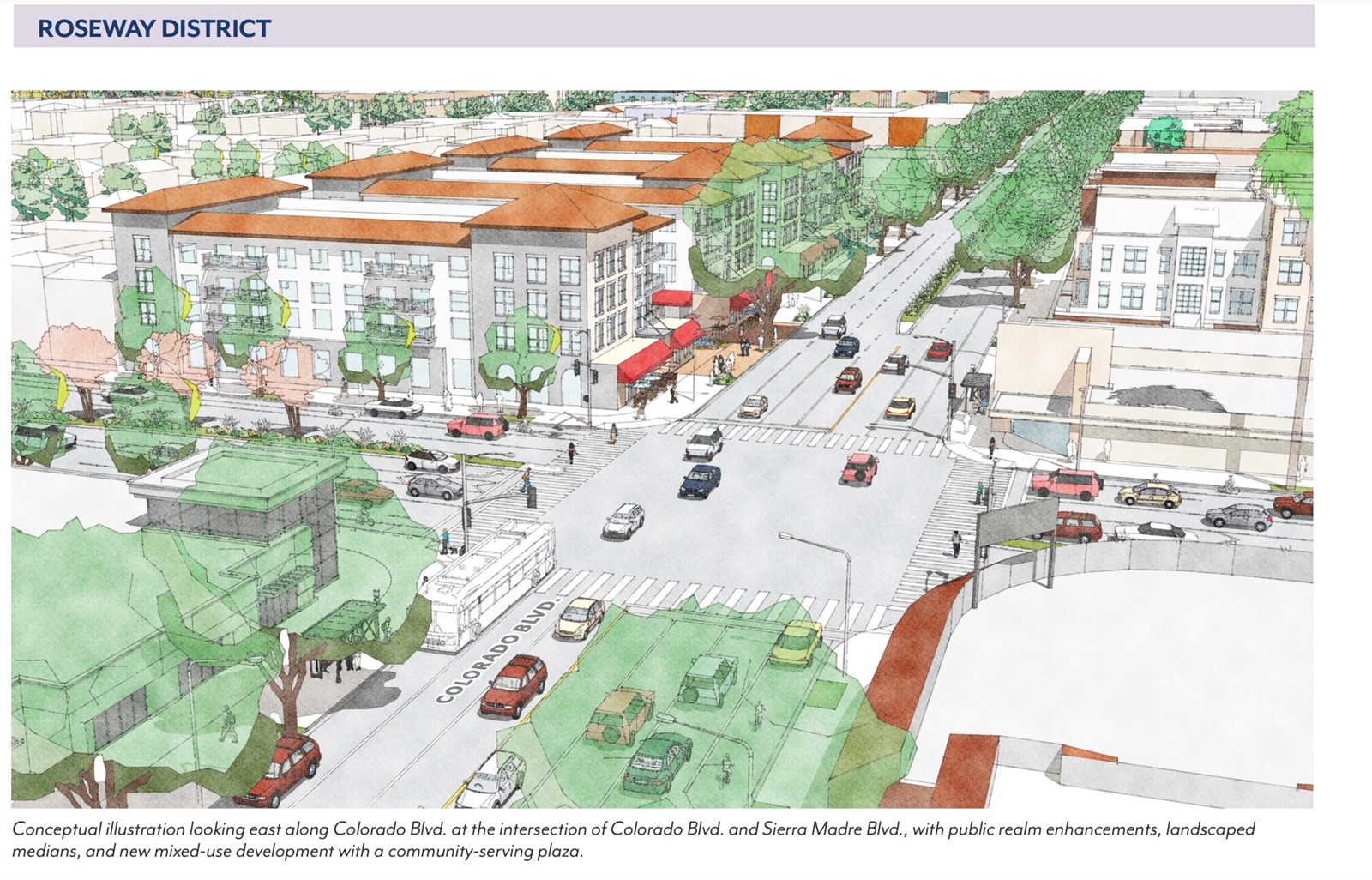


Residents in southeastern Pasadena can expect more protections for existing street trees, new pedestrian-friendly walkways and crosswalks, and the potential for a new linear park under a neighborhood blueprint approved by the Pasadena City Council.
The Lamanda Park Specific Plan, unanimously adopted Monday, outlines development goals for a 189-acre area bordered by the 210 Freeway to the north, Roosevelt and Vista avenues to the west, Colorado Boulevard to the south and Kinneloa Avenue to the east.
Councilmember Gene Masuda expressed gratitude to key city officials for their support in making the plan a reality. Although there was some debate early on about the need for another specific plan, it ultimately moved forward due to the persistent efforts of staff and its supporters, he said.
“Vince Bertoni, David Reyes, they stood with me; we had a lot of meetings, and it just kept moving, so I’m very grateful for that,” said Masuda, whose council district covers the area. “The reason why the Lamanda Park Specific Plan was important is because we have all those motels, and it’s kind of an area that needs a lot of improvements.”
The specific plan is the only new one developed as part of the city’s “Our Pasadena — Putting the Plan in Motion” outreach program. Launched in 2018, the initiative aims to implement Pasadena’s general plan by updating seven specific plan areas and creating the Lamanda plan.
Lamanda Park, an independent town before its annexation by Pasadena in 1920, has long served as an employment hub, particularly in research, technology and warehousing. It has a diverse mix of commercial and industrial uses that reflect its historical roots.
Over time, Lamanda Park has also evolved into a hub for technology-focused businesses, providing incubator spaces for start-up companies that contribute to the region’s life science sector.
The area will also soon welcome Pasadena Rusnak Porsche, a two-story, nearly 60,000-square-foot auto dealership OK’d by the City Council in July. The project is expected to bring a much-needed economic boost to this historically underplanned part of Pasadena.
“Lamada Park is a very important economic hub for the city of Pasadena,” said Principal Planner Anita Cerna, who presented the project at the meeting. “There’s over 750 businesses; many of them have been with the city for more than 20 years. So the vision is to continue this area as a hub for research and development, light industrial and creative businesses, supported by flexible spaces and diverse housing opportunities.”
The plan says it is building on this vision by establishing goals, policies and standards aligned with the general plan. It incorporates input from community members, the Planning Commission, the Design Commission and the City Council, officials said.
Some community members suggested adding more amenities like restaurants, retail shops and possibly a park.
Several residents raised concerns about the lack of pedestrian access to the Home Depot entrance. In response, the plan now requires new developments on lots that face both Foothill Boulevard and Walnut Street to provide pedestrian access from both streets.
The idea of creating a park within the plan boundaries also received significant support from the community. In response, the plan now includes goals to look into potential sites, including a possible linear park — a narrow stretch of space — along the former railroad right of way on Walnut Street.
The Planning Commission, which reviewed the specific plan and recommended the City Council’s approval in August, has suggested the city allocate $50,000 to fund projects during the plan’s first year to help kick-start its implementation.
This marks the first time the Planning Commission has included such an initiative as an implementation action item. This was in response to community concerns about the lengthy process of turning specific plans into visible action, said Director of Planning & Community Development Jennifer Paige.
“We’re hearing a lot from the community that we have these great plans and they don’t see a lot of change,” she said. “And it’s really dependent on private development because we know that the public dollars are limited.”
Councilmember Tyron Hampton echoed community frustrations about the slow pace of changes following the adoption of specific plans.
He noted that while residents might expect transformations within 10 to 15 years, the reality is that progress often takes 30 to 40 years, largely because it depends on private development.
“And I think that needs to be explained upfront, even when presenting these to the community as we’re doing specific plan updates,” he said.
Hampton said he believes it’s important for the city to take a more active role in investing in areas like Lamanda Park, especially given that it’s home to more than 700 long-standing businesses.
“We have to invest in their community. We have to invest in their business space for them to make the investments that we want to see moving forward so that we can see these plans actually turn into something fruition,” Hampton said.
Councilmember Felicia Williams proposed using Route 66 anniversary federal funds and county storefront rehabilitation grants to support improvements in Lamanda Park while capitalizing on private investments.
“A lot of these specific plans don’t get implemented, but we have a new Rusnak Porsche going in there that’s just going to dramatically change this area,” she said. “So this is really a good timing for us to kind of ride that wave of their investment and then put city investment in.”
Mayor Victor Gordo said all specific plans are now part of the city’s capital improvement budget, but they include unfunded projects.
He suggested exploring available funding sources and advocating for state support to implement these plans.
“And I think what this plan does is put in place deliberate planning so that when people do invest, they’ll have a guideline of what we would like to see as a community in that part of our city,” the mayor said. “And that’s the victory here.”
 PREVIOUS ARTICLE
