


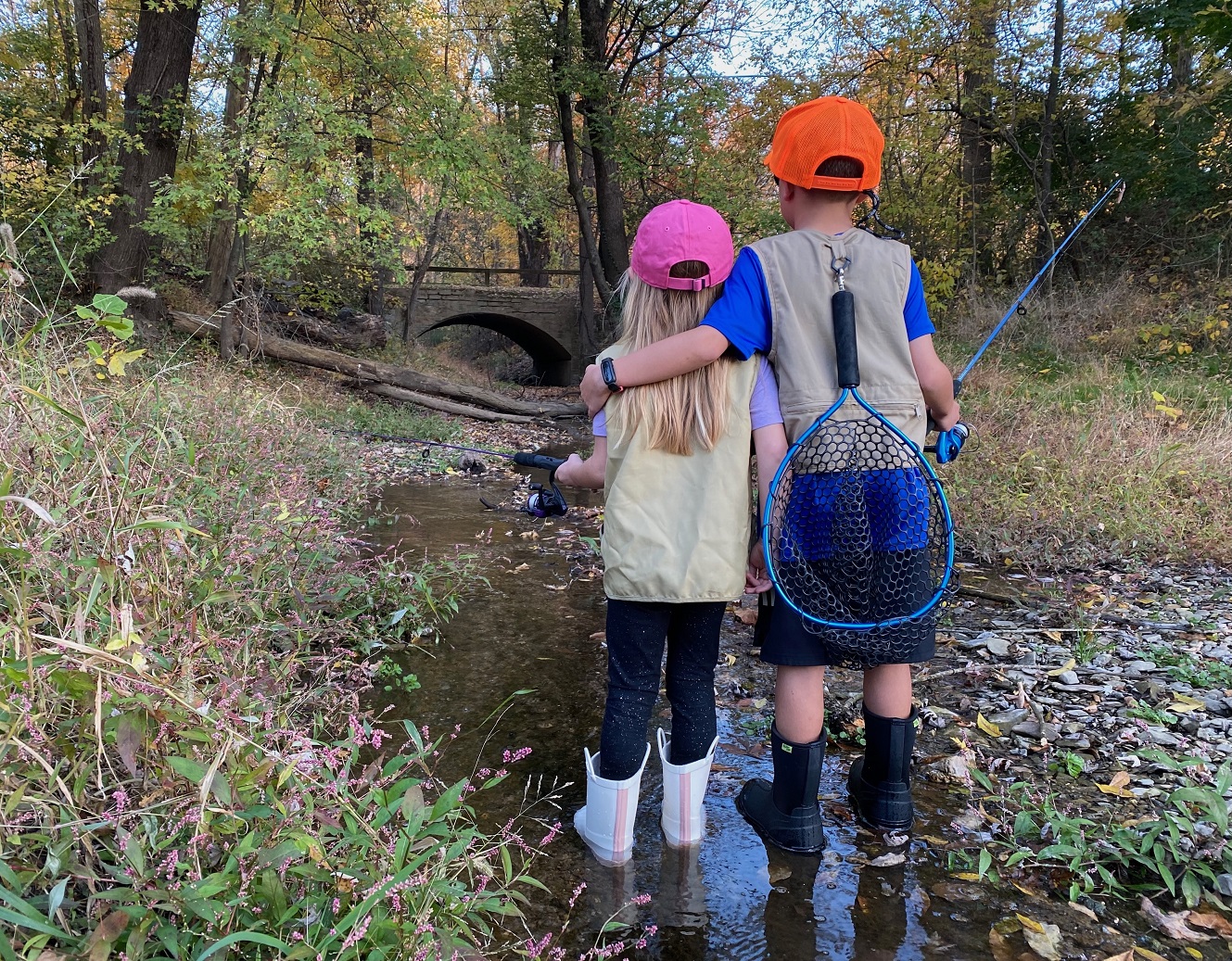


Family lineages, like water, trickle downward from their origins, meandering and merging with others at the confluence of lives and landforms. As if tracing blue lines on a map, these tumbling streams chart their own paths, but eventually combine to form a new flow — one that garners vitality through time from multiple sources.
This analogy took on special significance when my wife gifted me an online genealogy membership for my 40th birthday to investigate my ancestral history. Growing up in Pine Grove, I had long known that my great-great-grandfather, John Alfred Frantz, had roots in Lebanon County before he moved north to start a family farm within a few miles of my eventual childhood home.
Since I attended Lebanon Valley College as an undergrad and ultimately took a teaching job in Palmyra; it intrigued me to discover John Alfred’s name on old United States census records close to my current home and workplace. Documents show that at age 17, John Alfred had apprenticed as a farm laborer at the long-running Yordy farm, just off Route 934 north of Annville.
With this road being the most direct route home from college, I often passed the farm when heading to and from my parents’ place, and I still drive past it regularly. It was even more fascinating to learn that his wife Agnes Bagenstose Frantz’s grandparents (my 4x great-grandparents) are buried along that same route, where I now turn toward my own home just a few miles to the southwest.
With a little more research, I found another lead to some Frantz headstones at the historical Bindnagle Church along Gravel Hill Road a short distance west of my home. A quick trip to the cemetery revealed Daniel and Christianna Frantz’s grave sites, and thanks to some well-documented census records, I noticed Daniel Frantz and John Alfred’s parents (John and Annie Heft Frantz) appeared on the same page of the 1850 census, meaning they were likely neighbors somewhere in Londonderry Township.
Most genealogy records hit a dead-end with John, as he died young in 1854, a year after his son John Alfred was born. There are no mentions of his burial site or even a death certificate.
Nonetheless, it was fascinating, and honestly quite exhilarating, for the puzzle pieces to come together — especially since there was a high likelihood that my great-great grandfather originated close to where I’m raising my own children. Considering I live in North Londonderry Township, which didn’t exist yet in the mid-1800s, and noting the obvious proximity of John Alfred’s neighbors, workplace, and buried kin, it was evident that he must’ve resided somewhere nearby.
Maybe we even fished in the same streams or hunted the same woodlots. This mystery lingered for a few days, as I pondered how fulfilling it would be to pinpoint the exact location of the original Frantz homestead.
It also made me wonder what the landscape might have looked like in the late 1850s when John Alfred was a child. I began a rudimentary internet search of Londonderry Township in the 1800s, and by a stroke of good fortune, eventually stumbled across a hand-drawn map of township residences in 1860.
The historical map remains preserved in the Library of Congress, but a quality photo was uploaded that made it possible to view property owner names, along with roads, waterways and boundary lines. Enlarging the map, I instinctively began tracing tributaries back from the Swatara Creek, which was relatively easy to find next to the Bindnagle Church Cemetery.
This was a familiar process, as one summer earlier, I had completed an exercise for an Aquatics Resources graduate course that involved mapping the watershed run-off from my yard to the nearest navigable waterway. Naturally, I followed the incoming flow, which passed the graveyard, up the curling hollow, across the paved road and toward the basin that forms at the corner of my backyard.
With sheer amazement, my eyes stopped in disbelief at a small dot marked “Widow Frantz,” recorded six years after my 3x great-grandfather John’s death. His son John Alfred would’ve been seven years old at the time, and his mom remarried soon after.
Remarkably, that same property is located within sight of my front porch — just 300 yards from the home I unsuspectingly purchased just over a decade ago. Daniel, who by birth date likely could’ve been John Alfred’s grandfather, lived even closer — a few paces from my driveway.
Our three properties form a sloping triangle of sorts, and all the surface water from our yards drains downward into the exact same stream. By amazing coincidence, our families — separated by nearly two hundred years — worked the soil, grew vegetables, and raised children on the very same landscape.
Last fall, I took my son and daughter fishing in the Swatara Creek. After stopping by the church cemetery to whisper a humble word of thanks to kindred spirits, we walked with rods across an old arch bridge and down the steep bank to the water’s edge.
As the kids waded through the mouth of the small, murmuring tributary from which our ancestral lines flow, multiple generations of our lineage converged together once more. It’s hard not to wonder if those familiar waters, in some strange way, called us home.
Frantz is a past president of the Pennsylvania Outdoor Writers Association. Contact the writer: outdoors@republicanherald.com
 PREVIOUS ARTICLE

