


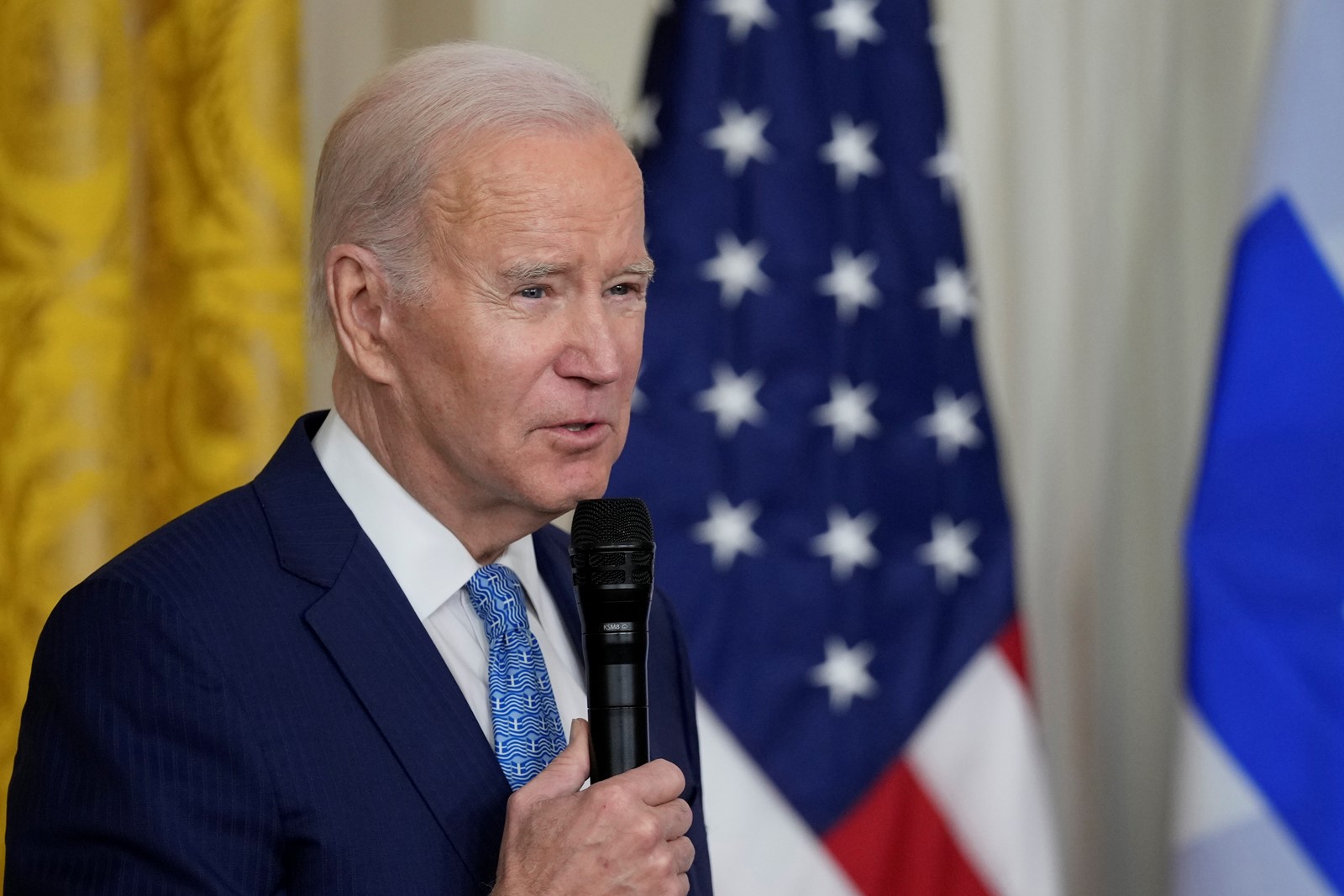


President Joe Biden on Thursday called on financial regulators to toughen oversight of medium-size banks that face reduced scrutiny in the wake of a regulatory rollback implemented during the Trump administration, his most aggressive response yet to the failure of two banks in March that rattled the nation’s financial system.
Biden’s proposals would not require any action from Congress and could be accomplished by regulators, administration officials said. They include steps to require banks to protect themselves against potential losses and maintain enough access to cash to carry them through a crisis.
The proposals would also subject more banks to annual stress tests conducted by regulators to ensure that they could survive events like the Federal Reserve rapidly raising interest rates — a catalyst in the failure of Silicon Valley Bank this month. They would broadly increase regulation on banks with $100 billion to $250 billion in assets, like Silicon Valley Bank.
Many of those measures could have helped regulators in the administration and at the Federal Reserve spot — and act to head off — problems earlier at Silicon Valley Bank, which saw losses mount quickly on its balance sheet as interest rates rose over the past year. The bank was heavily invested in government bonds, and when rates went up, the value of those bonds fell, eventually spurring the largest depositor flight in American history.
Biden also called on regulators, including the Federal Reserve, to increase supervision of banks with $100 billion to $250 billion in assets.
Last quarter’s economic growth revised downward
The U.S. economy maintained its resilience from October through December despite rising interest rates, growing at a 2.6% annual pace, the government said Thursday in a slight downgrade from its previous estimate. But consumer spending, which drives most of the economy’s growth, was revised sharply down.
The government had previously estimated that the economy expanded at a 2.7% annual rate last quarter.
The rise in the gross domestic product — the economy’s total output of goods and services — for the October-December quarter was down from the 3.2% growth rate from July through September. For all of 2022, the U.S. economy expanded 2.1%, down significantly from a robust 5.9% in 2021.
Consumer spending rose at a 1% annual rate last quarter, downgraded from a 1.4% increase in the government’s previous estimate. It was the weakest quarterly gain in consumer spending since COVID-19 slammed the economy in the spring of 2020. Spending on physical goods, like appliances and furniture, which had initially surged as the economy rebounded from the pandemic recession, fell for a fourth straight quarter.
Government to start looking for bias in small business lending
Banks will need to start reporting the demographics and income of small business loan applicants under new rules published by the Consumer Financial Protection Bureau on Thursday.
It’s a move that policymakers hope will lead to less discrimination and more transparency in the small business lending market, similar to how other laws have regulated the residential mortgage market for decades.
Under the Dodd-Frank Act, Congress mandated the bureau to start collecting data on small business lending decisions to look for patterns of discrimination. Implementation of the rule has taken more than a decade, and the bureau was sued by the California Reinvestment Coalition for its failure to start collecting this data.
Bank regulators have for decades collected data on residential mortgage applicants — including race, geography, whether the loan was approved and the interest rate — under a 1970s era law known as the Home Mortgage Disclosure Act. The data collected under HMDA has long been used by regulators and the public to look for potential signs of banks discriminating against borrowers, also known as redlining.
The size of the small business lending market is roughly $1.4 trillion, according to the CFPB.
Compiled from New York Times and Associated Press reports.
 PREVIOUS ARTICLE
