


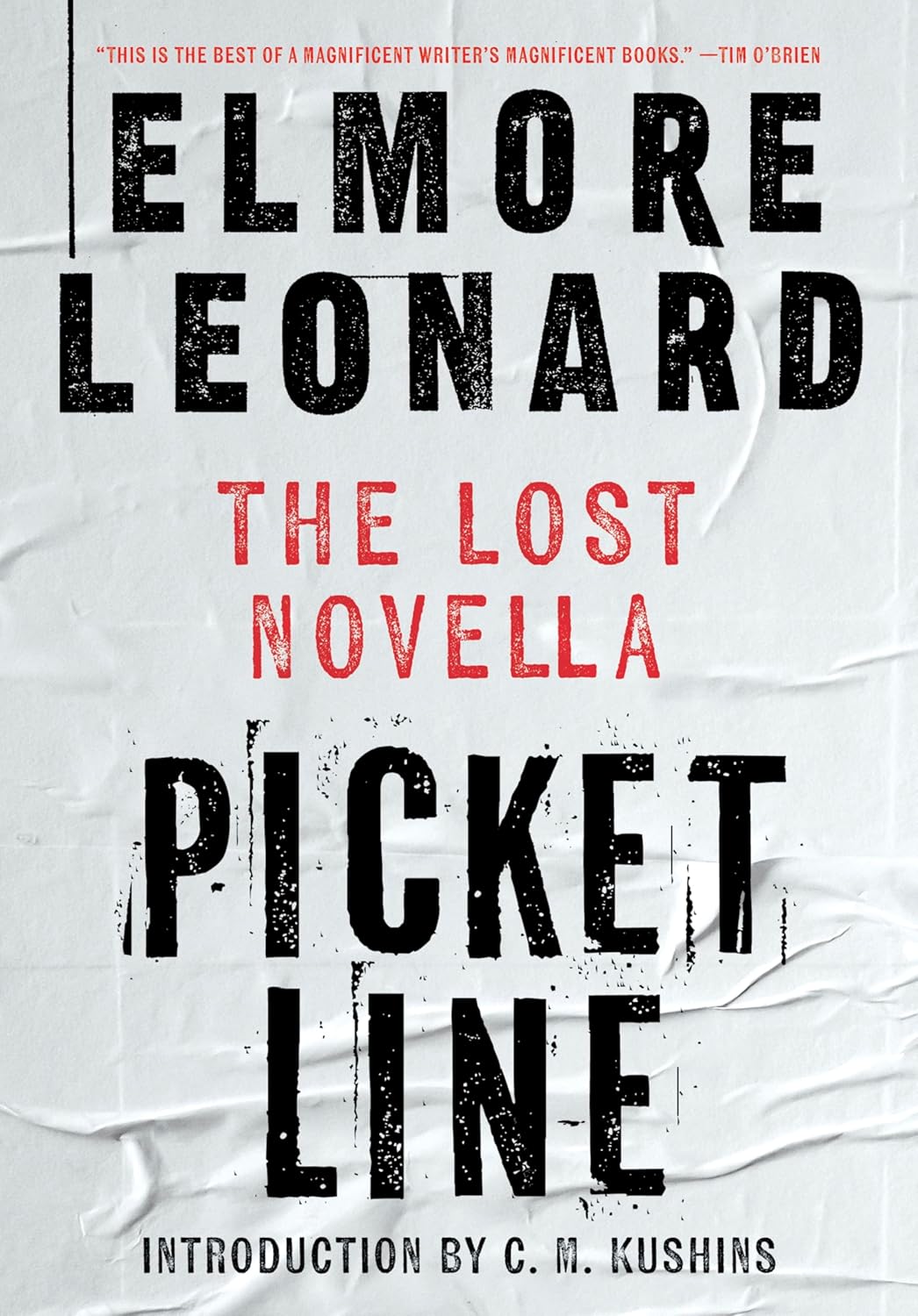


Elmore Leonard was already a successful novelist and screenwriter when the film producer Howard Jaffe approached Leonard’s agent with an idea for a movie about a heroic fruit picker. It was 1970, and Jaffe wanted a screenplay centered on someone like Cesar Chavez, the Catholic, Mexican American activist who led campaigns to unionize farmworkers in California’s Central Valley.
In response, Leonard researched farming, trade unions and the biographies of religious firebrands. He wrote one draft after another, trying in vain to align his vision with Jaffe’s. To better convey his ideas, he put together a prose “typescript” that eventually became a novella — only to learn that the producer had dropped the project.
Leonard was able to repurpose some of his research into the screenplay for the Charles Bronson vehicle “Mr. Majestyk,” a 1974 crime thriller about a shotgun-toting melon grower. But the novella, titled “Picket Line,” stayed on the shelf. Now, a dozen years after the author’s death, we can finally read this early work for ourselves.
Like all of Leonard’s books, “Picket Line” is a taut and engaging tale. Crime dramas made Leonard famous, but this is a social-justice story. Two Chicano men, Chino and Paco, drive across a barren Texas landscape in the 1970s. They reach the farmland of the Rio Grande Valley, where they enter a world of racism, exploitation and movement activism. Leonard renders their adventures and their thoughts in spare, elegant, Hemingway-inspired prose.
Chino and Paco quickly pass the narrative baton to other strong-willed characters, including an Anglo policeman, a university-educated Latina union organizer and a Black man from Detroit who joins a crew of scab pickers. In this way, “Picket Line” builds a convincing portrait of the spirit of a lost, idealistic age.
A melon field becomes the principal stage as the striking workers demand better pay, led by the charismatic organizer Vincent Mora. Everyone who sees the strike is transformed by it. As Mora puts it: “Once a man walks out of the field and joins a picket line, he’s never the same again.”
The novella gains momentum as it flows from one briefly sketched and absorbing scene to the next. The short chapters feel like narrative descriptions of film storyboards — which is precisely what they were meant to be.
As the journalist C.M. Kushins explains in an enlightening introduction, Leonard wrote “Picket Line” to win Jaffe over with his own imagery and characterization for their “fruit picker” movie. The novella is really a film rendered in prose. It has the cinematic mastery of scene and dialogue that characterized Leonard’s later works, including “Get Shorty” and “Rum Punch,” novels that transformed him into a best-selling author whose works Hollywood loved to adapt.
“Picket Line” disappoints, however, when the story reaches its final chapters. From its very first pages, the novella suggests that the picker Chino is headed for a face-off with the union leader Mora.
When that encounter happens, Leonard falls back on the hard-boiled, crime-novel dialogue that would serve him well later in his career.
In “Picket Line,” however, the attempt to give the story a gritty twist falls flat — and feels false to the real-life Latino history that inspired the tale.
Maybe that’s why Leonard kept “Picket Line” shelved for so long.
Or perhaps it was cursed: Leonard retrieved the manuscript in the early 2000s when he was asked to contribute to a new online magazine, but the venture went under just before the novella was to be published. (It was an odd partnership; at that point, Leonard didn’t even own a computer.)
In Kushins’s recounting of the book’s journey to publication, Leonard’s many fans will get a rare glimpse into the crazy orbit of literary agents, movie producers and Hollywood stars that surrounded him. And in the novella itself they will no doubt enjoy witnessing the prose voice of the master storyteller resurrected.
 PREVIOUS ARTICLE
