


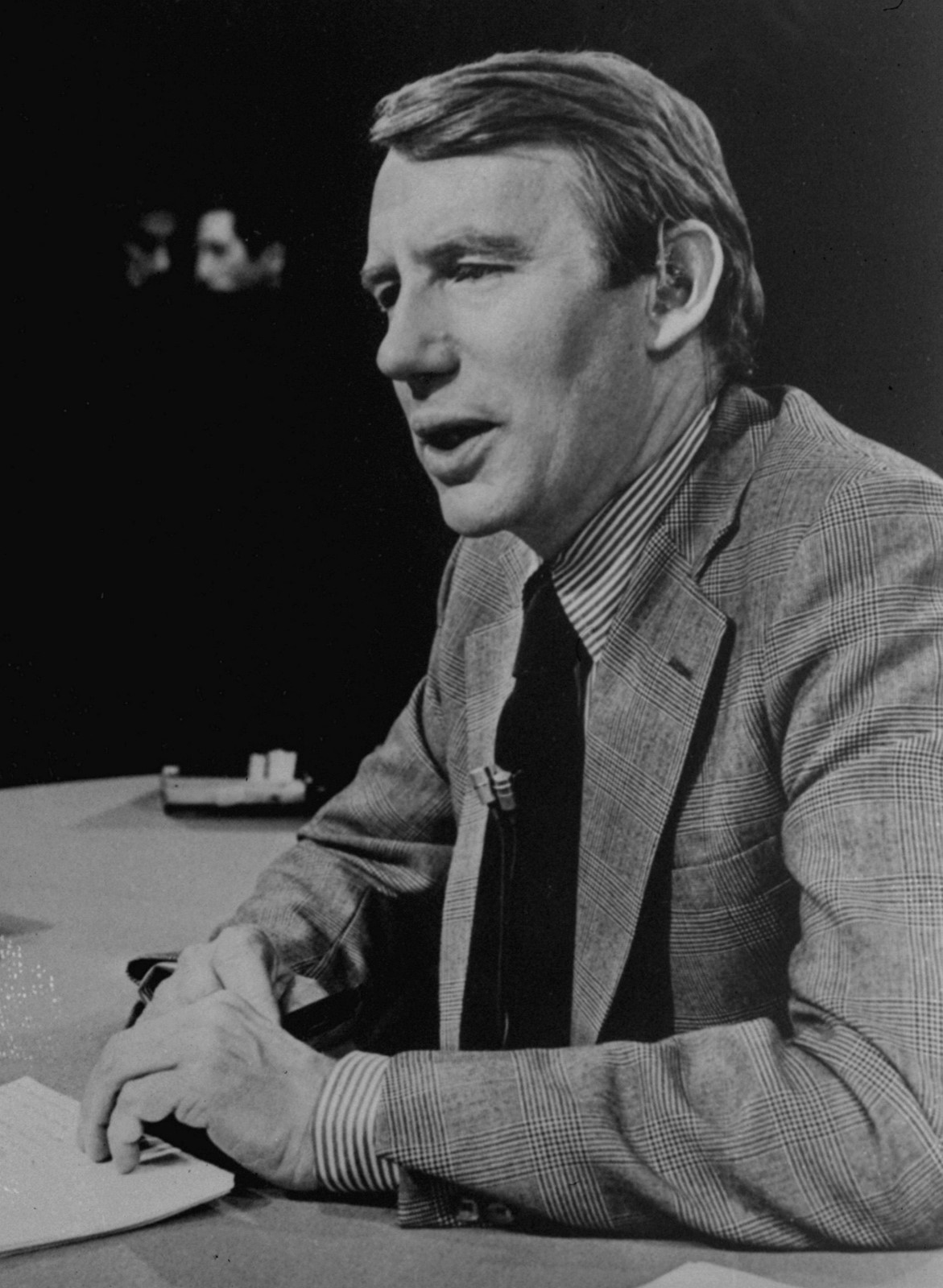


NEW YORK>> Robert MacNeil, who created the even-handed, no-frills PBS newscast “The MacNeil-Lehrer NewsHour” in the 1970s and anchored the show with his late partner, Jim Lehrer, for two decades, died Friday. He was 93.
He died of natural causes at New York-Presbyterian Hospital, according to his daughter, Alison.
MacNeil first gained prominence for his coverage of the Senate Watergate hearings for the Public Broadcasting Service and began his half-hour “Robert MacNeil Report” on PBS in 1975 with his friend Lehrer as Washington correspondent.
The broadcast became the “MacNeil-Lehrer Report” and then, in 1983, was expanded to an hour and renamed the “MacNeil-Lehrer NewsHour.” The nation’s first one-hour evening news broadcast, it remains on the air today with Geoff Bennett and Amna Nawaz as anchors.
It was MacNeil’s and Lehrer’s disenchantment with the style and content of rival news programs on ABC, CBS and NBC that led to the program’s creation. “We don’t need to SELL the news,” MacNeil told the Chicago Tribune in 1983. “The networks hype the news to make it seem vital, important. What’s missing (in 22 minutes) is context, sometimes balance, and a consideration of questions that are raised by certain events.”
MacNeil left anchoring duties at “NewsHour” after two decades in 1995 to write full time. Lehrer took over the newscast alone, and he remained there until 2009. Lehrer died in 2020.
When MacNeil visited the show in October 2005 to commemorate its 30th anniversary, he reminisced about how their newscast started in the days before cable television.
“It was a way to do something that seemed to be needed journalistically, and yet was different from what the commercial network news (programs) were doing,” he said.
MacNeil wrote several books, including two memoirs, “The Right Place at the Right Time” and the bestseller “Wordstruck,” and the novels “Burden of Desire” and “The Voyage.”
He also created the Emmy-winning 1986 series “The Story of English.”
In 2007, he served as host of “America at a Crossroads,” a six-night PBS package exploring challenges confronting the United States in a post-9/11 world.
Six years before the 9/11 attacks, discussing sensationalism and frivolity in the news business, he had said: “If something really serious did happen to the nation — a stock market crash like 1929, ... the equivalent of a Pearl Harbor — wouldn’t the news get very serious again? Wouldn’t people run from ‘Hard Copy’ and titillation?”
“Of course you would. You’d have to know what was going on.”
That was the case — for a while.
Born in Montreal in 1931, MacNeil was raised in Halifax, Nova Scotia, and graduated from Carleton University in Ottawa in 1955 before moving to London, where he began his journalism career with Reuters. He switched to TV news in 1960, taking a job with NBC in London as a foreign correspondent.
In 1963, MacNeil was transferred to NBC’s Washington bureau, where he reported on civil rights and the White House. He was on his first presidential trip on Nov. 22 when President John F. Kennedy was assassinated in Dallas. While his work covering the killing was overshadowed by that of his NBC News colleagues, he may have had his own brush with the drama of that day.
After the shots were fired in Dealey Plaza, MacNeil made his way to the nearest building, the Texas School Book Depository the building from which the fatal shots had been fired. There, he asked a man who was leaving and another in the lobby where the nearest telephone was. Kennedy’s accused assassin, Lee Harvey Oswald, later told Dallas police that he had encountered a Secret Service agent at the building. Historian William Manchester later concluded in his 1967 book, “The Death of a President,” that the man in the suit, crew cut and press badge was, in fact, MacNeil.
In his autobiography, “The Right Place at the Right Time,” MacNeil wrote that “it was possible, but I had no way of confirming that either of the young men I had spoken to was Oswald.”
He spent most of 1964 following the presidential campaign between Kennedy’s successor, Lyndon Johnson, and Republican Barry Goldwater.
MacNeil returned to London in 1967 as a reporter for the British Broadcasting Corp.’s “Panorama” series.
In 1971, MacNeil left the BBC to become a senior correspondent for PBS, where he teamed up with Lehrer to anchor public television’s Emmy-winning coverage of the Senate Watergate hearings in 1973.
The New York Times contributed to this story.
 PREVIOUS ARTICLE
