




By Liam Rue
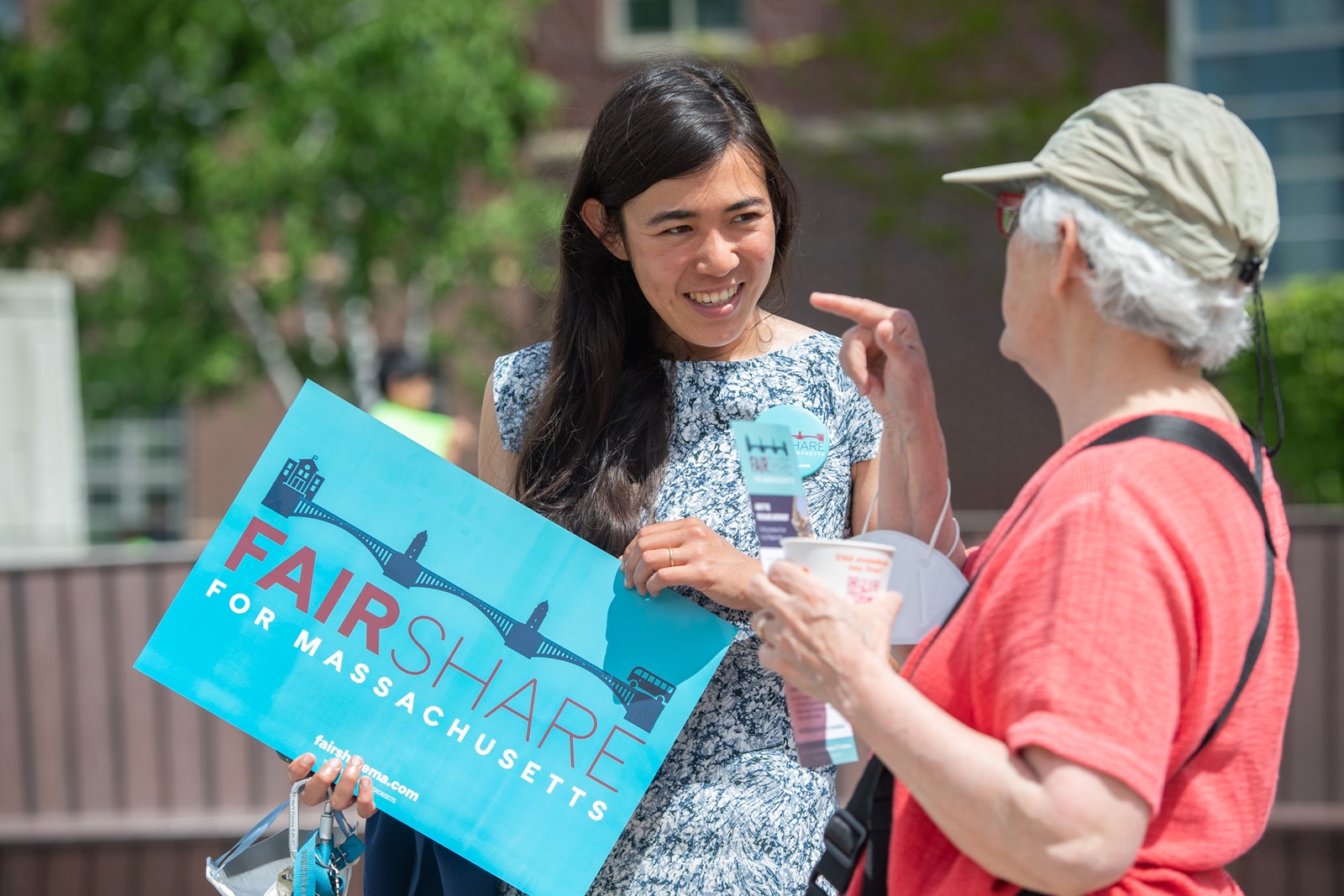
What if I told you that free school lunch at all public schools, free community college, and massive improvements to public transportation across Massachusetts were all made possible by just one tax? That Tax has a name, and it’s called the Fair Share Amendment (a.k.a. the Millionaire’s Tax).
With so many improvements originating from this amendment, it begs the question: what does this bill teach us about how to win real political changes that improve millions of lives?
First, here is a bit of background: the Fair Share Amendment is an amendment that Massachusetts passed in 2022 which taxes 4 percent of all millionaires’ money in excess of $1 million.
The results speak for themselves: we now have ample evidence that we can, in fact, improve millions of lives just by taxing the rich a tiny 4% of their wealth. Contrary to opponents’ fear-mongering that the tax would hurt businesses and force millionaires to flee the state en masse, there is no evidence of this either. In fact, the bill just raised $2.2 billion in 2024; so much that it has helped all UMass colleges become tuition-free for families making under $75,000 a year.
But what has the Fair Share Amendment taught us about how to win a better world? This is even more inspiring than any of the massive material benefits the tax has brought Massachusetts. The story behind how this tax passed shows us how much is possible when we know exactly what we are fighting for and how to win it.
When in 2011 advocates conceived of the tax as a solution to both unfair tax policy and to underinvestment in education and transportation, they did not know it would take 10 years to pass.
Nevertheless, these organizers planned for the long haul, brought people together around a common goal, and stayed focused on how to achieve it, says Henry Morgan, executive director of the Public Higher Education Network of Massachusetts (PHENOM). “We built a large enough coalition and persisted through the challenges to achieve our common goal,” said Morgan, who organized as part of the campaign to help pass the amendment.
As Morgan notes, the art of coalition building is key to any progress. Rather than be picky, the organizers behind the Fair Share Amendment saw the importance of bringing in as many groups as possible as long as they shared the goal of taxing the rich. Sure enough, year after year, the momentum only grew as teachers’ unions, progressives, transportation groups, education groups, socialists, and everyday citizens saw its potential and did their part.
Essential tactics to win hearts and minds include writing op-eds like this one (America as we know it wouldn’t exist without them), signing petitions, organizing rallies and teach-ins, tabling, writing to your legislators, speaking up at city hall meetings, and knocking on doors.
The fight for the Fair Share Amendment also demonstrated the importance of focusing on winning over a few dedicated individuals when starting out. Any mass movement for change starts with the leadership and vision of a few passionate people bold enough to fight for something no one else cares about.
When we make a compelling case for change, have a focused goal, and get as many people as possible to join our side, victory is only a matter of time.
When Martin Luther King became the champion of the Montgomery Bus Boycott in 1956, he had no idea the Civil Rights Act would pass eight years later. But he and his allies knew something like it would soon become a reality as long as they stayed the course.
Liam Rue is a senior at the University of Massachusetts Amherst senior and is a volunteer for the nonprofit Public Higher Education Network of Massachusetts (PHENOM).
 PREVIOUS ARTICLE
