


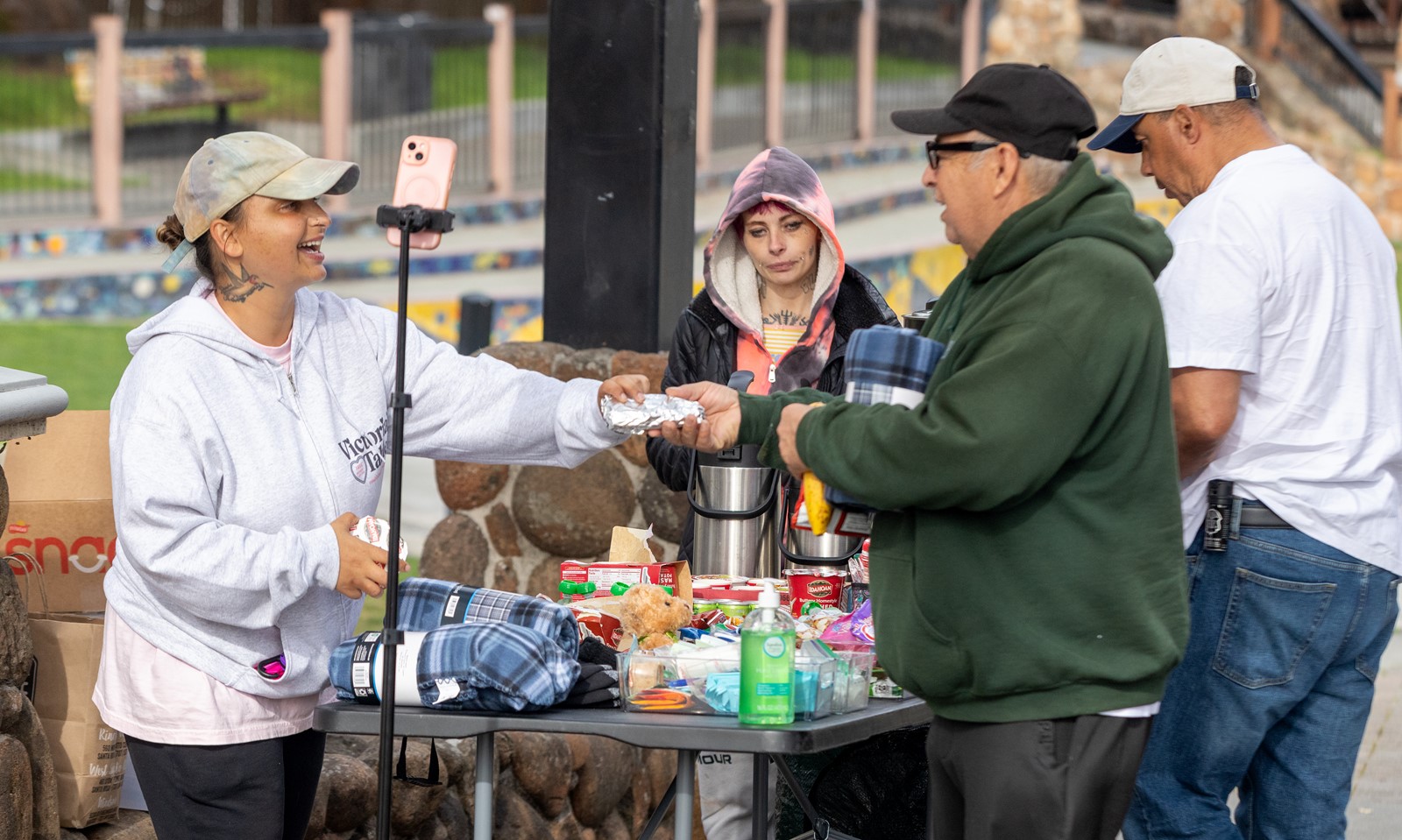


Victoria Anastasia busily arranged granola bars, juice boxes, woolen caps and bottled water across an eight-foot folding table she had set up at Prince Gateway Park, near the Prince Memorial Greenway in downtown Santa Rosa.
Between trips to her car for more bins of snacks, fruit and hand wipes, she greeted passersby and urged them to take what they needed.
“It’s free?” a middle-aged man on a mountain bike asked, slowing to a stop.
“Yes,” she said, smiling.
He picked up a banana. “This will really come in handy later.”
“Do you want to take another one?” she asked.
The scene has become a near-daily ritual at Victoria’s Table, the one-woman mobile giveaway that Anastasia, a longtime Petaluma resident, livestreams six days a week on TikTok to more than 32,000 followers from locations across Sonoma County, including Steamers Landing Park in Petaluma and the Santa Rosa Transit Mall.
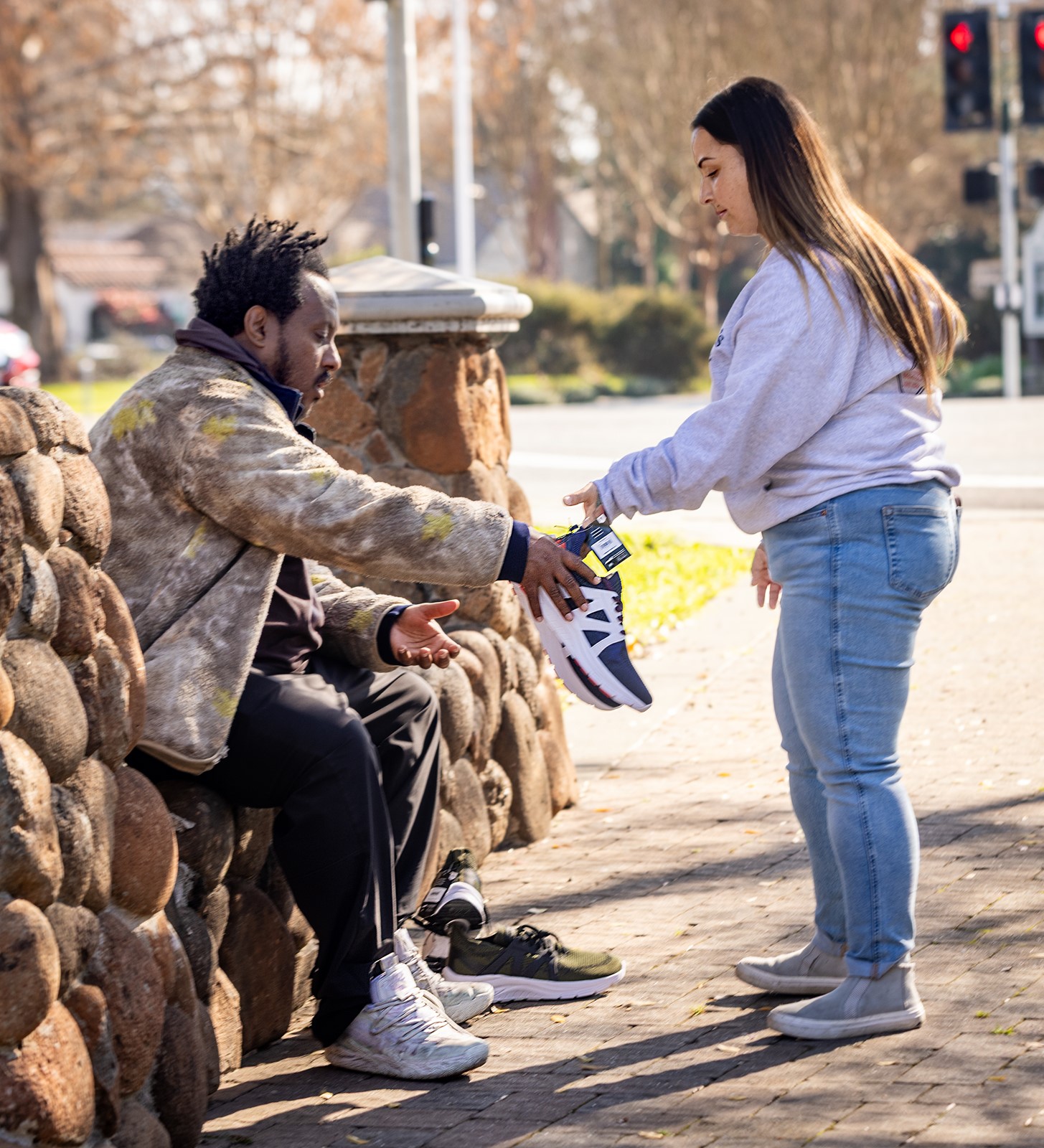
On a recent Friday, her livestream drew 1 million likes, a milestone she marked with a brief dance before returning to pour hot coffee and distribute new shoes and other supplies bought with donations from viewers.
Her approach reflects a broader phenomenon on TikTok and other platforms, where creators film acts of generosity, such as paying for strangers’ groceries, distributing cash or supplying tents and food, in videos that blend charity with performance. The clips can inspire viewers and generate donations, but they also build audiences and, in some cases, revenue streams.
Anastasia lives rent-free with her mother, who helps cover household expenses, allowing her to devote most of her time to Victoria’s Table. In addition to donations earmarked for supplies, some TikTok followers contribute specifically toward her car payment, gas and other bills that make the pop-ups possible, she said.
During livestreams, viewers can also purchase virtual “gifts” through TikTok; the platform shares a portion of that revenue with creators. Anastasia said she relies on a mix of those gifts and direct donations to sustain the project and her basic expenses.
A light-bulb moment
Anastasia, 33, was between waitressing jobs last November when she began searching for what she called a deeper sense of purpose.
“I was feeling like I was waking up just doing the same thing each day,” she said. “I was ready for something different.”
She started by posting motivational videos on TikTok from her home. But when a tripod she ordered for her smartphone arrived, her plans shifted.
“All of a sudden, this light bulb went off,” she said. “I can go in public, and I can actually make a difference.”
Taking $10 from her bank account, she bought a case of water and some chips and set up on a Petaluma street corner, livestreaming to a few hundred followers as she offered the items to anyone who passed by.
“Giving back has always made me feel good; my love language is gift-giving,” she said.
A viewer suggested she make a sign clarifying that the water was free. Another advised her to bring a table. Within weeks, Victoria’s Table had drawn tens of thousands of followers, many of whom began sending money or purchasing items from an online wish list to stock the next giveaway.
Anastasia now livestreams her trips to local grocery stores, allowing followers to recommend what to buy. She films unboxing videos of donated food, clothing, sleeping bags and outdoor supplies.
“I feel overwhelmed by the amount of support,” she said. “I have the time and the drive, but they’re the ones who really carry the table.”
Domino effect
One of her most ardent supporters is her mother, Laura Anastasia, a retired special education teacher.
“It’s a good way for her to give back and express herself,” Laura said of her daughter.
Beyond the food and clothing, she said, her daughter offers what she calls “kitchen therapy” — conversation, encouragement, a listening ear.
“She’s always been a good talker, but this has given her a lot of confidence,” Laura said.
Laura now joins her daughter three times a week, managing the phone during shopping livestreams and unboxing sessions.
Passersby sometimes contribute on the spot by dropping off sandwiches, breakfast burritos, or other items for the table.
Online supporters have helped finance larger gestures: purchasing a bicycle assembled by a Petaluma shop for one man; arranging for a local barber to braid the hair of someone celebrating 30 days of sobriety; and underwriting the giveaway of 150 Costco hot dogs and other goods at a Feb. 1 event honoring Shirley Raines, a Los Angeles social media creator and homeless advocate who died Jan. 27 at 58.
Though many who approach the table are homeless, Anastasia insists it is open to anyone.
“I’d say one in 20 people will get a lot of stuff,” she said. “But a lot of the time, when people grab a lot, it’s because they’re sharing. And I always try to encourage them to take more; don’t be shy.”
If donations were to dry up, she said, she would continue in whatever form she could manage, offering conversation, encouragement, even free hugs.
“It’s more than a table,” she said. “It’s a stop and reminder to take care of yourself.”
‘A great ministry’
Regulars have begun to emerge. On a recent Friday, Robert Campbell, who has lived along the Joe Rodota Trail for years, stayed at the table for nearly half an hour, chatting with Anastasia and her mother while gathering food for the day.
He said he had walked past her several times before approaching a month ago.
“It’s a great ministry,” Campbell said. “I find myself looking forward to the days when she comes out here. It’s a highlight of the day.”
In three months of operating Victoria’s Table, Anastasia said, only once has a police officer asked her to move: when she set up beneath a Highway 101 overpass in Santa Rosa.
“He was really nice about it,” she said.
She now favors parks and open spaces, avoiding storefronts and sidewalks.
“I get asked if people bug me or ask me to leave,” she said. “Honestly, it’s the opposite; people are protective and looking out for me.”
Anastasia’s outreach is also drawing commendation from one of the region’s largest homeless service providers.
“It’s incredibly benevolent and generous and meaningful that somebody from the community is doing this,” said Jennielynn Holmes, chief executive of Santa Rosa-based Catholic Charities of Northwest California, in a phone call Wednesday, Feb. 18.
For people experiencing homelessness, Holmes said, what matters most is feeling seen by the broader community rather than pushed to its margins.
“Efforts like this are incredibly impactful,” Holmes said. “(They come) from a place of caring — spending personal time and entering into a conversation with people who normally get judged or shunned in many settings.”
Grassroots initiatives like Victoria’s Table, she added, can serve as vital entry points for people seeking to connect with the local social service network. Such efforts are becoming increasingly important, she said, amid what she described as a significant national assault on social services.
“That means locally, we all have to step up more,” she said. “Particularly as we look down the road to the impact of H.R. 1 (known as the “One Big Beautiful Bill Act”) and other policies being put in place that are going to create a whole new group of vulnerable people.”
Although Catholic Charities does not solicit donations through social media in the same way that Anastasia does, Holmes said the organization uses those platforms to raise awareness about its programs, including the Caritas Center services hub at 301 Sixth St. in Santa Rosa.
There, people experiencing homelessness can shower, do laundry, receive mail and meet with caseworkers at a weekday drop-in center. The center also provides nearly 200 shelter beds for families and operates a health clinic.
Holmes emphasized the organization’s fiduciary responsibility to ensure that funds are used for their intended purposes. Unlike individuals raising money independently, nonprofits are subject to state and national audits and oversight, a factor that may influence donors, she said.
Along with administrative overhead, nonprofit status offers donors assurance that their contributions are directed to the stated cause and can open doors to funding partnerships that may be unavailable to individuals.
Anastasia, for her part, said she is already seeking nonprofit status.
Her long-term goals include expanding to other cities, such as San Francisco, and helping others replicate the concept.
“I’d like to change the world one table at a time,” she said. “And there are people who have been inspired. I’ve seen little tables pop up here and there (on TikTok). The goal is to help as many people as I can.”

