


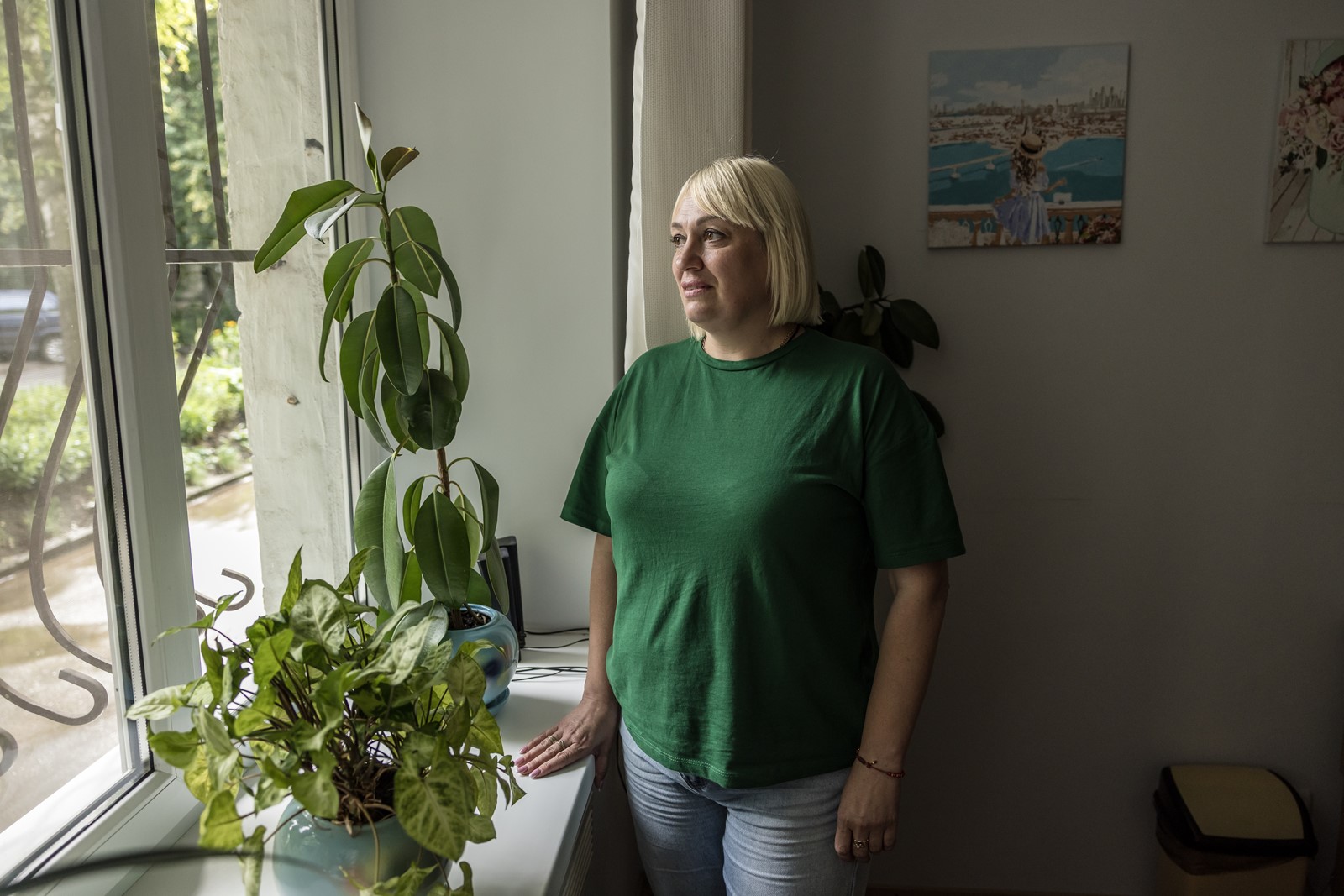


SUMY, Ukraine — Poor and pregnant, the woman moved into Room 4 of the shelter in early May with her 9-year-old son. She had escaped her abusive husband. But now, the Russians were coming.
For vulnerable women near the front lines like Nina Holubieva, the women’s shelter in Sumy, Ukraine, near the Russian border, has become a last resort, a refuge from abusive men that also takes in vulnerable poor mothers. Yet even as they flee violence at home, the women are desperate to escape the encroaching war outside. As the Russians started pushing into the Sumy region this spring, that became much harder.
“I wanted a family, I wanted something decent,” said Holubieva, 37, who on a recent Saturday wore a donated shirt proclaiming “Victoria’s Secret Angel” and a tangle of dark hair pulled back in a ponytail. “But this is how it turned out.”
Russian troops first crossed this border in January, part of their effort to drive Ukrainian troops out of the neighboring Kursk region of Russia. Now, Russian soldiers are about 13 miles from Sumy, a city of about 256,000, even as Ukrainian officials say troops have stalled their advance.
Explosions shake the windows and doors of the shelter, the Mother and Child Center, almost every day. A nearby building no longer has a wall; from the street, you can see a pink-tiled bathroom on the top floor and a cracked hallway mirror, reflecting the gray sky.
The closest bomb shelter is two doors away, so Holubieva and the other mothers here move into the hallway when things get really bad. Having a second wall for protection is better than nothing.
“In the evenings, the attacks begin, they’re shooting, missiles are intercepted overhead,” said Tetiana Beres, 42, the shelter’s director, who lives in Sumy with her husband and 14-year-old daughter. As she spoke, blast waves shook the walls.
“I think maybe I should leave,” she said. “Then again, I ask myself — where would I even go?”
‘Difficult to leave’
She added, “It’s terrifying to stay, and it’s also difficult to leave.”
The shelter caters to women who have been beaten by partners; it also takes in women who’ve been beaten down by life. Every region in Ukraine is supposed to have a government-funded shelter, but funding has dwindled since Russia launched its full-scale invasion in February 2022, Beres said.
Demand in Sumy for the shelter, which can hold only six women and their children before doubling up families in rooms, is always high. Since the invasion, the need has increased, especially in the last six months.
“My children are now scared even when they play games with shooting sounds,” said Alina Serdiuk, 30, who moved to the shelter with her two sons in late May. “They won’t play online games that involve weapons. If they hear a sound like ‘bang-bang,’ they get frightened. Even a car backfiring or a door slamming makes them jump.”
Domestic violence rates have increased in Ukraine, a likely result of both the stress of the war and a growing realization that such abuse is wrong, experts say. Domestic violence was criminalized in Ukraine in 2019; while certain cases could be prosecuted before then, the punishment was mainly fines and community service. In 2021, the year before the invasion, the Office of the Prosecutor General registered about 4,800 cases of domestic violence in Ukraine. In 2024, there were 8,900.
It was impossible to independently confirm the stories of the women staying in the Sumy shelter. Records are scarce; many of the potential crimes described by the women were never reported to police or investigated.
But Beres confirmed that Holubieva had talked about her previous abuse and that she had been forced to evacuate her town because of the Russians’ advance. A shelter intake form said she suffered from “difficult life circumstances,” including the threat of violence.
Another woman, Yuliia, 41, said she and her two daughters once lived with her husband and her father in a village about 7 miles from Sumy. She did not want her last name used in this article because she worried about possible retaliation.
Whenever she heard a drone buzz outside — which has happened more frequently in the past year — she shielded her children, ages 1 and 10, with pillows, she said. She stacked bags of clothing near the windows. She took down the glass chandelier.
None of that helped with her husband, she said.
Product of abuse
Yuliia said she was the product of generations of abuse, going back to her grandfather.
“I grew up with this violence, and now my daughters are growing up with it, too,” Yuliia said.
On April 6, she said, her husband was drunk at 9 a.m., and she poured an open beer on him. He started hitting her, she recalled. They screamed at each other, and then Yuliia’s father said she needed to be tied up, because she was out of control. She said the men tried to smother her with a pillow, as her children watched. Eventually, Yuliia escaped and called for help. She was taken to the hospital.
That day, the police brought her to the shelter, Beres said, adding that Yuliia had bruises on her neck and face. A shelter intake form said Yuliia was “a survivor of domestic violence” who needed help “addressing emotional trauma caused by abuse.” Her daughters were later brought to the shelter as well.
“My first impression was peace, that no one would hurt me here anymore,” Yuliia recalled. “That was the greatest thing — protection and normal living conditions for me and my children.”
A week later, the Russians sent two ballistic missiles into central Sumy, according to the Sumy City Council, killing 34 people, some of whom were friends of Yuliia, riding a bus on their way to church.
The shelter has little money. The women who come here are often poor, yet have to find and prepare their own food.
Holubieva, who is caring for her 9-year-old son and newborn, has few resources.
Her village of Bilopillia, which once had 15,600 residents but has largely emptied out, is about 6 miles from the Russian border. When Holubieva was 16, her parents died; she raised two siblings in a one-room apartment provided by the government. Holubieva, who left school after the ninth grade, married a man she met when she was 25. They had a son.
Eventually, she said, her husband started to abuse her and her child.
After the Russians invaded, everything got worse.
“My son is terrified of shelling,” Holubieva said.
She said the police helped her leave two years ago. The couple divorced, she said. She has no idea where her former husband is now.
H
 PREVIOUS ARTICLE
