


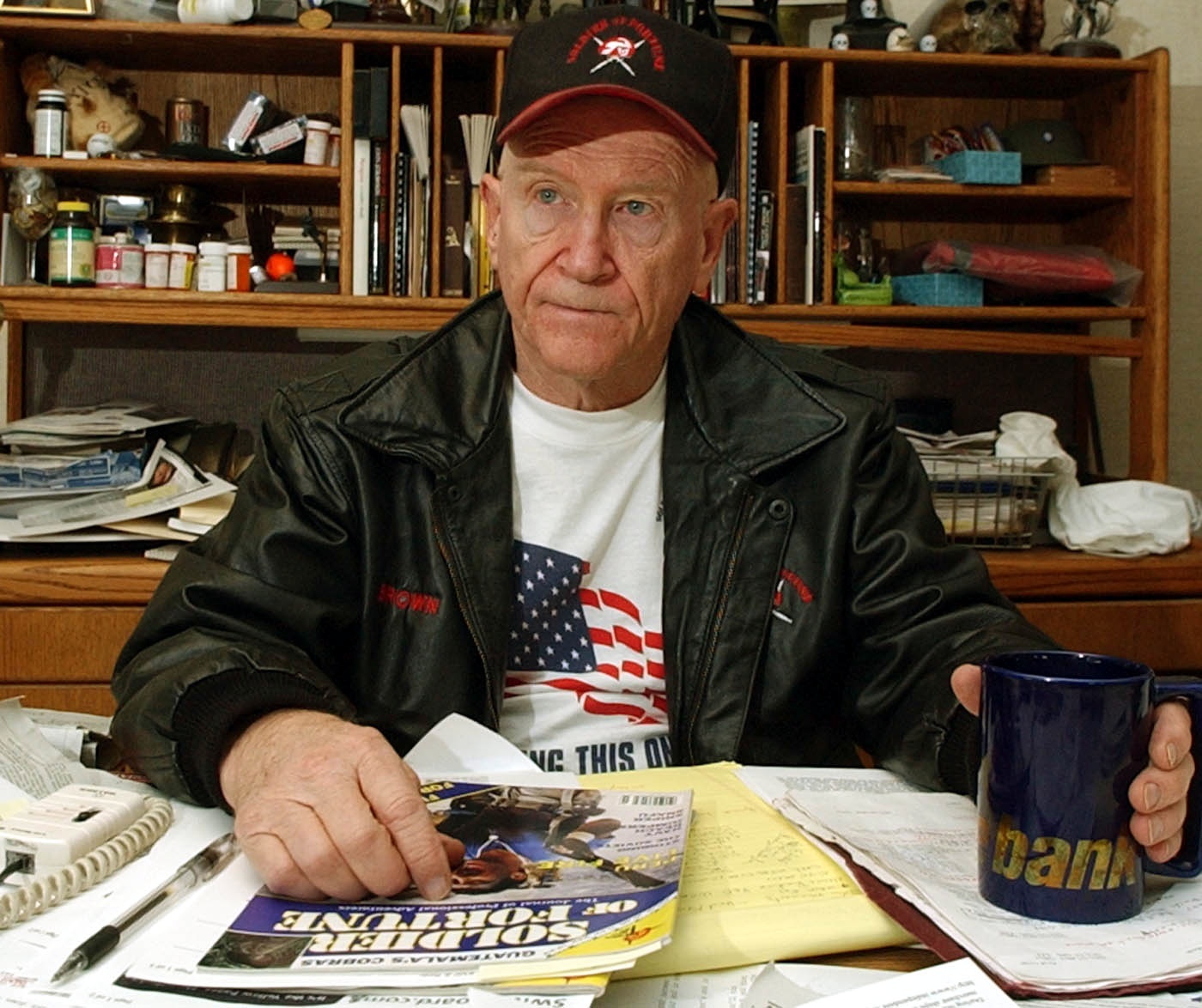


Robert K. Brown, a Special Forces officer in the Vietnam War who founded Soldier of Fortune magazine and for years attracted a following of combat veterans and professed mercenaries to fight leftists abroad with guns and gonzo journalism, died on Aug. 28. He was 93.
His death was announced by his wife, Marie Brake, through the magazine’s Facebook account on Nov. 2, which would have been his 94th birthday. No further details were provided.
An Army Green Beret who did clandestine work in Indochina and retired as a lieutenant colonel, Brown created Soldier of Fortune in Boulder in 1975 as a “journal of professional adventurers” that was “anti-Communist, pro-military and pro-police.” As editor and publisher, he filled the magazine’s pages with tales of fighters and battles, survivalist techniques and ads for guns, military equipment and mercenaries.
As readership climbed to a peak of 150,000 in the 1980s, Soldier of Fortune became a glossy, full-color monthly and a popular purveyor of gonzo military journalism — first-person protagonist accounts of firefights and mercenary exploits in international hot spots, with no pretense to objectivity, in the style of Hunter S. Thompson, the counterculture writer of the 1970s.
A 1985 cover featured a sweat-streaked Sylvester Stallone firing a submachine gun from that year’s film “Rambo: First Blood Part II.” The magazine reverberated in pop culture, its name used in movies, bestselling video games and a 37-episode television series that starred Brad Johnson for two seasons in 1997-99.
Brown, who became a board member of the National Rifle Association, generated outrage among critics with classified ads for veterans offering their services as bodyguards and guns-for-hire to “fight for freedom” in Afghanistan, Burma, El Salvador, Nicaragua and elsewhere, as well as for “private” work. Several lawsuits were brought by families of people killed by gunmen hired through the ads.
In the late 1970s and ’80s, Brown recruited — and often joined — dozens of freelance correspondents for what he called “participatory journalism” assignments. They carried guns and notebooks into conflicts in Africa, Asia, the Middle East and Latin America. Many assignments were billed as training and supply missions, but some clearly involved combat on the side of right-wing factions.
“If we were shot at, we shot back — we didn’t hide behind a log,” Brown told the Middle East magazine Bidoun in 2010. “I’ve had several of my reporters killed in the course of pursuing their vocation, working primarily as writers but also giving advice and training to these groups.”
At least four Soldier of Fortune recruits were killed in mercenary operations deployed under the rubric of humanitarian and journalistic missions.
Brown denied hiring mercenaries, but he made no secret of his own involvement, which was detailed in his memoir, “I Am Soldier of Fortune: Dancing with Devils” (2013, with Vann Spencer).
“For the past nearly four decades,” he wrote, “I’ve been humping a rifle and a camera around the world’s combat zones. I’ve hunted terrorists with the Rhodesian African Rifles and fired up a Russian fort in Afghanistan with the mujahideen. I’ve searched for POWs in Southeast Asia and survived a Sandinista rocket barrage alongside Nicaraguan Contras. In between firefights, takeovers and insurgencies, I’ve managed to put out a magazine.”
To his followers, Brown was an idealized combat veteran — a former Golden Gloves boxer with a master’s degree in political science, who by his own account had plunged into jungles and crossed deserts for the chance to engage the enemy. He posed for pictures with rattlesnakes and weapons, relished war stories and used language that could blister the paint off an outhouse.
“Regardless of his stinking politics,” Robert Miller, a lawyer in Boulder told The New York Times in 1980, “he is 100% honest. He has principles, and whether you think they are good or bad, he never betrays them.”
Brown was proud of his “humanitarian services,” most of which were impossible to verify. He received a medal from the government of Peru for leading a paramedic team to assist in the recovery efforts after an earthquake in 1970. Soldier of Fortune once offered a $10,000 reward for anyone who would assassinate Idi Amin, the brutal Ugandan dictator, a proposition Brown similarly counted as a humanitarian effort.
He called the Black government of South Africa incompetent, but he insisted he was not a racist, saying Soldier of Fortune had rejected ads from the Ku Klux Klan and the American Nazi Party. In time, as memories of the Vietnam War receded, the magazine devoted more attention to raising money and matériel for the Contra rebels fighting the leftist Sandinista government in Nicaragua.
The Reagan administration in the mid-1980s privately encouraged unofficial aid programs like one conducted by the Omega Group, the magazine’s parent company in Boulder (Brown was its president), and declined to take a position on the mercenary fighters of Soldier of Fortune. Lt. Col. Oliver North, a mastermind of Iran-Contra, the scheme in which arms were sold illegally to Iran to fund right-wing rebels in Nicaragua, wrote for the magazine.
In the 1980s and early ’90s, Soldier of Fortune fought several multimillion-dollar lawsuits brought by the families of people killed or wounded by hit men they said were hired through the magazine’s classified ads. Some lawsuits were settled, and in others large jury awards were overturned on appeal.
After the Cold War, Soldier of Fortune continued covering international conflicts, focusing on American heroes, conservative politics and new firearms technology.
But the lack of an overarching ideological enemy like communism took the edge off its reports, and its mercenaries gave way to private contractors hired by the government to protect American assets in foreign war zones.
Like many magazines, Soldier of Fortune lost readers and advertisers to the internet and in 2016 ceased publishing in print and converted to an online publication.
Robert Kenneth Brown was born in Monroe, Mich., on Nov. 2, 1932, the older of two sons of Florence B. Brown. The father of Robert and his brother, Alan, was a steelworker. Robert grew up in Highland, Mich., and graduated from George Rogers Clark High School in Whiting, Ind., in 1950. He attended Michigan State University for two years in the early ’50s, and transferred to the University of Colorado, where he earned a bachelor’s degree in history in 1954. He joined the Army that year, attained the rank of lieutenant in the clandestine Army counterintelligence service and mustered out in 1957.
He reenrolled at the University of Colorado and earned a master’s degree in political science in 1966. His master’s thesis, on Fidel Castro’s July 26 Movement, took him briefly to Cuba.
In 1960, Brown married Joan Gardner. They had a daughter, Janice, and were divorced in 1963. In 1995, he married Mary Jenkins and was divorced in 1999. He later married Brake.
In 1964, Brown rejoined the Army. He was assigned to Vietnam, qualified for Special Forces duty as a captain and was a team leader on the Vietnam-Cambodian border, gathering intelligence on enemy forces. In the late 1960s, he was wounded in a mortar attack, returned to the United States and quit active duty with disabilities. He remained in the Army Reserves until 1985, when he resigned with the rank of lieutenant colonel.
 PREVIOUS ARTICLE

