


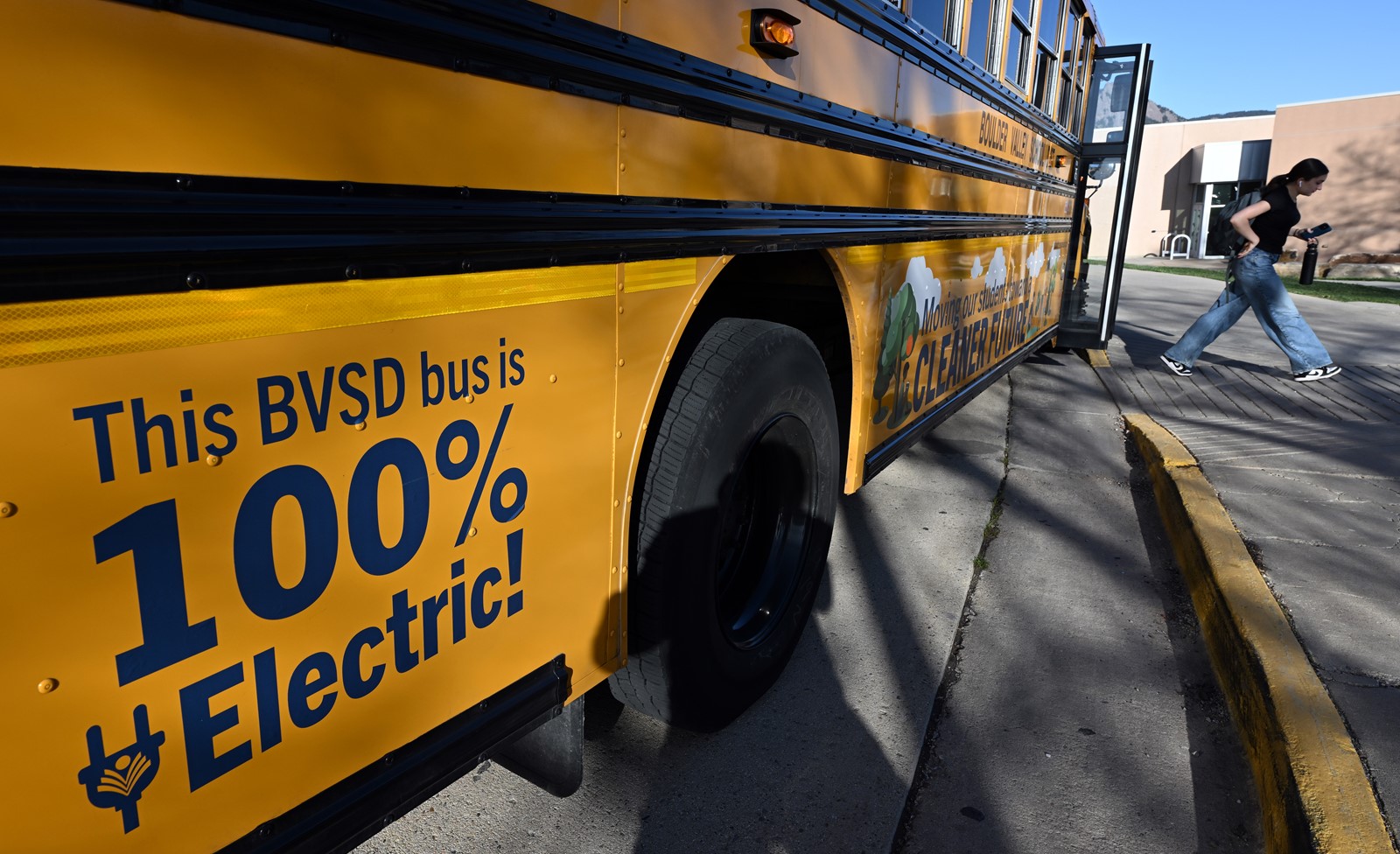


The Boulder Valley School District met almost all of its five-year environmental sustainability goals, from adding five new climate related classes to reducing greenhouse gas emissions, based on an update at Tuesday’s school board meeting.
Wins included installing a solar array at the rebuilt New Vista High School in Boulder that’s expected to almost entirely offset the building’s electricity use, according to district officials. The district also added six electric buses to its fleet this fall, for a total of 13 electric buses. Overall, the district reduced greenhouse gas emissions by 29%, the equivalent of taking about 5,000 cars off the roads for a year, according to district officials.
Integrating green building principles, providing professional learning for staff members and creating sustainability dashboards for each school were other goals met.
“It’s a celebration,” said Ghita Carroll, Boulder Valley’s sustainability and energy officer. “We made a lot of progress.”
One area where the district struggled was reducing water use and cost, given the past two hot, dry summers. Costs have more than doubled since 2008, according to the district. The district created a water team that started meeting in 2024 and helped develop a water management plan to track progress and look at solutions, Carroll said.
“Current conditions are now really underscoring the importance of this work,” she said.
Areas the district is focusing on include changes to irrigation controls to detect leaks in real time and automatically shut off the water. Carroll said that’s a priority because 80% of the district’s water use is from irrigation. Another way the district has reduced its water use was moving to turf fields at all of its secondary schools.
Other changes included increasing xeriscaping, switching fixtures for low-flow versions and adding educational signs to schools about water use. The district now is working on a plan for summer watering, based on the watering restrictions in place in the 11 municipalities and districts that supply the district’s water.
“Water management is going to be a key priority,” Carroll said.
Efforts at the student level included adding classes, starting the district Green Youth Council and developing requirements for seniors to earn the Seal of Climate Literacy. The state Legislature established the Seal of Climate Literacy in 2024. A high school diploma endorsement that’s similar to the state’s Seal of Biliteracy, the climate seal is awarded “to graduating students who demonstrate mastery in climate literacy and attain green skills or technical green skills.”
Last year, 20 seniors received the Seal of Climate Literacy. This year, 51 seniors are graduating with the climate seal. To qualify, students need to successfully complete two classes in the area of climate literacy and an experiential learning project.
“We’re very excited about all of those students,” Carroll said. The district now is developing a sustainability plan for the next five years, including getting feedback from staff members, student groups, the Sustainability Advisory Committee, municipalities and the University of Colorado Boulder. Carroll said priorities based on that feedback include water management, resilience, greenhouse gas reduction and green job skill development.
A final plan is expected to be presented to the school board for approval in the fall.
 PREVIOUS ARTICLE
