


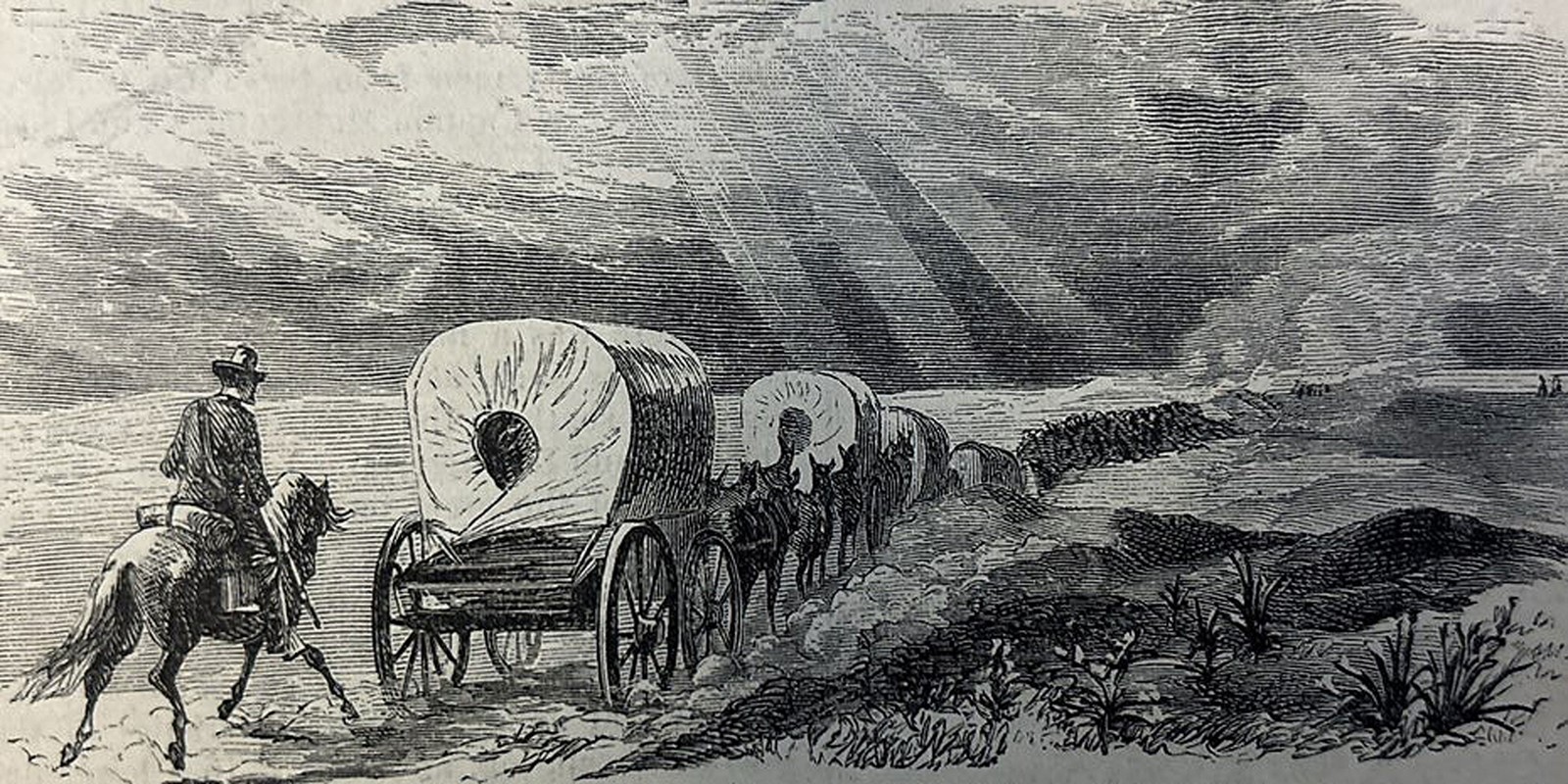


The Gold Rush to California has been called, to quote on famous view, “The largest mass movement of people in American history.” By people, of course, they meant men.
Not many women traveled on the wagons west in the 1850s, and those intrepid ones that did were under extraordinary stress. At the top of the list of the many fears to be faced were attacks from a variety of outlaws, cholera and other diseases, bears, lions and snakes, with infections coming in second place. And those weren’t idle fears either, as the death rate for women on the trail was reportedly 22% higher than that for men.
Sadly, very few of these courageous women got all the way to our Petaluma Valley in those early days.
Crossing the scorching desert could only be done at night, and pushing wagons over mountains — plus fording of creeks and rivers — were very dangerous tasks. In fact, the No. 1 cause of death on the trail was drowning, which took place during those fordings. Who would have guessed? Later, in attempts to provide more safety against such a danger, wagon bottoms were tarred and their canvas tops were coated in oil to help them float a bit better.
Quarrels and fights between angry men carrying guns could also prove fatal at any time, and rain, mud and dust were not any fun either.
The men’s main chores, in addition to keep-on a-heading West, were to tend the stock and wagons, hunt game for food and protect the train from attacks. The women built the campfires and fed the children, cooking and doing the laundry in the creeks and lakes. Often, they would have to walk miles beside the wagon to lighten it’s load.
It was never-ending work.
Bruises, cuts, broken bones, disabled wagons and crippled livestock were common, and medicinal care was scarce. Boys as young as 8 were taught to shoot a flintlock shotgun, and something called “sparrow pie” soon became a staple. Most women carried a sheathed knife for some personal protection.
Often asked question on the trail include, “Would California be a better place for them?” and ‘Would they live through the journey to get there?”
The ‘jumping-off point’ to the west was the Missouri River. Rafts were hired to carry people, their wagons and their stock over that vast water-barrier, and most everything west of that river was wilderness — out of the law’s jurisdiction. Each wagon train had it’s own “laws” and enforcers, and most of the routes would start out by early May so that grass along the trail would be available for the livestock.
They headed West to Fort Kearny in Nebraska and then up the Platte River to Fort Laramie in Wyoming, then to South Pass Junction, where the wagons continuing to California parted from those going to Oregon. By the time the procession had reached that point on the trail, it was getting into September, with firm friendships having been made, and those forever partings were often wrenching events.
The California-bound wagons then traveled across the Nevada desert into the Sierra Mountains, hopefully to reach Sacramento before the snows came. Up to then, it had been six to seven months on the rocky trail in a drafty wooden box with no springs or heat, pulled by exhausted animals for about 2,200 grueling miles, moving an average of 16 hours a day.
“My first recollection of California began riding in that creaky old wagon drawn by six emaciated cattle, the last of a herd of 22 that we had started with,” wrote Anna Cromwell Reed in 1866. Anna did make it all the way to Petaluma and in 1893 her son Clarence married Dixie Proctor here, as the Reed, Cromwell and Proctor families were to intermarry and become important builders of our community for many decades forward.
Westward immigrants like the Reeds had sold their farms in the East to raise cash for the long trip West, and they tried to produce many of their own provisions, prior to arriving at the Missouri River. That was mainly because of the “snake oil salesmen” there, who offered only inflated prices and second-rate supplies.
In 1852, one could purchase there a wagon, harness and a double yoke of oxen (four 4 oxen), for about $450, but that was a big chunk of savings then, $18,000 in today’s bucks. An early drayage option that had to be made at that time, was either for horses, fast, but fragile or mules, tough but stubborn, or oxen, strong, but slow. Oxen were the biggest seller, and most folks chose to buy two yokes for $80 bucks extra, as insurance against animal loss along the way. Often a milk cow was also purchased to pull along behind the wagons.
In 1850, the population of Sonoma County was 560, with just 1% of those were female.
Just two years later, the population had grown to 2,208 — with 10% of those female.
This surge happened because the Donation Land Act, meant to encourage homesteading, had gone into effect, granting families twice the land offered to single men. So up went the numbers of women on the trail. An interesting quote from those times was that, “Single ladies were valued higher than gold!”
Mutual efforts from both men and women soon became essential, but child-bearing years were 17 to 28 then, and the average woman gave birth to five children. Because of this, during their 20s, most women were either pregnant, nursing or caring for infants. Some simply gave it up early on and turned back, assuming that option was even possible.
Folks on the trail had to learn to throw aside luxuries.
Men, women and children alike wore high leather boots to protect from snake bites, thorns and rocks. Women searched daily for brush or dried buffalo dung for fires. They milked the cow, churned butter, squatted over campfires and sat on the cold ground to eat.
Sometimes, however, washing clothes in a creek served as a rare get together for the women, a time of feeling a bit less lonely while catching up on news of the trail. Some larger wagon trains even carried a midwife to deliver babies, and the women rallied around each other during those often difficult and stressful occasions.
Female equality in the 1850s and ‘60s was not legally recognized, but what went on behind cabin doors, in the wagons, and under the buffalo robes, we can only guess pine. I’m sure that some real love existed, and some mutual decision-making, as well.
Most of those undaunted women did get through it. And they survived.
Skip Sommer’s “Petaluma Past” runs once a month in the Argus-Courier. Sommer is an honorary lifetime member of the Petaluma Historical Museum and Heritage Homes, and the 1987 Petaluma Good Egg. You can reach him at skipsommer31@gmail.com.
 PREVIOUS ARTICLE
