


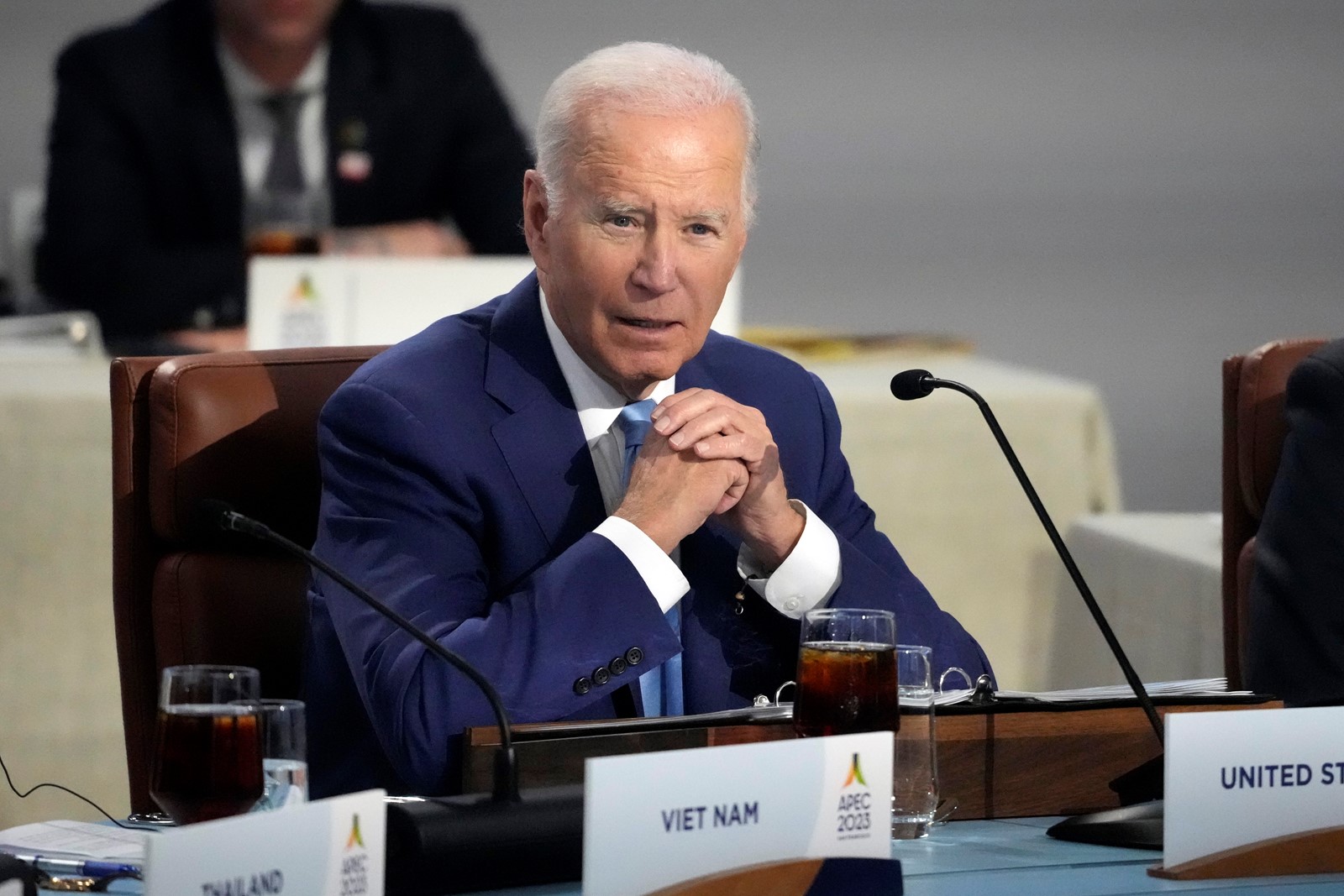


SAN FRANCISCO — President Joe Biden on Thursday made America’s case to national leaders and CEOs attending the Asia-Pacific summit that the United States is committed to high standards in trade and to partnerships that will benefit economies across the Pacific.
“We’re not going anywhere,” he declared.
Fresh off his meeting with Chinese President Xi Jinping, Biden also told business leaders that the U.S. was “de-risking and diversifying” but not “decoupling” from Beijing. But he did not mince words in suggesting the U.S. and friends in the Pacific could offer businesses a better option than China. He also noted that U.S. economies had invested some $50 billion in fellow Asia-Pacific Economic Cooperation economies in 2023, including in clean energy technologies, aviation and cybersecurity.
“This is not all kumbaya, but it’s straightforward,” Biden said. “We have real differences with Beijing when it comes to maintaining a fair and level economic playing field and protecting your intellectual property.”
Biden sought to send a clear message about American leadership as business leaders grapple with the risks of doing businesses in the midst of wars in the Middle East and Europe and a still shaky post-pandemic economy. He also spent time Thursday letting Indo-Pacific leaders know that the U.S. is committed to nurturing economic ties throughout the region. APEC includes 21 economies.
Biden in his remarks to the CEOs sought to highlight his administration’s efforts to strengthen ties with the region. APEC members have invested $1.7 trillion in the U.S. economy, supporting some 2.3 million American jobs. U.S. companies, in turn, have invested about $1.4 trillion in APEC economies.
Later, during talks with APEC leaders at a working lunch, Biden spoke about efforts funded by his Inflation Reduction Act to improve sustainability, climate change and clean energy infrastructure in the U.S.
“I encourage everyone around this table to also take strong national actions,” Biden said. “It will take all of us to meet this moment.”
Biden also sought to underscore that he was seeking to responsibly manage the strained U.S. relationship with China one day after he and Xi sat down for more than four hours of talks at the bucolic Filoli Estate near San Francisco.
“A stable relationship between the world’s two largest economies is not merely good for the two economies but for the world,” Biden said.
Xi, too, met with American business leaders — at a $2,000-per-plate dinner Wednesday evening.
“There is plenty of room for our cooperation, and we are fully able to help each other succeed and achieve win-win outcomes,” he told them, according to an English translation.
Xi did not address the APEC CEOs meeting but instead sent a lengthy “written speech” in which he wrote that “forcing uniformity will not advance cooperation in the region” and declared that China was looking for stability during a moment of “turbulence and change” in the world.
“The region cannot and should not be an arena for geopolitical rivalry, still less should it be plunged into a new cold war or camp-based confrontation,” Xi wrote.
Separately, Xi on Wednesday signaled that China would send the U.S. new giant pandas, just a week after three from the Smithsonian National Zoo were returned to China, much to the dismay of Americans. There are only four pandas left in the United States, at the Atlanta Zoo.
Biden and Xi understand that the complicated ties between the two nations have major global impacts. Their meeting Wednesday was in part an effort to show the world that while they are global economic competitors, the U.S. and China aren’t rivals seeking conflict.
 PREVIOUS ARTICLE
