


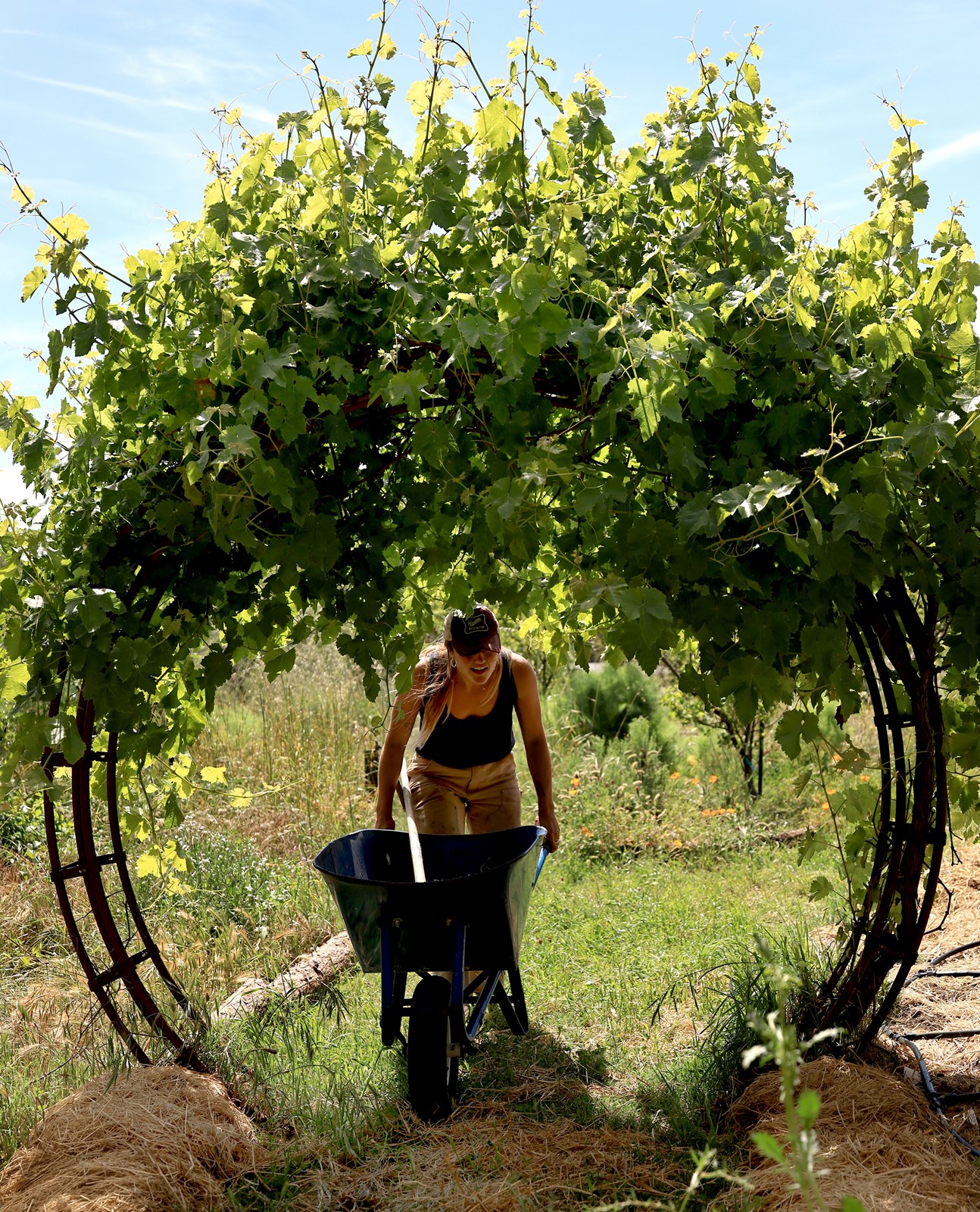


Schoolyards across Sonoma County have become places of bounty, learning and healing through the advent of school gardens. Teachers take classes out into those gardens where they incorporate the beautiful space into an outdoor learning lab for math and science as well as writing, art and more. Students who are anxious are able to find peace and solace there that helps them to regulate their nervous systems. Many of those gardens were started with the help of the School Garden Network.
There are now around 150 school gardens in the School Garden Network. Once those gardens are established the network helps teachers by providing resources such as plants and seeds as well as hosting helpful workshops throughout the school year.
Since 2021 the School Garden Network has also been hosting weeklong summer day camps where students learn new skills, make new friends and enjoy time in the garden. The team behind the network includes Sue Davis, executive director; Jesse Schmieg, Summer Garden Camp manager; and Hayley Dougan, farm manager at Solar Punk Farms where the newest camp takes place.
The summer camps have become very popular and are gradually expanding. Most of the camps happen at the Salmon Creek School in Occidental, where the campus is home to a one-and-a-half-acre garden.
“There’s a beautiful redwood forest, a big soccer field, a creek and the garden and so it provides so many different nature elements for kids,” Davis said. “It’s really the ideal garden camp location.”
Gardening activities are incorporated into all of the weeklong day camps and there are different themes for each one. The camps explore such topics as how to keep our bodies and Earth healthy, how local pollinators interact with plants, and critters that are swimming in the creek and flying overhead. There’s a STEM focused week where campers learn engineering skills and explore environmental structures.
Solar Punk Farms
This year the team is collaborating with Solar Punk Farms in Guerneville for a weeklong day camp for middle school students. Davis said she’s really excited about this new camp offering.
Hayley Dougan reached out to Davis for advice on starting a new summer camp at the farm and a collaboration was born.
“It’s a new partnership, but I’ve known Hayley in the community for many years and I was grateful that she reached out to me,” Davis said. “They have such a beautiful vision for community engagement and education.”
“I really love working with kids and especially in the garden,” Dougan said. “I think it’s a really great collaboration. I love what School Garden Network is doing, so it’s cool to be another satellite site.”
Solar Punk Farms is a regenerative farm, and Dougan said campers will be learning all about the nutrient cycle, building soil, planting seeds and tending plants. They will be harvesting and eating food from the garden as well as enjoying the flowers that grow on the farm. She said students can look forward to lots of fun activities.
“We’ll be doing lots of games and building some naturalist skills,” she said. “We’ll be doing a little bit of bird identification and sound mapping. It’s going to be a really fun week outside hanging out with nature.”
Dougan studied environmental science and biology and has a keen interest in outdoor education, gardening, regenerative agriculture and sustainable food systems. She had previously worked at the Catalina Environmental Leadership Program on Catalina Island, where she taught students about sustainability and stewardship principles. She said it included a lot of outdoor adventure and experiential learning.
“That really opened my eyes to how impactful experiential learning can be, where students are having an experience, learning about why we have that experience and what came up for them and then how that kind of applies to the greater world,” she said. “It can be really impactful for students, especially ones who maybe aren’t as suited to learning in the classroom.”
Dougan said she loves being surprised by students and seeing the spark, or the “a-ha” moment they get when they realize that this plant grows the food that they eat on their table. “Sometimes we have that disconnect when you buy it from the grocery store, but realizing that these things are really living things growing in the ground, that’s one of the things I look forward to the most,” she said.
She also really likes seeing kids get more comfortable out in nature.
“If they’re not comfortable sitting in the dirt on day one, and they’re sitting in the dirt by the last day, I feel like I’ve done something right to make them feel a little bit more comfortable in the natural world,” she said.
Dougan said she’s always learning from kids she works with as well.
“They just see the world in a more uninhibited way and it allows them to make different connections that I wouldn’t have ever thought to make before,” she said. “I’m learning stuff from them all the time.”
Environmental education
Dougan is excited to bring more of an educational element to the farm. The network team is starting to do more workshops on things like no-till agriculture and compost building. There will also be some bouquet-making workshops. The team partners with the Guerneville school through the Magnolia project that gives seventh through 12th grade students an opportunity to work on the farm with Dougan for a week.
The team hosts events like the Saturday Wine and Wander tour where they educate the public about regenerative farming. There are volunteer days on the farm that they call Work/Plays where lots of people come out and help them do big planting projects.
“That’s really fun because we get a lot of repeat folks coming back and we just have a really good time working in the garden together,” she said.
Dougan said one of the things that makes Solar Punk Farms special is that it’s very community focused and they’re trying to create a really welcoming, inclusive space for everybody. They’ve become a bit of a community hub and, she said, it’s been really nice getting to know their neighbors.
“Lots of people stop by to shop at the farm stand or to pick up their CSA boxes,” she said. “It’s nice to interact with them and hear about stuff that I grew that they really liked.”
Solar Punk Farms is inspired by Queer Theory, which challenges traditional ideas about gender, sexuality and gender identity, and that LGBTQ folks have been inherently breaking binaries — or challenging the restriction of a two-option gender culture.
“I think that kind of thinking is a really good thing to bring to science — to break down binaries,” she said. “Not everything is one or the other or black and white, everything occurs across the spectrum, especially in the natural world. And so, that kind of thinking is what we want to encourage folks to be doing — getting creative, thinking outside the box, accepting all sorts of ideas and outlooks.”
Summer Garden Camp
Jesse Schmieg, summer garden camp manager for the School Garden Network, is excited about the new camp at Solar Punk Farms.
Schmieg, whose pronouns are they and them, studied biology with an emphasis on ecology and evolution at Sonoma State and likes helping kids understand that people of any age can do science.
“It’s nice to see them feeling empowered and being able to see themselves in a role of being a researcher,” Schmieg said.
While growing up in Minnesota, Schmieg spent summers gardening, camping and canoeing.
“I distinctly have this one memory that always stands out to me where I was canoeing on a river and I looked down into the water and there was a loon that was fishing,” they said. “And so I actually just sat there in the canoe and watched it fish for a little bit. That was something that really sparked my love of wildlife and it just really expanded and spiraled from there.”
Schmieg said that kids get excited about more than the plants growing in a garden and remembers the excitement of seeing rabbits, bugs and toads they found in their childhood garden.
They also like teaching kids about the local pollinators that visit the garden.
“It’s really great to share how we can benefit through growing food and being healthy in that way, but we can also help the health of an ecosystem by providing food for some of these pollinators,” Schmieg said.
Schmieg is also a very big proponent of allowing kids to find something that they feel curious about and giving them the tools to make deeper connections either through encouraging questions or by more hands-on skills that come with being in a garden.
“It’s just really giving them the space to figure out what they feel joy in doing outside,” Schmieg said. “Sometimes that’s like building a little fort out of sticks, or they are really fascinated with feathers and they want to identify all the different bird feathers that they’re finding. So it’s really great to be able to see the kids come into their own and see all of their own individual passions really develop as they spend more time in nature.”
Schmieg said it would have been really beneficial as a kid to have visited a place like Solar Punk Farms.
“There is a huge benefit of it being an LGBTQ farm because there is already that sense of community and that sense of empowerment that comes along with that,” Schmieg said. “As a kid, I felt fairly isolated, and so it’s always great to see not only examples of people who are like you, but also seeing that you can go on to live a very fulfilling and successful life. I think it helps inspire you to find that success for yourself.”
Dougan said the most important part that she’d like to impart to everyone who visits is that through farming, humans can have a positive impact on the planet.
“I think that nowadays, especially, there’s a lot of doom and gloom out there in the world about all of the bad things that we’re doing to the planet,” she said. “And I’m hoping to show kids that there is a way to make a positive impact and that we are a part of the ecosystem, we’re not separate from it.”
While there’s a lot of educational opportunities at the network’s camps the number one priority is that the kids are outside and having fun.
“So while we have adapted lessons for different ages, really, we just want the kids to have fun, connect with each other, eat fresh food and enjoy the workings of a garden space,” Davis said. “That’s the ultimate goal.”
The valuable work that the School Garden Network has been doing, throughout the school year and summer is about to expand out of necessity in the face of massive school budget cuts. The network is planning to pivot and to take on more of the work of maintaining the gardens and providing instruction.
Davis noted that school gardens, school garden educators and school garden programs are getting cut as well as school counselors, librarians, teacher’s aides and all sorts of other staff.
“It’s really scary for the parents, the students and the teachers who are trying to understand what that’s going to mean for these schools,” she said.
The School Garden Network is trying to address this by building capacity within the organization to take on more of the burden. They’re calling upon the community for help both in the form of expertise as well as possible help with funding so they may continue to nurture and cultivate these invaluable school gardens.
For more information about the School Garden Network and their camps and programs visit https://www.schoolgardens.org/ and for more information about Solar Punk Farms and their summer camp you can also visit https://www.solarpunkfarms.com/.
 PREVIOUS ARTICLE
