


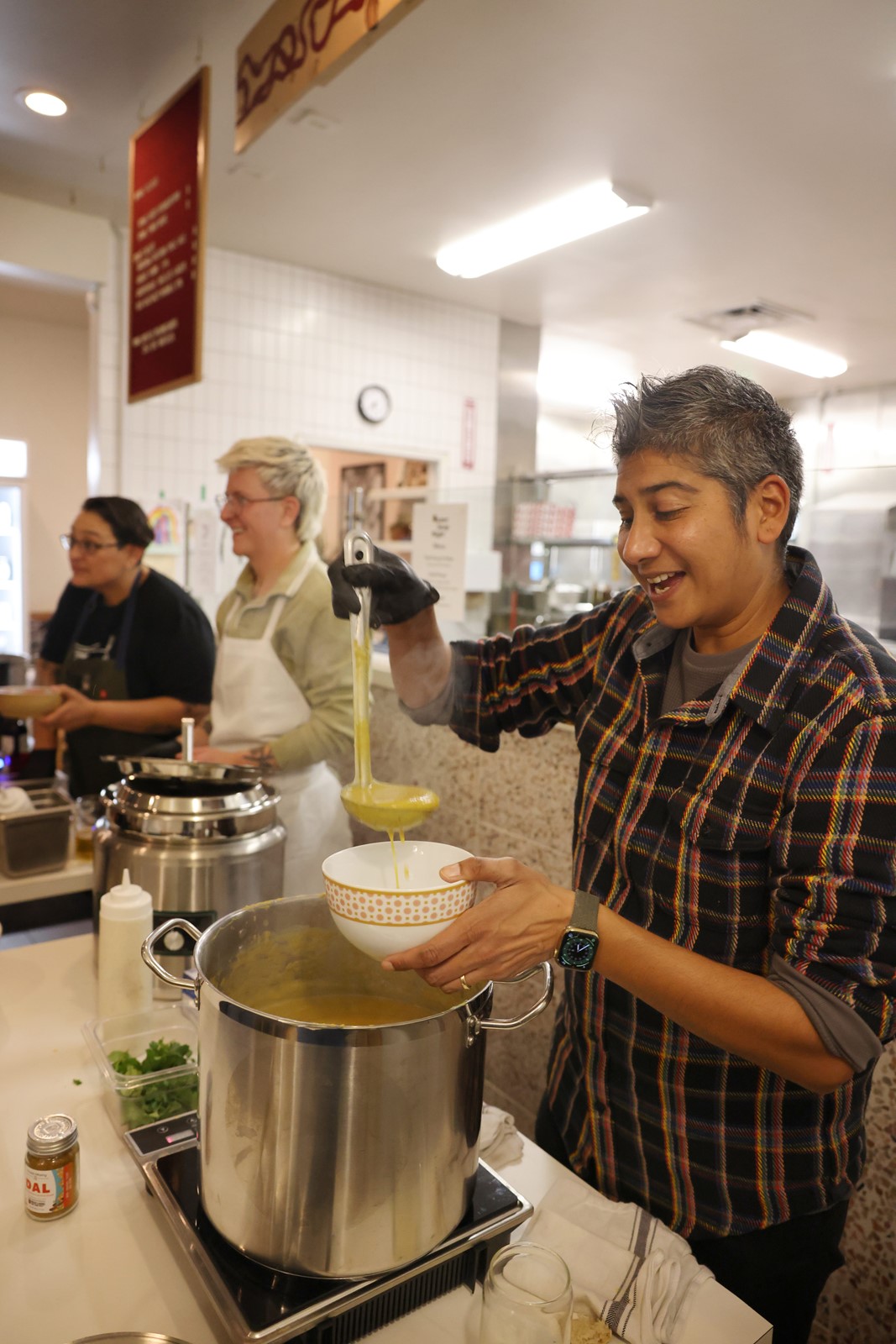


The warm scent of simmering lentils drifted through Slow Co. Pizza in Cotati, drawing people inside and toward something more nourishing than dinner on a chilly late autumn evening. Queer Soup Night Sonoma County, barely six months old and already a magnetic force, was hosting its fourth gathering — a volunteer-powered, donation-based community supper built on a simple premise: show up, eat soup, support local queer-focused nonprofits and reconnect.
The night’s menu embodied that spirit with hearty pork pozole, fragrant lentil dal-inspired soup and creamy vegetarian potato and leek.
“The soup is so good, I really didn’t realize it was going to be this delicious,” said attendee Ava Robb while savoring her second bowl of lentil soup. “I’m really happy to be here and be able to also support local nonprofits, especially when it comes to the queer community.”
That blend of comfort and purpose is precisely what co-organizers had in mind from day one. What started in Brooklyn in 2017 has expanded into a network of local chapters across the U.S. and Canada.
For Sonoma County lead organizer and chef Preeti Mistry, bringing the event here was a long time coming.
Mistry first got involved with Queer Soup Night in Oakland in 2018. After moving to Sonoma County in 2020 and hosting several pop-ups, Mistry said they had an epiphany: what they loved wasn’t the hustle, but the sense of community those soup nights created.
“It was like a light bulb went off in my head,” they recalled. The 2024 election sharpened that urgency. “After that, I was like, OK, we have to do this.”
E. Samuell MacLaughlin and photographer-activist Sarah Deragon soon joined Mistry. MacLaughlin handles logistics, donations and communication. Deragon draws on years of queer community organizing and a deep commitment to accessible, welcoming spaces.
Mistry calls on their chef connections to secure venues and food partners.
Accessibility is a priority, so the team considers ADA compliance, public transit, family-friendliness, dietary preferences, and racial and economic inclusivity when planning events. No one is turned away for lack of funds.
“We need more gathering spaces where we can all come together,” MacLaughlin said. “Especially in these times, people want to feel surrounded by support and community. Soup does that in this celebratory, accessible way.”
Deragon, who previously organized in big-city queer scenes, sees Queer Soup Night as an act of “joyful activism.” Rather than relying on bars, she emphasizes intergenerational connection in an inclusive, alcohol-free space.
“Sonoma County is a smaller queer community,” Deragon said. “So it’s important to create a space where everyone feels seen — queers with kids, older folks, young people who are questioning.”
At each gathering, those ideals come to life as guests dance to music from the local DJ duo Cute Coffee, share second helpings and sometimes bring containers to take soup home. Beneficiaries such as Food for Thought, the Sonoma County food bank founded by queer community members during the AIDS crisis, reflect the organizers’ deep care for grassroots institutions.
By centering hospitality, warmth and generosity, Queer Soup Night shows that community-building doesn’t always roar. Sometimes, it simmers gently and steadily in a pot of soup, served with bread, music and room at the table for everyone.
The next Queer Soup Night Sonoma County is set for Sunday, March 22, at Marla Bakery in Santa Rosa. Follow on Instagram @qsn_sonomacounty to learn more.
 PREVIOUS ARTICLE
