


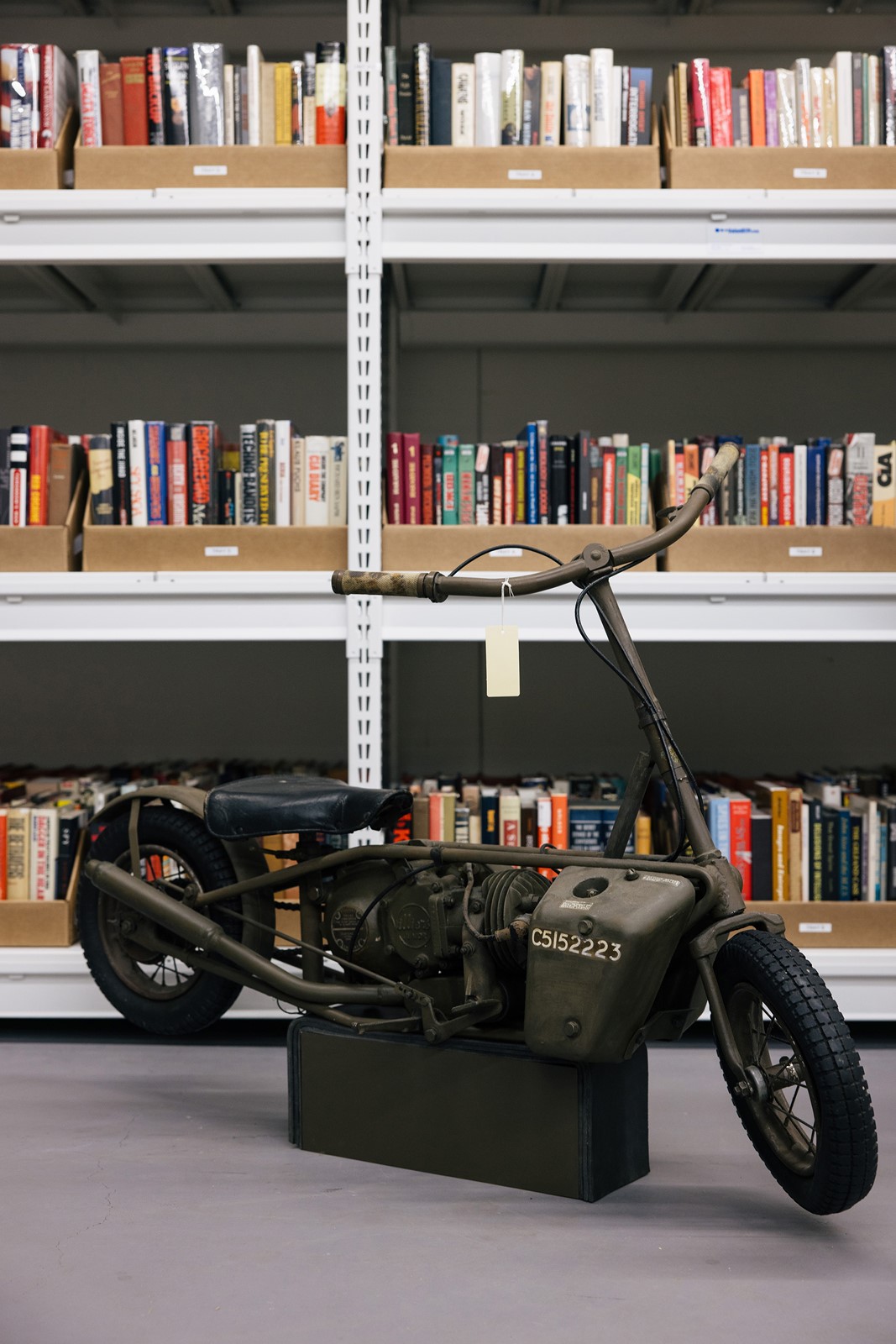


WASHINGTON — To get into the International Spy Museum’s new fourth-floor vault, we bored a hole in the ceiling, lowered ourselves using a rope and put a guard to sleep with a drug-tipped dart after taking down the surveillance camera with just two keystrokes.
OK, they just let us in.
The museum, which opened in the Penn Quarter neighborhood of Washington in 2002 and moved to a bigger space in L’Enfant Plaza in 2019, has more than 10,000 objects in its collection, including statues, pens, disguises, listening devices and books used all over the world in the service of professional espionage.
As with most museums, a vast majority of those objects are not on display. And until a few weeks ago, they were far away, stored at a location outside the capital — making it a challenge for museum historians to reach the objects for study and preservation.
In 2020, the museum began consolidating its collection in its new building, a project that it completed this year.
Many of the artifacts in the vault came from one man: H. Keith Melton, a founding board member of the museum, who became one of the world’s renowned spy collectors.
He is not a former intelligence agent himself; rather, he made his money as one of the country’s largest McDonald’s franchise owners. A condition of his donation, which he first pledged in 2016, was that the collection would eventually be moved to the museum itself, Melton said.
“To properly care for, maintain, catalog, access the artifacts, they needed to be on the premises,” Melton said in an interview. “You can’t deal with it remotely. Artifacts need care and feeding and vigilance, and they need to make sure they’re not deteriorating.”
The collections team at the International Spy Museum recently opened the doors to its den of secrets, offering a reporter and photographer a look at tools of the trade.
There are roughly 4,000 books in the vault, most of them donated by Melton. The most treasured of these is a World War II-era briefing book created by MI9, a wartime branch of British intelligence, to get Americans up to speed on its top secret espionage innovations. It includes designs for cameras disguised as cigarette lighters, coat buttons and gold teeth concealing compasses, and maps printed on clothing.
Laura Hicken, the museum’s collections manager, estimated that there were fewer than 20 copies of this book in the world.
Among the museum’s newest acquisitions are original courtroom sketches by William Sharp, an illustrator who died in 1961.
One is of Rudolf Abel, the Soviet spy who operated undercover in the United States for almost a decade and who was portrayed by Mark Rylance in the 2015 Steven Spielberg thriller “Bridge of Spies.” In the drawings, Sharp portrayed Abel as looking stressed.
“For us, where so much of our history is told through gadgets and weapons and concealment devices, this is so incredibly personal and such an intimate look into the consequences of the things we cover,” Hicken said, referring to the sketch.
(The museum, which is recognized by Guinness World Records as the world’s largest espionage museum, has come under criticism in the past for sanitizing the unethical behavior of spy agencies.)
Another set of Sharp-penned sketches is from the trial of Ethel and Julius Rosenberg, who were arrested in 1950 for espionage and executed in 1953. The drawings feature Judge Irving R. Kaufman, who sentenced them to death, and an unguarded Ethel Rosenberg, whose culpability has come under doubt in the last decade.
The Spy Museum has also received gifts and loans from international governments. The South Korean government, for example, lent items said to have been seized from a North Korean spy who crossed into the south. Among these is a pen that, when clicked a certain way, would have been capable of injecting a paralyzing agent into an unsuspecting victim.
 PREVIOUS ARTICLE
