


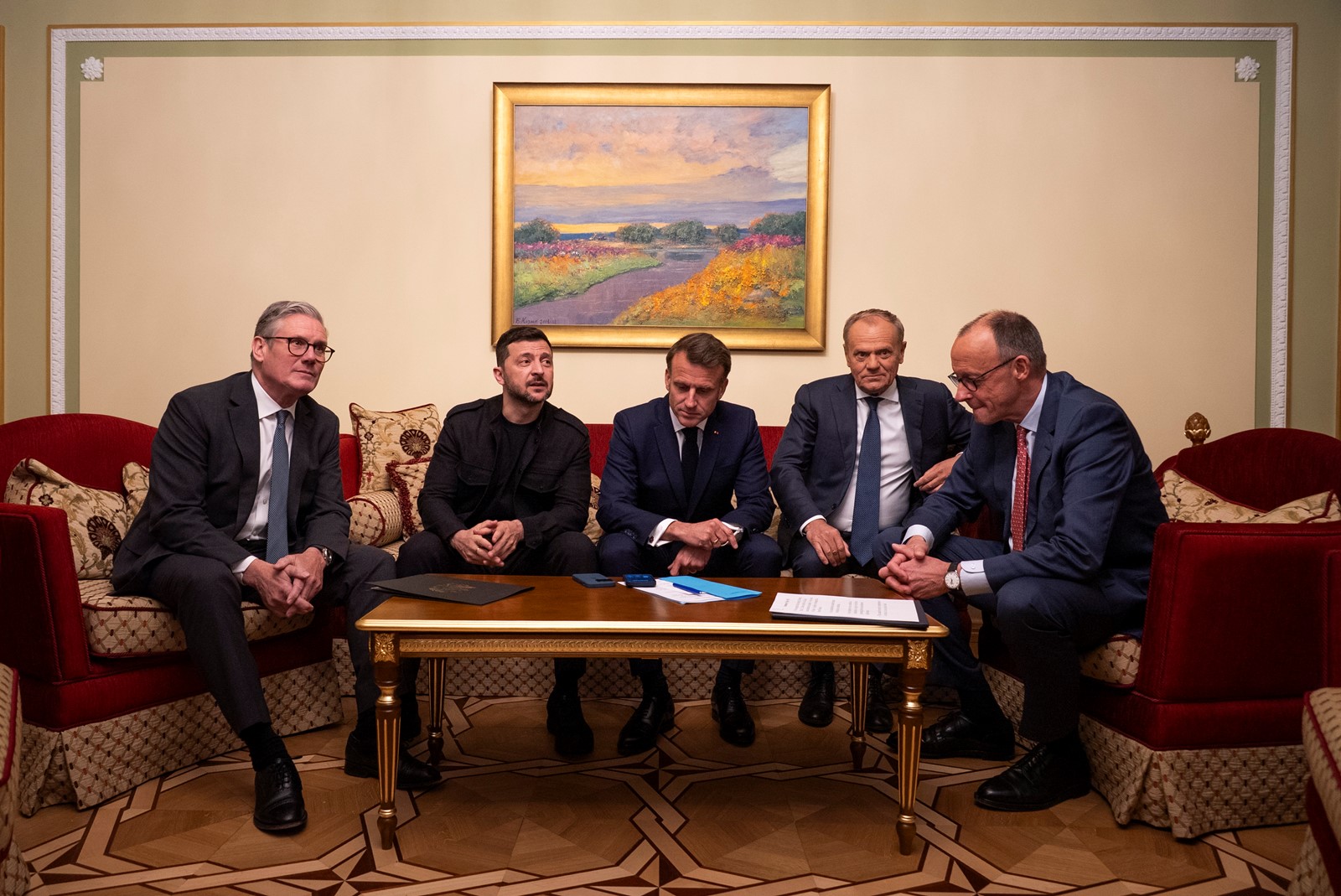


KYIV, Ukraine — The leaders of Britain, France, Germany and Poland, on their first joint visit to Ukraine, said Saturday that Russia would face “new and massive” sanctions on its banking and energy sectors if President Vladimir Putin refused to agree to a full, unconditional 30-day ceasefire.
“All of us are calling Putin out,” British Prime Minister Keir Starmer of Britain said at a news conference in Kyiv, the capital, with President Emmanuel Macron of France, Chancellor Friedrich Merz of Germany, Prime Minister Donald Tusk of Poland and President Volodymyr Zelenskyy of Ukraine. “If he’s serious about peace, then he has a chance to show it now,” Starmer said, referencing Russian President Vladimir Putin.
Starmer said the European effort, which calls for a truce to begin Monday, had been coordinated closely with the White House.
A senior U.S. official, speaking on background because of a lack of authorization to discuss the negotiations, said that President Donald Trump had been in touch with European leaders throughout the week, before the announcement in Kyiv, and that he signaled to Starmer and Macron on Saturday morning that he supported their proposal for sanctions absent a ceasefire by Monday.
Trump is also not opposed to having the United States help monitor a ceasefire, but did not make firm commitments about what that would entail or require, the official said. White House officials stressed that Trump has left sanctions on the table repeatedly, including in a recent Truth Social post.
The Trump administration proposed the 30-day ceasefire, to which Kyiv agreed, during talks this spring in Saudi Arabia.
Earlier in the day Saturday, Ukraine’s foreign minister, Andrii Sybiha, released a photograph of the five leaders huddled around a phone. Sybiha said they were talking with Trump.
“Ukraine and all allies are ready for a full unconditional ceasefire on land, air and at sea for at least 30 days starting already on Monday,” Sybiha wrote on social media. “If Russia agrees and effective monitoring is ensured, a durable ceasefire and confidence-building measures can pave the way to peace negotiations.”
Before the European leaders gave their news conference, Kremlin spokesperson Dmitry dismissed the threat of new sanctions, telling Russian broadcaster Rossiya-1 that the country was “accustomed to such pressure measures and knows how to minimize their consequences.”
He had earlier said that Russia remained opposed to any ceasefire unless Western nations stopped providing military aid to Ukraine, according to the Russian news agency Tass.
The visit of the European leaders to Kyiv — which began with a solemn tribute to the thousands of Ukrainian soldiers killed in battle as the men laid flowers at a makeshift memorial — came one day after Russia’s celebration of the 80th anniversary of the Soviet Union’s victory over Nazi Germany. At that celebration, Putin welcomed President Xi Jinping of China and other foreign dignitaries to Moscow for a military parade meant to project Russia’s power and Putin’s bid to reshape the global order.
The two events crystallized both the changing contours of the war in Ukraine and the broader geopolitical shift underway since Trump entered office. In only a few months, Trump has reversed core tenets of U.S. foreign policy, and is presiding over the weakening of the trans-Atlantic bond that helped set Europe on the path to peace after the cataclysm of World War II.
 PREVIOUS ARTICLE
