


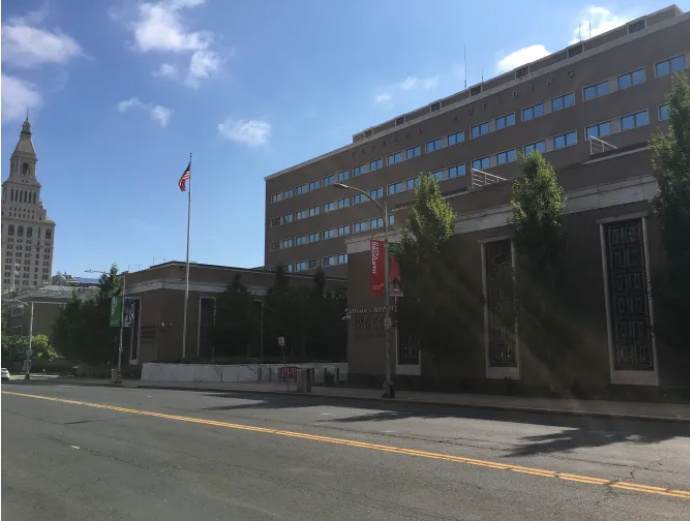


Immigration agents fired a Taser in a public area of the federal building in Hartford, Conn., to immobilize an Afghan refugee as he walked out of a legal hearing associated with his decade-old asylum application, according to a witness and others familiar with the events.
Those people allege that on May 9, plain-clothed Immigration and customs enforcement agents didn’t identify themselves as they confronted former Yale University student Saifullah Khan as he left a 6th-floor immigration courtroom with another person and walked toward an elevator.
Unsure of what was happening, the witness and others said Khan tried to run back into the courtroom, calling, “Judge, judge,” for U.S. Immigration Judge Ted Doolittle. At the courtroom door, they said he fell to the floor and struck his head after being hit with the Taser, a hand-held device that fires darts designed to paralyze targets with an electric charge.
One of Khan’s lawyers said he was taken to a federal immigration detention center in Massachusetts.
Little information
Repeated attempts failed to reach anyone from a variety of federal agencies who presumably could provide the government’s view of what happened and why Khan was detained.
The clerk’s office at the U.S. Immigration Court said the file on Khan’s case can not be accessed without a case number. When a number was produced, the office said the file was confidential.
A related immigration petition filed by Khan in U.S. District Court is sealed, something a federal official described as routine practice in asylum cases.
Advocates for Khan refused or were reluctant to discuss his immigration case. A close associate said she has been warned against publicizing the matter because doing so could provoke federal immigration authorities.
U.S. District Court judges, whose offices are located on a lower floor in the same building but operate separately from the immigration courts, were unaware of the events concerning Khan, according to their offices, but have been informed about increasingly aggressive immigration activity in the building under the Trump administration.
Khan’s advocates were said to be working to learn what happened to him, why and how to respond. He has lived in the U.S. for more than a decade and they said he has complied with immigration authorities over the decade or so that he has had an asylum petition pending.
The advocates said Khan was admitted to the U.S. under a student visa around 2012 and applied for asylum when he left Yale about three years later. His May 9 detention occurred less than two months after he sued four senior Trump administration officials, including U.S. Attorney General Pam Bondi and Homeland Security Secretary Kristi Noem, in an attempt to force a decision on his asylum application.
Khan, who is 32 and lives in New Haven, Conn., became well-known in the New Haven a decade ago because of a sexual assault accusation that resulted in his expulsion from Yale and a defamation suit he filed against the university in retaliation after a jury acquitted him of the sexual assault charges.
He was born in a Pakistani refugee camp after his family was forced from Afghanistan by the Taliban, according to the suit against Yale.
The suit describes Khan as a “precocious” youngster and voracious reader who aspired to a degree from a U.S. University. Yale admitted him to its class of 2016 — after Yale, university alumni and the Hotchkiss School agreed to provide him at no charge with a year of preliminary study, according to the suit.
At Yale, Khan concentrated on neuroscience, helped create a student-run think tank on international terror and conflict and worked as a teaching assistant. He was on track to graduate until 2016, according to the suit.
On Halloween night in 2015, a female student who lived in Khan’s dormitory accused him of sexually assaulting her. He said they spent the night together and engaged in consensual sex after attending a party and a performance by the Yale Student Orchestra earlier in the evening.
Khan denied the rape allegation. But he was ultimately expelled after an inquiry by Yale’s University-Wide Committee on Sexual Misconduct.
Based on the assault allegations, state prosecutors charged him with four sexual assault crimes and tried him in state court. A jury acquitted him of all charges in 2018.
A year later, Khan sued his accuser and Yale for defamation and a variety of rights violations he said he experienced during Yale’s in-house sexual misconduct investigation and the resulting expulsion. Khan claimed the process leading up to and including expulsion was one-sided and prevented him from defending himself.
“The university has in recent years been subjected to regulatory and public relations scrutiny over how it handles claims of sexual misconduct by male students and male employees against female students and female employees,” the suit said. “The campus is also in the thrall of various claims of identity entitlement, rendering the campus less a place of unbridled intellectual stimulation and more a smug hothouse catering to social justice warriors intent on remaking the world in their own image.”
Yale and the accuser challenged the suit, but lost when the state Supreme Court ruled for Khan on a legal question referred by a federal appeals court that ultimately allowed the suit to proceed.
 PREVIOUS ARTICLE

