


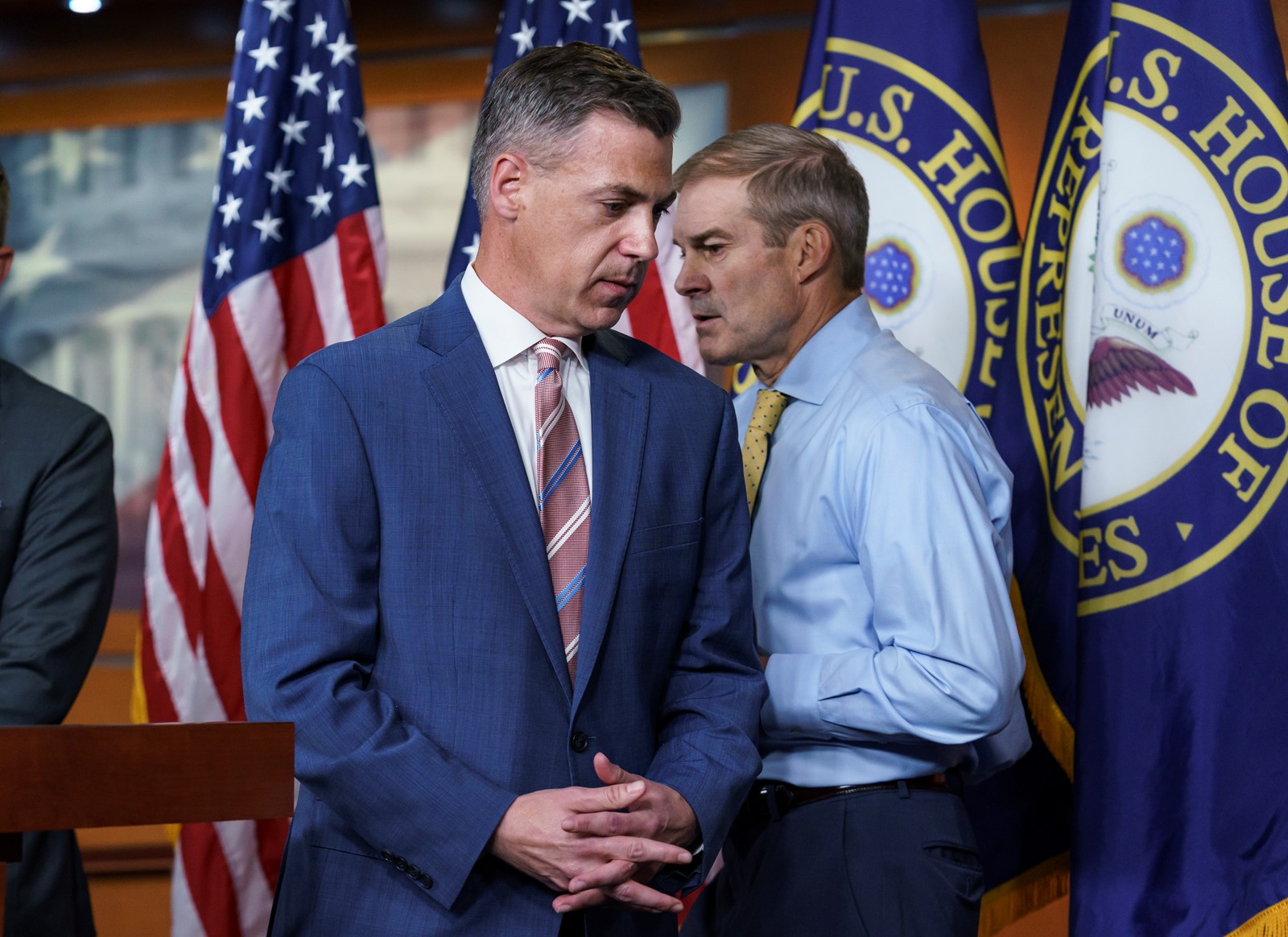


Rep. Kevin McCarthy on Wednesday pulled five Republicans from a select committee investigating the Jan. 6 mob attack on the Capitol after Speaker Nancy Pelosi took the unusual step of barring two of former President Donald Trump’s closest allies in Congress from the panel, citing concerns that they would disrupt its work.
McCarthy called a rushed news conference to condemn Pelosi’s decision and accused her of excessive partisanship. He pledged to carry out a Republican-only investigation into the events of Jan. 6 — and focus on whether Pelosi could have done more to protect the Capitol from violent supporters of Trump.
“Why are you allowing a lame-duck speaker to destroy this institution?” he asked.
Pelosi had said earlier Wednesday that she was rejecting the appointments of Reps. Jim Banks, R-Ind., and Jim Jordan, R-Ohio, based on their ties to Trump and comments they had made disparaging the inquiry.
She acknowledged that her move was “unprecedented” but called it necessary given the men’s actions related to the deadly events of Jan. 6, when supporters of Trump stormed the Capitol based on his lies about a stolen election, injuring dozens of police officers and delaying Congress’ official count of electoral votes to formalize President Joe Biden’s victory.
“With respect for the integrity of the investigation, with an insistence on the truth and with concern about statements made and actions taken by these members, I must reject the recommendations of Reps. Banks and Jordan to the select committee,” Pelosi said. “The unprecedented nature of Jan. 6 demands this unprecedented decision.”
McCarthy had included the pair — two of Trump’s staunchest and most combative allies on Capitol Hill — among his five picks to sit on the committee, signaling that he was approaching the inquiry as a partisan battle. Both voted against counting electoral votes for Biden just hours after rioters ransacked the Capitol.
Pelosi said she had based her decision not on those votes but on concerns raised by Democrats, including members of the select committee who had discussed the possibility that obstruction from Banks and Jordan could derail their work.
Many Democrats hailed the move.
“There is no place on this committee for unserious members,” said Rep. Mike Quigley, D-Ill. “Speaker Pelosi absolutely made the right decision by rejecting GOP members who have made it clear they would use this platform to grandstand and spew misinformation. In fact, Congressman Banks has already broadcasted his intention to sabotage the proceedings.”
Rep. Bennie Thompson, D-Miss., chair of the select committee, said he would “not be distracted by sideshows” and pledged to move forward with the committee’s work, including its first public hearing next week.
Pelosi had quietly debated her options with Democratic members of the panel, who expressed reservations about letting Republicans with reputations as firebrands closely associated with Trump’s efforts to undermine the election serve alongside them.
Democrats got high-profile backup from Rep. Liz Cheney, R-Wyo., and McCarthy’s former No. 3, whom Pelosi appointed to the committee after Cheney was ousted from her leadership position this spring for criticizing Trump.
“The rhetoric that we have heard from the minority leader is disingenuous,” Cheney said on the steps of the Capitol. “At every opportunity, the minority leader has attempted to prevent the American people from understanding what happened, to block this investigation.”
She said Pelosi had been right to reject Jordan and Banks. She called Jordan a potential “material witness” to the attempted insurrection and said Banks had “disqualified himself” with recent comments disparaging the committee.
Banks arranged for House Republicans to join Trump at a recent event at the southern border in which a participant in the Capitol riot at times served as a translator. Banks also released a combative statement Monday night in which he blamed the Biden administration for the response to the riot — which occurred under the Trump administration — and called the committee a creation of Pelosi’s to “malign conservatives and to justify the Left’s authoritarian agenda.”
At a news conference with McCarthy, Banks suggested Pelosi had failed to secure the Capitol.
“She knows we were prepared to fight to get to the truth,” he said. “She doesn’t want to go down that path.”
Capitol security is overseen by the Capitol Police Board, which has three voting members: the sergeants-at-arms of the House and Senate and the Architect of the Capitol. Paul Irving, the House sergeant-at-arms at the time of the attack, was hired in 2012 under Speaker John Boehner, a Republican. The Senate sergeant-at-arms at the time, Michael Stenger, was hired in 2018 when Sen. Mitch McConnell, R-Ky., led the chamber.
 PREVIOUS ARTICLE
