


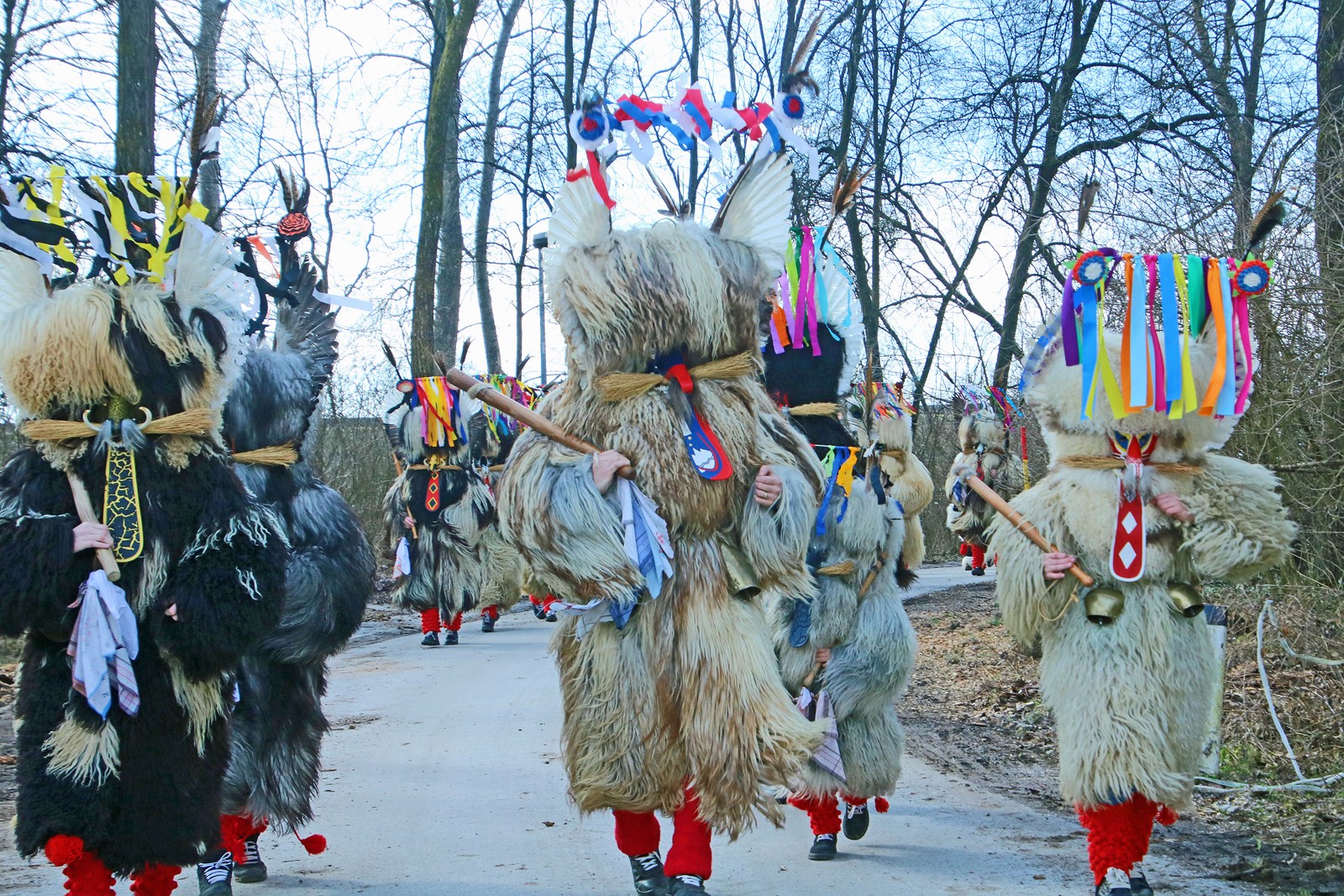


Brandishing clubs topped with hedgehog spikes, more than 40 shaggy, sheepskin-cloaked monsters surrounded me, some 10 feet tall, all frenetically shaking their hips to clang ear-splitting cowbells chained to their waists. Wicked red tongues dangled down their furry chests and jumbo fowl feathers sprouted from their huge ribbon-strewn heads.
Very surreally, I was in the teeny Slovenian village of Spuhlja, walking door to door with these mystical Kurents to carry out a powerful ancient tradition, kindly rewarded with customary white wine spritzers at every home.
The goal of this zany pagan rite is simple: Kurents (also called Kurenti) chase away the harsh winter and evil spirits while rushing in spring and prosperity. During their yearly appearance, Kurents are the iconic stars of Kurentovanje, the annual, extraordinary and biggest Shrovetide carnival in Slovenia, celebrated in its oldest town, Ptuj (purportedly dating back to the Stone Age).
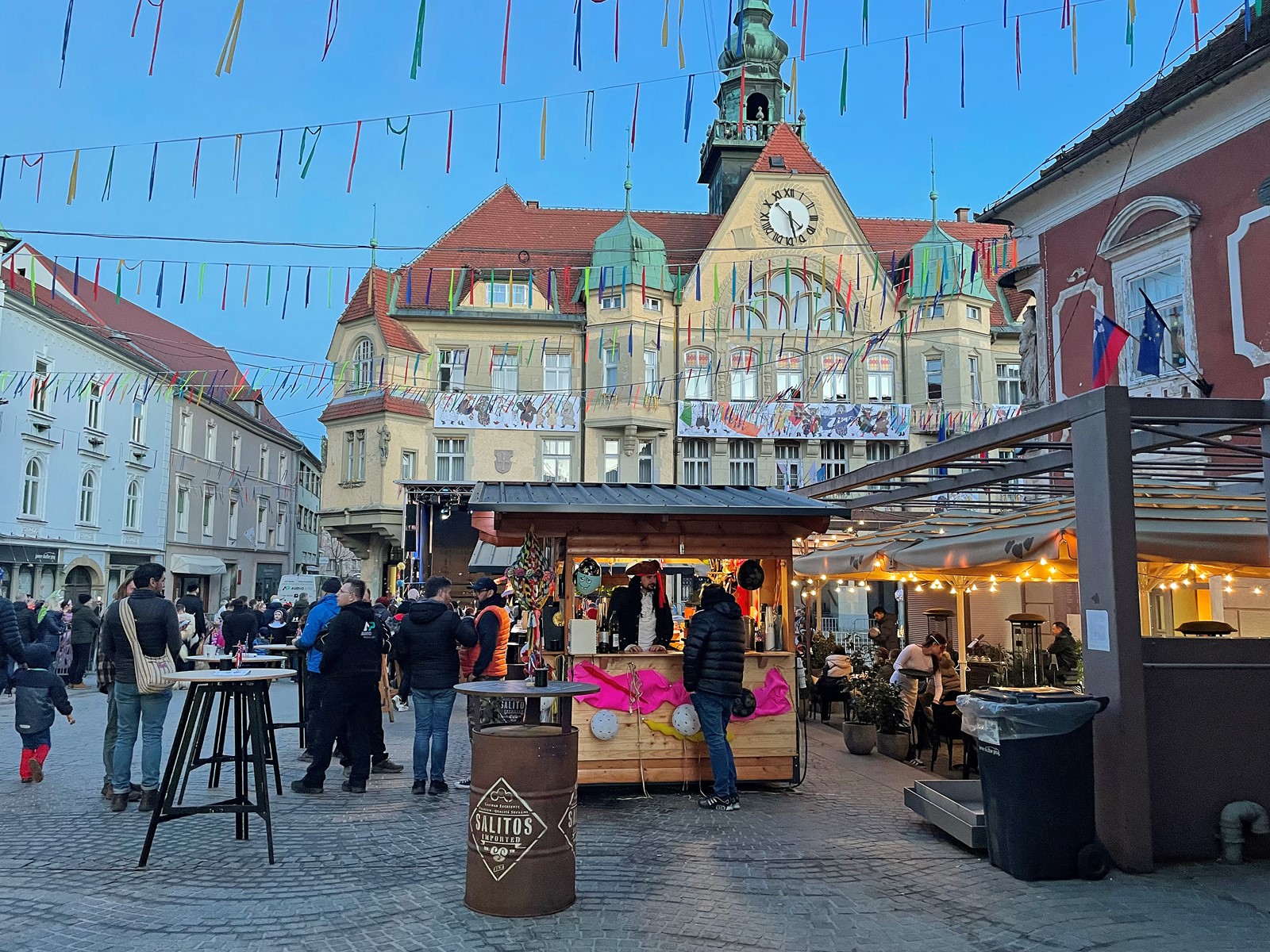
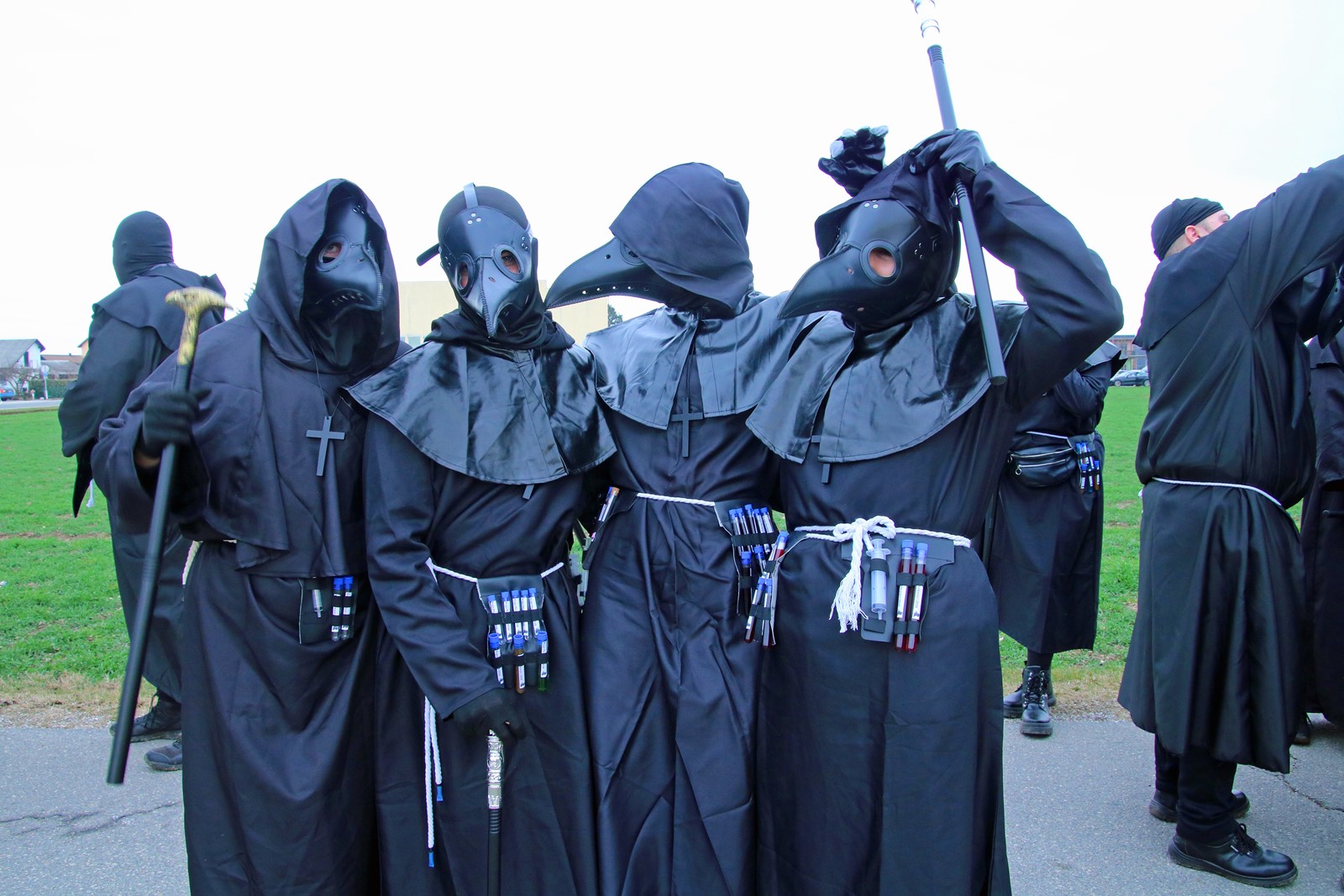
At February’s 11-day ethnographic explosion, hundreds of Kurents — along with swirling gypsies, whip-crackers, Krampus demons and folkloric figures — raucously paraded through Ptuj’s historic center, just a cobblestoned stroll from my hotel below a medieval castle. A pirate bartender in an outdoor booth sold Jagermeister shots in orange test tubes to costumed spectators, including a frog, banana, toothpaste and Minnie Mouse.
Besides reveling in Ptuj’s nightly processions and two other local carnivals — one featuring scores of human Slovenian Barbies — I hoped to experience why UNESCO listed the Kurents’ door-to-door rounds as an Intangible Cultural Heritage of Humanity in 2017. Simply put, they’re a vital “living expression” of this area’s unique culture passed down through generations.
So a few miles from Ptuj, after being tipped off at a cafe by its owner (a Kurent not in costume yet) in Spuhlja, I zipped along the main road to his rural hamlet of 900 people. On this Friday the 13th, my driver-guide-translator Janez Kopar quickly found the Kurents’ 10:30 a.m. starting spot at a mint-green ranch house playing the Guns N’ Roses song, “Sweet Child O’ Mine” and across from four horses sauntering around a pasture. For now, the Kurents had their humongous head-masks off, as did the spooky, pitchfork-wielding devils who routinely escorted them; both contingents included young kids and teens. Most of the hairy brigade didn’t speak English but they warmly welcomed me to join their countryside visits under one condition.
“If you come with us, you must drink,” a grinning Kurent said in Slovenian, handing me a pre-rounds spritzer.
Kurent Krazy
To get the lowdown, a couple days earlier I met in my Hotel Ptuj with Kurent honcho Ales Ivancic, president of the Federation of Kurenti Associations, which oversees 26 groups with a total of 1,200 fuzzy members.
What’s it like to wear a man-size costume that can require 12 dead sheep, cost $3,000 and weigh 90 pounds? “It’s a sauna in there,” Ivancic said through my interpreter, adding that the temperature inside the woolly shroud can reach 150 blazing degrees.
Although the Kurents’ origins may hark back to the fifth century or earlier, the first written mention of them was in 1829. Once upon a time, only bachelors could be Kurents, but these days you’ll find married men, their offspring and a smattering of women underneath pelts.
“You have to remember people long ago were basically living off the earth, so whatever they plowed, that was what they had to eat,” Ivancic said. “The real message of the Kurents is happiness but also fertility of nature and fertility to have children who helped work the land.”
Two days later, under crisp blue skies in Spuhlja, I rambled off with my sprawling Kurent posse, which looked like a battalion of Wookiees on steroids. We were accompanied by horned black or red devils, their masks wildly fringed with bushy lionlike manes of sheepskin, with skeleton crossbones emblazoned on their jumpsuits’ backs. No one could talk with the hefty headdresses on, and they could barely see out of peepholes obscured by their straggly bangs. Kurents have no peripheral vision, so I was accidentally poked with hedgehog pricks a couple times.
Jaunting down pastoral paths, it was obvious Kurents invaded the ’hood — their midriff bells deafeningly rang as they gyrated their unwieldy bodies en route to dramatic arrivals.
At individual homes, they formed a circle or line and boisterously jumped, whirled, shimmied and twerked, the brass cowbells intensely reverberating. Everywhere the residents excitedly waited outside, hugged their supernatural guests, and when head-masks came off and sweaty red faces emerged, they all schmoozed while refreshments flowed.
Consider it a party in motion, with a baa baa bizarre flair.
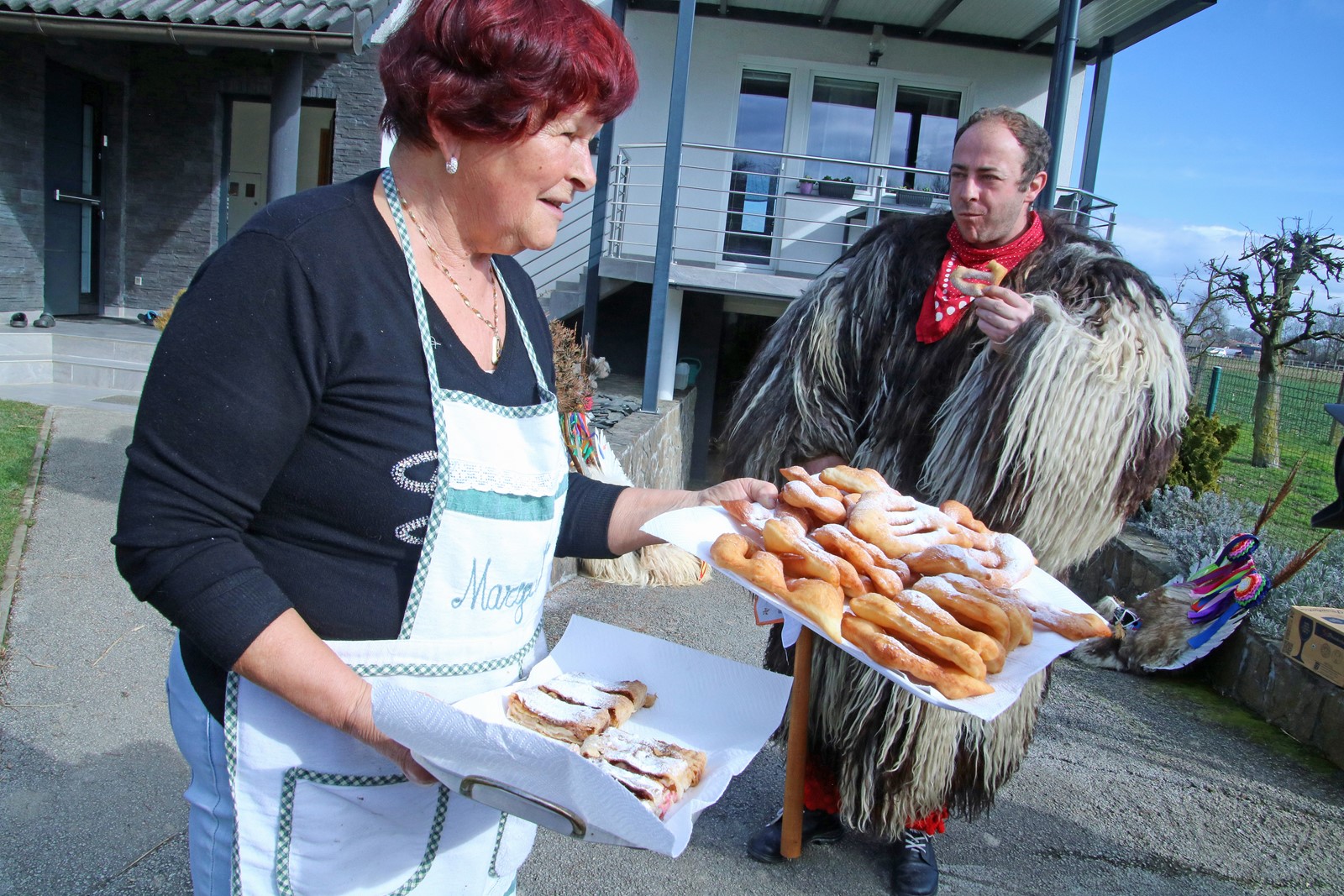
In olden days, Kurents were offered pork sausages, eggs and wine at doorsteps, all to replenish their energy and court good luck. On my route, homeowners plied Kurents and devils with pork cutlets, chicken soup, French fries, chicken nuggets, home-baked apple strudel, home-brewed red and white wine, Slovenia’s Union-label beer, schnapps (Slovenia’s national drink), pork sausage sandwiches, salami, cheese, chocolate bars and, of course, spritzers (called spicer), occasionally served in shiny glass goblets. First, though, came out heaps of krofi, the traditional, insanely delicious doughnuts crammed with apricot jam.
An estimated half-million krofi are sold during carnival in the Ptuj area (and I think I inhaled half of them).
After several door-to-door hours, a hulking Kurent told me in Slovenian, “You look thirsty,” and before I knew it a beaming, elderly resident gifted me a bottle of his homemade pear brandy with the whole fruit stuck inside.
Behind the masks
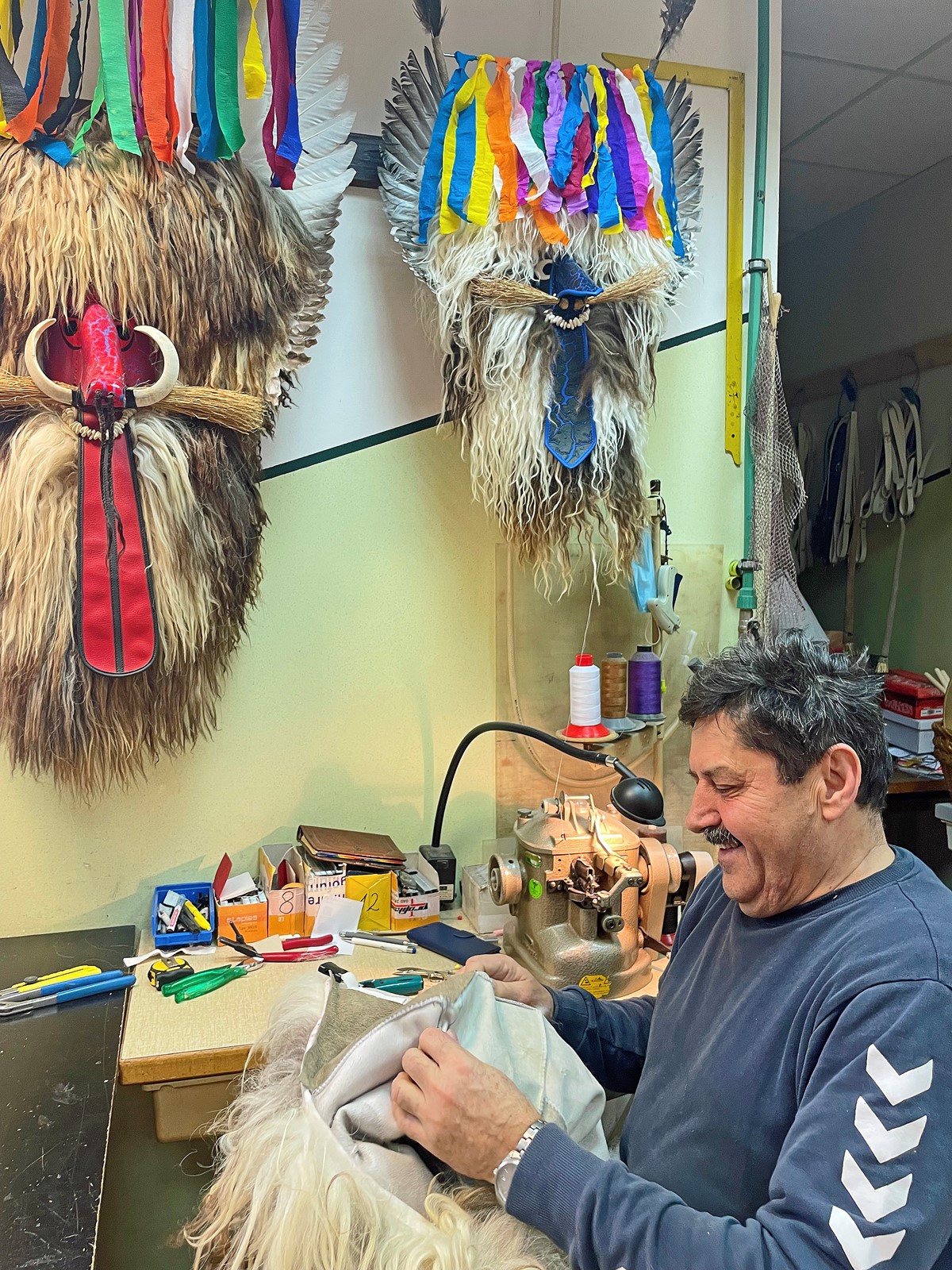
Like a surgeon, Marko Klinc carefully hand-stitches Kurent costumes in his Spuhlja workshop as unattached, beak-nosed Kurent faces weirdly stare from walls. Klinc is considered the premier artisan creating the intricate ensembles, a venerable craft he mastered from his father and passed down to his own son. He delicately paints every leather countenance, strings white beans as teeth, applies a straw mustache, and sometimes adds boar tusks. Kurents from the other side of the Drava River sport cow horns on their heads. “The faces may look alike but no two are identical,” Klinc said through my translator. A customer may require three fittings.
Obtaining the materials is the most challenging and “three-fourths of the job.” With sheepskins in short supply in Slovenia, Klinc travels to Bosnia, Scandinavia and neighboring Croatia to buy them. For the cowbells, he searches Austria, France and Italy.
Kurents are the hallowed highlights of Kurentovanje, which began in 1960, but they have many carnival cronies — log-haulers, horselike rusas, cockerels, fairies, plowmen and others. I got up close to a slew of funky costumes (and almost fell over trying on a Kurent suit) at Ptuj Castle’s hilltop museum overlooking the Drava. Afterward a museum gift shop employee insisted I taste a popular souvenir. “One of our national animals is the Carniolan bee,” she revealed, bestowing a snort of honey schnapps.
A favorite character is the “old woman carrying the old man.” Essentially, a real male stands in a bottomless wicker basket with a female mannequin attached to the front as if she’s toting him.
“This is very very funny. It’s like you have a husband who goes to the pub and he’s drunk and you need to carry him home,” said local historian Marija Hernja Masten. She gave a Slovenian-language group tour of Ptuj’s medieval square after dispensing sips of her homemade plum brandy to participants. Kurentovanje’s anointed “prince” Miro Kokol tagged along, decked out in 17th-century finery; when not a fake royal, he’s a train driver for Slovenian Railways.
There’s that joke, “A guy walks into a bar … .” Well, I was at a cozy tavern in Ptuj when a rowdy, fully garbed, bell-ringing band of Kurents walked (squeezed) into the bar after having to duck their enormous heads under the door frame and not accidentally knock drinks from patrons. You ain’t see nothing like it. I had just devoured a bowl of sirovi struklji z jurcki (cheese dumplings with porcini mushrooms) at the same establishment, the Old World-style Gostilna Rozika. Another night another wacky scene unfolded: Vivacious costumed gypsies from the just-finished parade packed the place as their musicians enthusiastically struck up folk tunes.
That gypsy evening, local Denis Kokot perched at the bar dressed in his Kurent civvies (black pants and jacket, signature red polka dot neck bandana and knee-high red knit socks). Kokot seemed psyched for the next night, the hugest public parade of Kurents in Ptuj; he’d be among the estimated 800 behemoth beasts gathering outside the Baroque, onion-domed town tower and then romping toward the main plaza.
“People around here basically live for this,” the 24-year-old explained. “My grandfather was a Kurent, my father did it and I’ve done it since I was 4. It is in our DNA.”
Surprise, surprise
Beyond Ptuj’s festivities, I soaked up two daytime carnivals in nearby agricultural villages, all boasting Kurents, pipe-smoking gypsies and the traditional folksy cast. However, in Cirkulane, the procession segued into pop culture: Human, pink-clad, blond-wigged Barbie dolls stretched into infinity. Roller-skating Barbies, cowboy Barbies, tulle-frocked Barbies, princess Barbies. In their staging area, “Ken,” wearing retro neon shorts and sun visor, distributed flutes of blueberry schnapps to the breathing adult dolls.The weather presented a chill but spring teased. In fact, on my previous door-to-door rounds in Spuhlja, younger Kurents and devils frolicked in the homeowners’ grassy backyards. They gleefully bounced on a trampoline and glided on swings. It seemed the Kurents had indeed banished winter.
Only exactly one week later, a massive snowstorm hit, closing schools and causing power outages.
 PREVIOUS ARTICLE
