


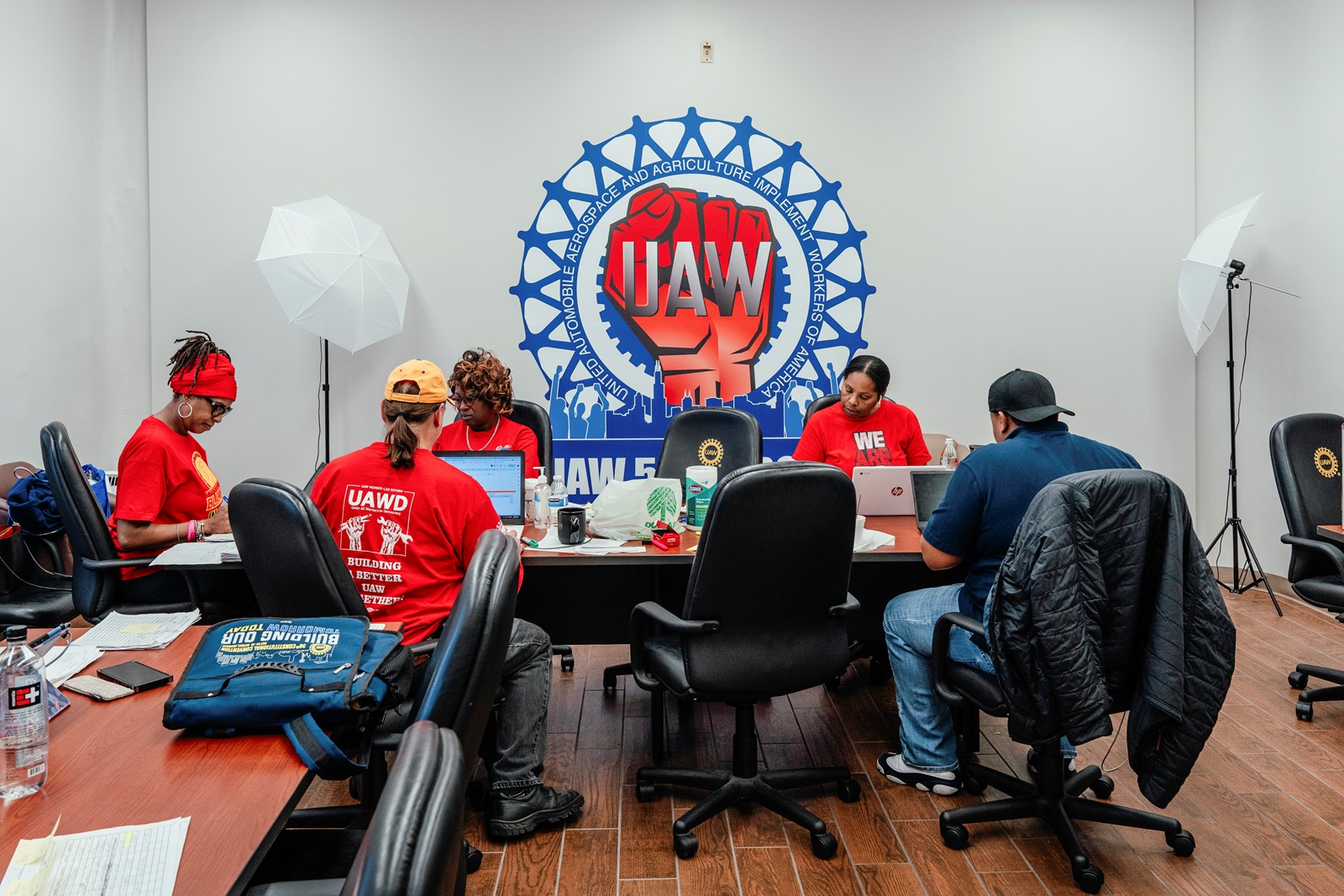


The United Auto Workers union said this week that it was undertaking an ambitious drive to organize plants owned by more than a dozen nonunion automakers, including Tesla and several foreign companies — a goal that has long eluded it.
The move comes weeks after the UAW won new contracts from General Motors, Ford Motor Co. and Stellantis that included wage increases of 25% or more over 4½ years for its 146,000 members employed there.
In addition to Tesla, the targets of the drive are two other electric vehicle startups, Lucid and Rivian, and 10 foreign-owned automakers: Toyota, Honda, Hyundai, Nissan, BMW, Mercedes-Benz, Subaru, Volkswagen, Mazda and Volvo.
The U.S. plants owned by those companies employ nearly 150,000 workers in 13 states, the union said.
If the organizing drive gains momentum, it could become one of the largest by the UAW since its infancy in the 1930s. The union’s past efforts to organize even single plants owned by the foreign automakers, concentrated in the South, came to naught.
A foothold among those companies would signal a shift in the American auto industry, where nonunion manufacturers have long had a significant cost advantage over the Detroit automakers.
The union said the organizing drive had been prompted by inquiries from several thousand workers at nonunion plants.
“Workers across the country, from the West to the Midwest and especially in the South, are reaching out to join our movement and to join the UAW,” the union’s president, Shawn Fain, said in a video posted on Facebook.
“The money is there,” he said. “The time is right.”
A Honda statement cited the automaker’s “competitive wages and benefits,” adding, “We do not believe an outside party would enhance the excellent employment experience of our associates.” Subaru did not comment directly on the union drive but referred to a series of wage increases and a comprehensive benefits package.
Rivian and Volkswagen said they had no comment.
The other companies did not immediately respond to requests for comment.
On Wednesday, the UAW activated websites where workers can electronically sign cards that serve as an official certification of their desire to have union representation.
Earlier, at a handful of plants, the UAW had already received signed cards from more than 30% of the workforce, the threshold required under federal law for the union to move forward with a vote on unionization, a person familiar with the matter said.
The union is now working to send organizers to areas around these nonunion plants to collaborate with workers at those factories, this person said.
After the UAW reached agreements with the Detroit automakers to raise wages, Toyota, Honda and Hyundai announced that they, too, would increase workers’ pay.
Toyota has told workers that it will raise hourly rates 9% in January. Honda will lift wages 11% and Hyundai 14% next year. Hyundai plans to increase wages 25% by 2028.
The UAW said Wednesday that it was making a concerted effort to organize a large Toyota plant in Georgetown, Kentucky, that employs about 7,800 workers and produces the Camry sedan and RAV4 sport utility vehicle.
UAW members have long earned more than nonunion workers.
At plants in the South, wages tend to start below $20 an hour and top out at less than $30. The top UAW hourly wage, previously $32, climbed to more than $40 in the contracts the union signed with the three Detroit manufacturers.
 PREVIOUS ARTICLE

