


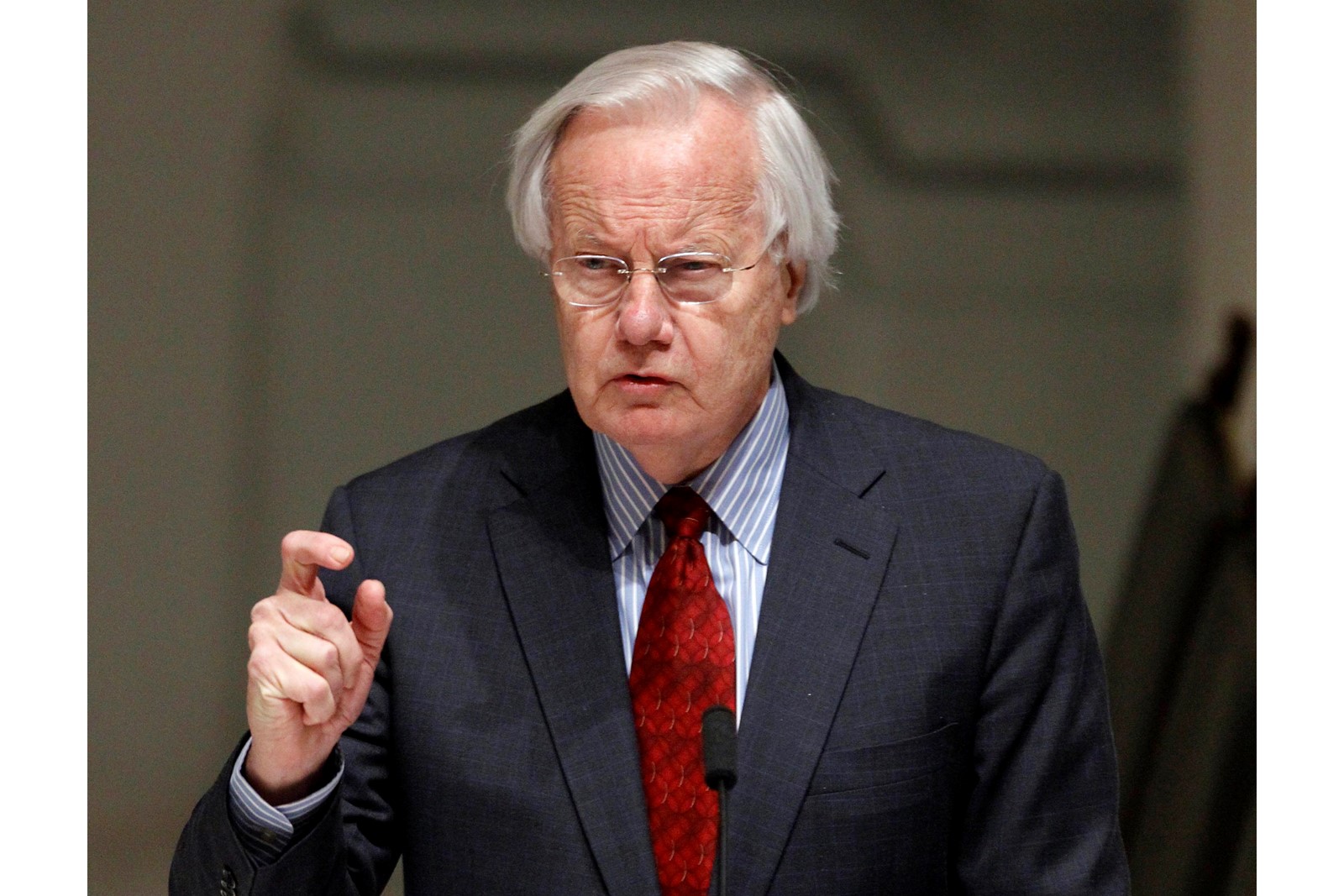


NEW YORK — Bill Moyers, the former White House press secretary who became one of television’s most honored journalists, masterfully using a visual medium to illuminate a world of ideas, died Thursday at age 91.
Moyers died in a New York City hospital, according to longtime friend Tom Johnson, the former CEO of CNN and an assistant to Moyers during Lyndon B. Johnson’s administration. Moyers’ son William said his father died at Memorial Sloan Kettering in New York after a “long illness.”
Moyers’ career ranged from youthful Baptist minister to deputy director of the Peace Corps, from Johnson’s press secretary to newspaper publisher, senior news analyst for “The CBS Evening News” and chief correspondent for “CBS Reports.”
But it was for public television that Moyers produced some of TV’s most cerebral and provocative series. In hundreds of hours of PBS programs, he proved at home with subjects ranging from government corruption to modern dance, from drug addiction to media consolidation, from religion to environmental abuse.
In 1988, Moyers produced “The Secret Government” about the Iran-Contra scandal during the Reagan administration and simultaneously published a book under the same name. Around that time, he galvanized viewers with “Joseph Campbell and the Power of Myth,” a series of six one-hour interviews with the prominent religious scholar. The accompanying book became a best-seller.
His televised chats with poet Robert Bly almost single-handedly launched the 1990s Men’s Movement, and his 1993 series “Healing and the Mind” had a profound impact on the medical community and on medical education.
In a medium that supposedly abhors “talking heads” — shots of subject and interviewer talking — Moyers came to specialize in just that. He once explained why: “The question is, are the talking heads thinking minds and thinking people? Are they interesting to watch? I think the most fascinating production value is the human face.”
Demonstrating what someone called “a soft, probing style” in the native Texas accent he never lost, Moyers was a humanist who investigated the world with a calm, reasoned perspective, whatever the subject.
Public television (and his self-financed production company) gave him free rein to throw “the conversation of democracy open to all comers,” he said in a 2007 interview with The Associated Press.
Over the years, Moyers was showered with honors, including more than 30 Emmys, 11 George Foster Peabody awards, three George Polks and, twice, the Alfred I. duPont-Columbia University Gold Baton Award for career excellence in broadcast journalism. In 1995, he was inducted into the Television Hall of Fame.
From sports to sports writing
Born in Hugo, Oklahoma, on June 5, 1934, Billy Don Moyers was the son of a dirt farmer-truck driver who soon moved his family to Marshall, Texas. High school led him into journalism.
He worked for the Marshall News Messenger at age 16. Deciding that Bill Moyers was a more appropriate byline for a sportswriter, he dropped the “y” from his name.
He graduated from the University of Texas and earned a master’s in divinity from Southwestern Baptist Theological Seminary. He was ordained and preached part time at two churches but later decided his call to the ministry “was a wrong number.”
On the day John F. Kennedy was assassinated in Dallas, Moyers was in Austin helping with the presidential trip. He flew back to Washington on Air Force One with newly sworn-in President Johnson, for whom he held various jobs over the ensuing years, including press secretary.
Moyers’ stint as presidential press secretary was marked by efforts to mend the deteriorating relationship between Johnson and the media. But the Vietnam war took its toll and Moyers resigned in December 1966.
In 1967, Moyers became publisher of Long Island-based Newsday and concentrated on adding news analyses, investigative pieces and lively features. Within three years, the suburban daily had won two Pulitzers. He left the paper in 1970 after the ownership changed. That summer, he traveled 13,000 miles around the country and wrote a best-selling account of his odyssey: “Listening to America: a Traveler Rediscovers His Country.”
His next venture was in public television and he won critical acclaim for “Bill Moyers Journal,” a series in which interviews ranged from Gunnar Myrdal, the Swedish economist, to poet Maya Angelou. He was chief correspondent of “CBS Reports” from 1976 to 1978, went back to PBS for three years, and then was senior news analyst for CBS from 1981 to 1986.
Then in 1986, he and his wife, Judith Davidson Moyers, became their own bosses by forming Public Affairs Television, an independent shop that has not only produced programs such as the 10-hour “In Search of the Constitution,” but also paid for them through its own fundraising efforts.
 PREVIOUS ARTICLE
