


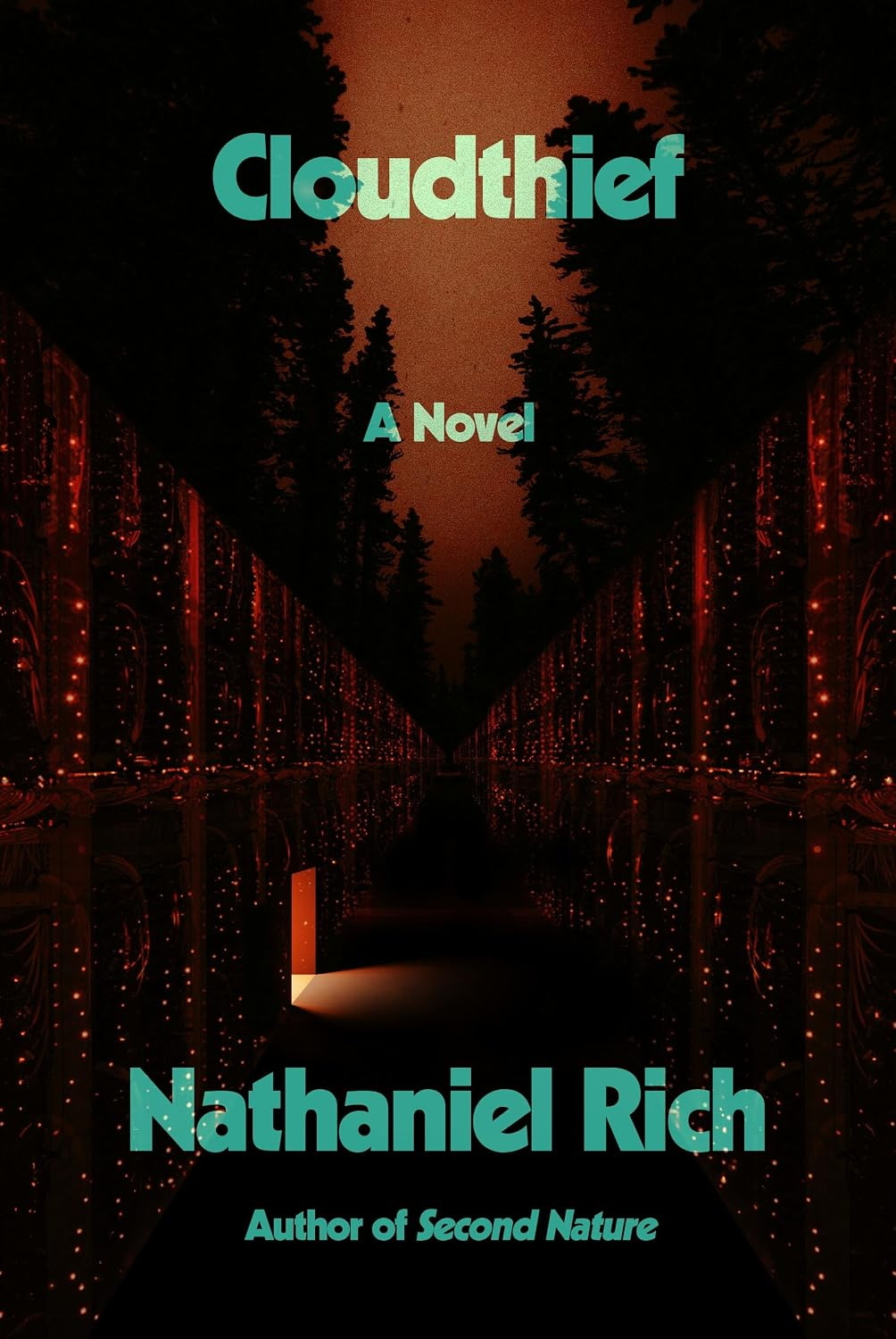


Nathaniel Rich has been an authoritative voice on the climate beat for more than a decade, publishing books and magazine stories that document our radically changing planet and the ways humans respond to it. His 2013 novel “Odds Against Tomorrow” envisioned — in a way that felt cutting-edge at the time — a cataclysmic hurricane that floods New York City. In “Losing Earth” (2019), Rich chronicled the crucial years when we first grasped humankind’s destructive impacts but failed to contain them while we still could.
Tim, the bumbling protagonist of Rich’s fourth novel, “Cloudthief,” is a climate journalist who writes magazine pieces that sound a lot like Rich’s. But he’s markedly less successful: Unlike Rich, Tim has no prizes or books to his name, and he barely scrapes by on freelance checks.
When Virginia, an alluring, privacy-obsessed woman he meets by chance, proposes they work together to steal servers from a data center and use the information they contain for profit, he’s almost instantly game. Maybe the plan will work, and Tim will be freed from the crumbling magazine industry. Maybe it won’t, but he will somehow (he tells himself) spin it all into some truly great copy. And maybe he’ll get laid.
What follows is a road trip that culminates in a heist caper. Rich inhabits both of these familiar forms with brisk effectiveness — he’s especially good with snappy dialogue — and sprinkles them with a hefty dusting of contemporary topicality. There are frequent passages about climate change and digital surveillance that, with slight adjustments, would not be out of place in Rich’s nonfiction. Most of this material will be familiar to his readers.
Underneath the topical coating, though, “Cloudthief” isn’t really about data centers, privacy or climate change. Its main subject seems to be Tim’s malaise — and, perhaps, a broader contemporary malaise for which Tim’s is meant to be a stand-in. He’s not just tired of climate journalism or the freelance life; he’s tired of his life, period:
I guess you could say I had burned out (or sunk into a hole). I couldn’t go on. But I couldn’t afford to stop … I needed money or I wouldn’t have an apartment. Yes, I might have applied for a comms job, regurgitating the same press releases I received daily, but I’d rather roughneck on a rig in the Gulf. I needed … what, exactly? Glory? Love? Fulfillment? Yes, each of these things, along with a hundred other inscrutable feelings threaded together in a mysterious totality, the shape and heft of which I had only begun to sense.
This is partly why he’s so drawn to Virginia and her less-than-fully-sketched-out scheme. She’s a rocket pointed straight toward transformation. With her, life feels exciting, up for grabs.
But Rich might have been afraid of putting too much explanatory weight on a writer’s existential boredom (or horniness). It’s as if he felt an obligation to make his characters’ actions more legible by providing motivations and back stories, but also resented having to write them and rushed accordingly. The tacked-on information about the characters’ childhoods and family woes is much less thought through than their digressions on global temperatures and server farms (much less interesting, too), and they make the novel feel less, not more, alive.
The book’s strongest component, by far, is the relationship between Tim and Virginia, which crackles with true-to-life ambiguity. They like each other. They’re using each other. Where’s the line? Neither character can say for sure, nor can the reader, and their interactions are all the more interesting for it.
On the road, the duo develops a sexual relationship charged by mystery and play. We come to understand that what’s going on between them in their motel bedrooms is, at least for Tim, revelatory, attuning him to aspects of his personhood he’d previously overlooked. But, in a touch that dovetails delightfully with the novel’s topical subjects, the erotic specifics are almost entirely blurred out. By evoking the special human quality of their sex without showing the act, Rich nimbly reconstructs the wall of intimate privacy that cloud-enabled surveillance constantly threatens to erode.
But the novel rarely achieves this level of synergy between theme, plot and writerly technique. Tim, we come to understand, is throwing stuff at the wall of his life, desperate to see what might forge a break, launch him into a new chapter — but ultimately not quite getting there. “Cloudthief,” for all its author’s obvious skill, is a similar gesture.
 PREVIOUS ARTICLE
