


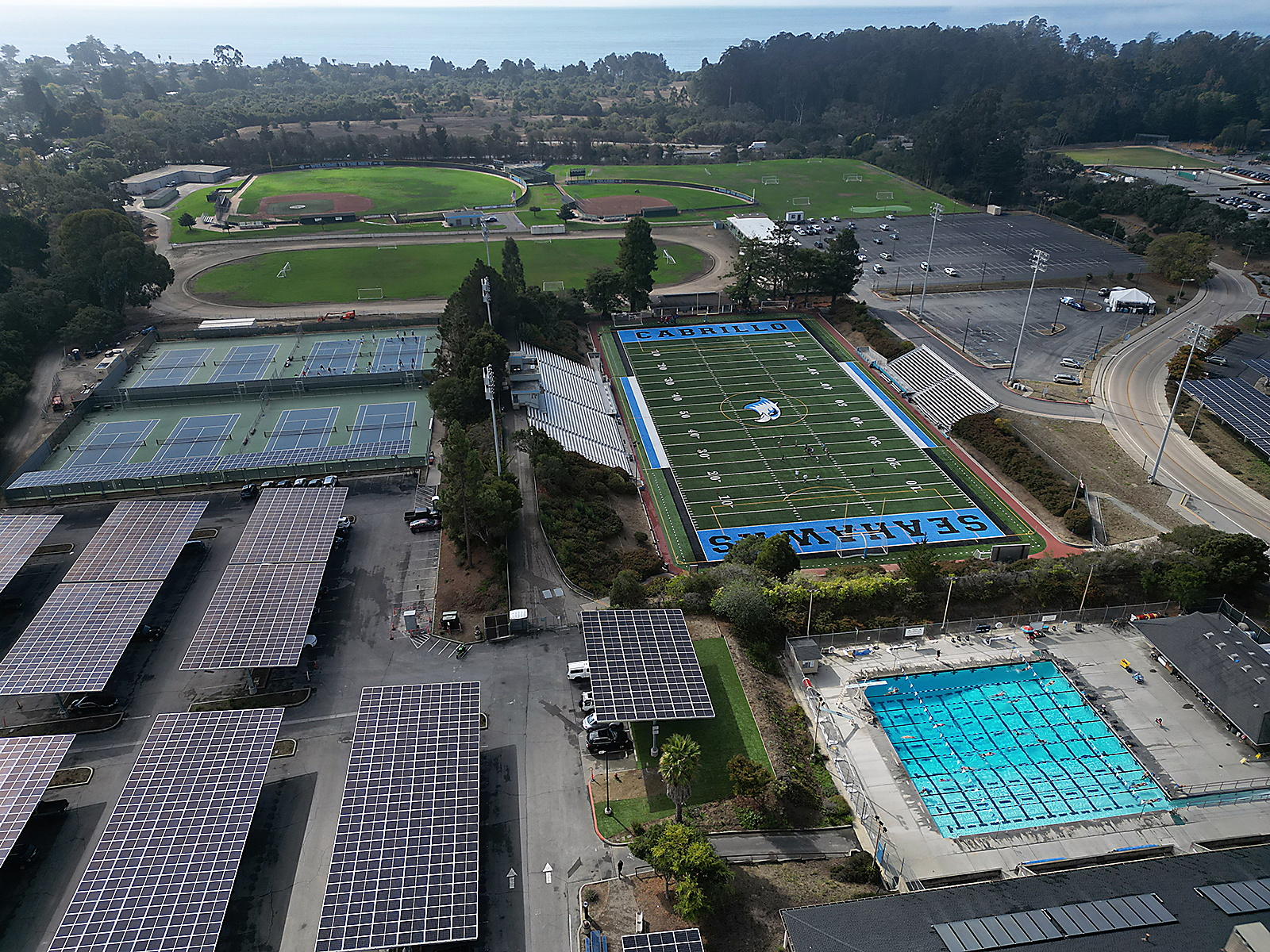


APTOS >> A student housing project in Aptos took a big step toward construction this week as decision-makers from Cabrillo College selected a developer and operator, aiming to break ground by next fall.
The Cabrillo College Board of Trustees named Greystar, an international real estate company, as the developer and operator of its 624-bed housing project slated for construction on its Aptos campus.
The estimated $181 million project has been years in the making. Although Cabrillo is the lead agency, the project is jointly supported by UC Santa Cruz and will be used to house many of its students as well.
“It’s a historic project,” Cabrillo President and Superintendent Matt Wetstein said during the board’s Monday meeting. “This is an incredible game changer for our students … the ability for students to seamlessly transfer from our institution to UCSC without even having to move and stay in that residence hall is an incredible achievement.”
Development plans include a four-story, approximately 50-foot tall, 250,000-square-foot building space on the multipurpose athletic fields in the southwestern portion of the campus, near the softball and baseball diamonds. The project, with help from former Cabrillo trustee and current state Sen. John Laird, was awarded a $111 million grant by the state last year to complement a pledge of $70 million from UCSC.
Touted as a project that will help alleviate the housing crisis in Santa Cruz County and the estimated 20% of Cabrillo students that are housing insecure, affordability requirements will set average rents at $1,046 per month. Moreover, the units will be divided among Cabrillo and UCSC students at a 60:40 ratio, respectively, according to a release from the community college.
“We are thrilled to see this student housing project advancing to the next phase,” UCSC Chancellor Cynthia Larive said in a Cabrillo release. “It will provide essential, affordable housing for our students and Cabrillo students. The project will also strengthen the transfer pathway between our institutions, giving students the opportunity to start at Cabrillo, then finish with a bachelor’s degree from UC Santa Cruz, all while living in the same housing. That is both unique and extremely beneficial.”
Brynna McComb, a project manager with JLL, the advisory group helping with pre-development, outlined a project timeline during the meeting that included a groundbreaking in the fall of next year and a targeted completion of July 2027.
“I was just marveling at what feels like an ambitious timetable,” remarked Trustee Christina Cuevas after a brief presentation on the project.
McComb replied, “It’s ambitious, but that’s what we’re aiming for.”
The board also unanimously voted to permit an addendum to the school’s 1999 environmental impact report in order to clear the way for housing construction. An analysis from consultants determined that an addendum to the original environmental document was all that was needed, given that the project isn’t expected to spark any new significant impacts, and no new mitigation measures are required that differ from the 1999 study.
Newly appointed Trustee Manuel Bersamin raised concerns that the Santa Cruz Mid-County Groundwater Basin, which supplies water to the Aptos region, has been critically overdrafted for decades and questioned how a large housing project could be justified given that problem.
Paul Stephenson, a senior managing associate with Environmental Science Associates, the consultant that prepared the addendum, said the Soquel Creek Water District’s Pure Water Soquel project — set to come online early next year — alleviated water shortage concerns. The new facility at Soquel and Chanticleer avenues will take in 1.3 million gallons of treated wastewater from Santa Cruz, purify it through its own filtration system and inject it into underground wells that will help bring the basin back into a place of sustainability, while buffering against creeping seawater intrusion.
“In the addendum, we prepared an analysis that showed that, even with our project, the demand plus our project would not exceed that sustainable pumping limit,” said Stephenson.
The student housing project will also be built as part of a public-private partnership, which allows the public entity to keep focused on delivering its core mission and services, while its private sector counterpart can assume some of the capital and construction risks of a proposed project.
Cabrillo selected Collegiate Housing Foundation as its private partner, a nonprofit that has worked with colleges and universities across the country to provide them with the benefits of housing facility ownership without their having to assume responsibility for financial, construction or operational elements.
 PREVIOUS ARTICLE
