


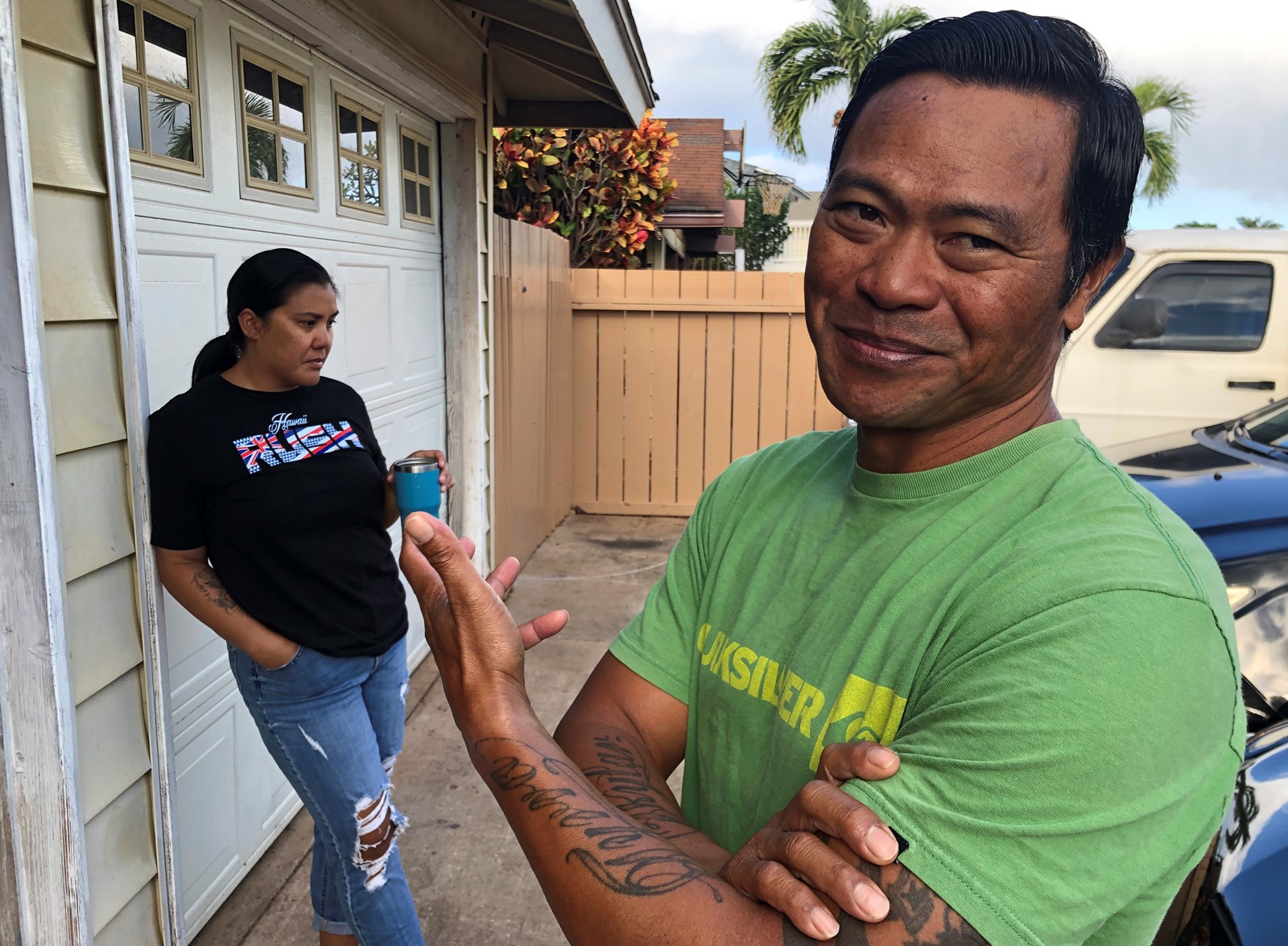


WAIANAE, Hawaii — Tedorian Gallano would like to buy a house for his wife and three youngest children in Hawaii, but real estate prices soared so high eight years ago he moved his family back to his childhood home outside Honolulu — and last year, his older brother followed suit.
Now, eight members from three generations of Gallano’s extended family share one bathroom in a house that’s so packed they’ve jerry-rigged an extra bedroom in the garage. Buying a home is “pretty much unattainable for the average working family” in Hawaii, the 49-year-old carpenter said.
“We always seem to have these hot markets that drive the prices up, and then it’s the hardworking local families that cannot buy houses who are kind of left out,” said Gallano, who’s a member of the carpenters’ union that’s been active on the issue.
Gallano’s situation is emblematic of the acute affordable housing crisis afflicting Hawaii, a problem so deep that there’s now widespread concern that many of Hawaii’s children won’t be able to afford to live there as adults. Many residents are fearful their entire state — a diverse and culturally vibrant society with unique values and a complex identity — is being gentrified before their eyes as home prices soar.
The median price of a single-family home topped $1 million in most areas of Hawaii during the coronavirus pandemic and has declined only modestly since. The state has the fourth-highest per capita rate of homelessness in the nation after California, Vermont and Oregon. Last week, new data showed the islands experienced net population loss five of the last six years. In 2022, U.S. census data showed more Native Hawaiians live outside Hawaii than within.
Now, amid growing urgency, both the governor and Hawaii’s legislative leaders are making housing a top priority.
In one of his first moves after taking office in January, Democratic Gov. Josh Green created a new housing czar to oversee the effort. One thing Chief Housing Officer Nani Medeiros is focused on is identifying roadblocks and redundant permitting at local and state levels that can hold up construction. The administration also wants to pour $1 billion into housing programs, including $450 million to subsidize the construction of affordable dwellings.
Lawmakers have sponsored bills to trim bureaucracy, fund public housing renovations and encourage construction of dense housing on state land next to Honolulu’s planned rail line.
Determined to find solutions, a college student taking a break during COVID-19 and a recent college graduate co-founded a nonprofit advocacy organization called Housing Hawaii’s Future to lobby on the issue. Nearly 1,500 people have signed their pledge to back more housing.
“It really bothers me that we are saying to the young people of Hawaii, ‘It’s great that you might have been born and raised and educated here, but now that you’ve become an adult, you have to leave, and you cannot come back,’ ” said state Sen. Stanley Chang, a Democrat who chairs the Senate housing committee.
Some moves to shore up affordable housing by easing development regulations are being met with trepidation by conservationists, who warn that going too far in that direction could endanger the islands’ world-famous ecosystems and farmland.
But currently, housing construction is not keeping up with demand. Only 1,000 to 2,000 new housing units are being built in Hawaii each year. Those numbers are dwarfed by the 50,000 new units a 2019 state-commissioned study estimated would be needed by 2025.
In contrast, in 1973, Honolulu approved permits for some 13,700 housing units, and the state’s three other main counties approved more than 4,000, said Paul Brewbaker, an economics consultant with TZ Economics.
In extreme cases, developers face backlogs of years, or even decades.
 PREVIOUS ARTICLE

