


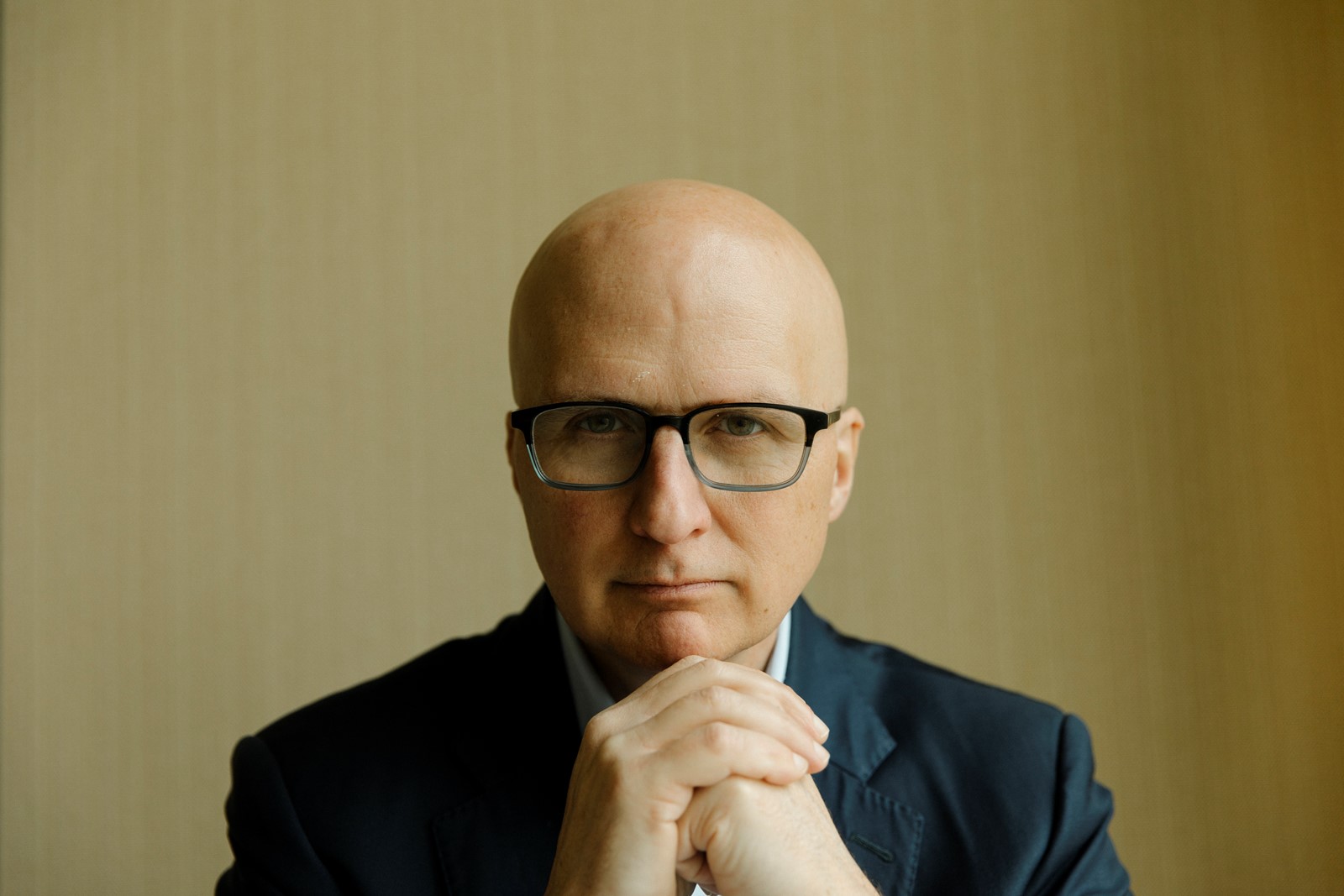



In the two years since Aaron Renn moved to Carmel, Indiana, he has become a kind of unofficial booster for the unusual suburb of Indianapolis.
For Renn, Carmel is proof that “we can have an America where things still work.” Run by Republicans for decades, with the same mayor from 1996 to 2024, the city has built big and beautifully, often in traditionalist architectural styles. The streets — bikeable and walkable — are almost eerily free of trash. Police officers enforce traffic laws strictly, and drivers behave with a noticeable lack of aggression. It’s Mayberry, or Bedford Falls.
I traveled to Carmel in February to talk with Renn about the ideas that had made him a new star in conservative Christian intellectual circles. But we ended up spending almost as much time talking about the city.
Renn loves city life and has lived in New York City, Chicago and Indianapolis. Carmel is different. Here, church bells chime full hymns over the town square. It’s a place where it’s easy to forget Renn’s best-known idea: his warning to Christians that America is in an era of distinct hostility to believers like them and that they must gird themselves to adapt to, as the title of his recent book put it, “Life in the Negative World.”
Renn’s schema is straightforward. Modern American history, he argues, can be divided into three epochs when it comes to the status of Christianity. In “positive world,” between 1964 and 1994, being a Christian in America generally enhanced one’s social status. It was a good thing to be known as a churchgoer, and “Christian moral norms” were the basic norms of the broader American culture. Then, in “neutral world,” which lasted roughly until 2014 — Renn acknowledges the dates are imprecise — Christianity no longer had a privileged status, but it was seen as one of many valid options in a pluralist public square.
About a decade ago, around the time that the Supreme Court’s ruling in Obergefell v. Hodges made same-sex marriage legal nationwide, Renn says the United States became “negative world.” Being a Christian, especially in high-status domains, is a social negative, he argues, and holding to traditional Christian moral views, particularly related to sex and gender, is seen as “a threat to the public good and new public moral order.”
Renn depicts a pattern: Christians who hold traditional beliefs about a range of social and political issues have come to be treated as pariahs by secular elites even if they have made an effort to avoid gratuitous offense. The phenomenon goes beyond “cancel culture” to describe a kind of wholesale skepticism of many Christian beliefs and behaviors in domains like academia and the corporate world.
Renn’s notion that Christians have no choice but to exist as a countercultural presence in “negative world” sparked a furious and continuing intra-evangelical debate. His critics say Christians should be a countercultural presence regardless of the prevailing cultural atmosphere, because true Christian values do not map neatly onto partisan politics. They also point out that Christians remain the country’s dominant religious group.
But “negative world” is now the dominant framework for many people trying to understand their place in contemporary America.
And these days, Renn is wondering whether a new epoch is dawning.
Renn has an unusual profile for someone who has captured the attention of American evangelicalism. He is not a pastor, an academic or a politician. He has no institutional affiliations with high-profile evangelical organizations. He is a mild-mannered former consultant with a wide-ranging Substack whose topics include urban policy, self-improvement and masculinity.
Born in 1969, Renn grew up in rural southern Indiana, almost in Kentucky. Renn was his class valedictorian and an obviously intelligent student, but no one around him suggested that he apply to any prestigious colleges. He chose Indiana University because he was a fan of their sports teams, and majored in finance because he wouldn’t have to take a foreign language. After graduation, he moved to Chicago and began working for Andersen Consulting, which later became Accenture.
Renn started thinking of himself as a city guy and began a popular email newsletter about Chicago public transportation. In 2009, he won $5,000 in a Chamber of Commerce contest soliciting new ideas for the city’s public transportation system.
In Chicago, he began reading and listening to sermons by a Presbyterian pastor in Manhattan, the Rev. Tim Keller, who was popular among urban creative-class evangelicals. Keller held that Christianity was politically neither right nor left and that the church could minister and appeal to urbanites without compromising its core beliefs.
Renn, who had always been politically conservative but dipped in and out of serious faith, was convinced. He sought out a church in Chicago and settled in.
Renn was married for eight years in Chicago, a relationship he has a policy of not talking or writing about, explaining that it’s “not a good look.”
In the wake of his divorce, Renn said, he was in a low moment professionally and personally. He credits his recovery in part to the “manosphere,” the network of masculinity influencers that he identified as a serious cultural phenomenon long before it burst onto the national political scene.
Renn sketched out the first public version of his “negative world” framework in his email newsletter in the fall of 2017, which went modestly viral when conservative writer Rod Dreher shared it online, calling it “one of the most insightful things I’ve read in a long time.” Renn had told his friends that he planned to shut down the newsletter at the end of the year if it did not reach 500 subscribers. He had only gotten about halfway to that figure in October when Dreher’s boost brought in more than 1,000 new subscribers.
Renn’s description of the contours of “negative world” range widely and include the spread of sports gambling, legalized drug use and even tattoos. But the framework might not have electrified evangelical America if not for the perception on the right of a new secular orthodoxy around sex, gender and race. When you ask someone who embraces the term to discuss their own experiences in “negative world,” the answer is almost always connected with this cluster of issues.
On the Christian right, then, a thesis is emerging: If conservative Christians are no longer a “moral majority” but a moral minority, they must shift tactics. They ought to be less concerned with persuading the rest of the country they are relevant and can fit perfectly well in secular spaces. They don’t. Instead, they must consider abandoning mainstream institutions like public schools and build their own alternatives. They must pursue ownership of businesses and real estate. And they must stop triangulating away from difficult teachings on matters like sexuality and gender differences. Resilience over relevance.
Renn’s many critics argue that some Christians have always lived in “negative world.” The Civil Rights Movement was led by a minister who was imprisoned and assassinated for activism that was founded on Christian principles. (Renn replies that activists like the Rev. Martin Luther King Jr. were persecuted because they were Black, not because they were Christians.)
“That’s the dangerous part, thinking that we’re living in a unique, unprecedented historical moment, as if we’re the first Christians in the last half-century to face serious restrictions on their faith,” said Patrick Miller, a pastor. “It has a tendency to justify more extreme measures in response.”
From the perspective of a certain kind of conservative Christian, the last few months in American politics and culture have frequently been exhilarating. Donald Trump became president. Tech companies are pivoting to the right. Bible sales are booming. The decline in the share of Americans who say they are Christians seems to have stopped, or at least paused. Celebrities, activists and former atheists are publicly converting.
A few days before Trump’s inauguration, Renn devoted an installment of his newsletter to the question on many of his readers’ minds: “Is the Negative World Coming to an End?”
Renn is not ready to answer definitively yet. It’s far too early, he says, and the “vibe shift” is too fragile. But he says he does see a clear new openness to Christianity among some people, and a broader course correction to the right.
“The Overton window of what you can say and do is much wider,” Renn said. People on the left are more comfortable criticizing what they describe as the excesses of diversity, equity and inclusion programs, for example. And Renn noted that when an employee of Elon Musk’s Department of Government Efficiency resigned following the discovery of racist online posts he had made in 2024, Vice President JD Vance wrote online that the man should be reinstated, referring to the posts as “stupid social media activity.”
Renn condemned the employee’s racist posts. But he said the context for forgiving the employee was important, coming after years in which, he claimed, “you could say anything you wanted about white people, but you could have your life destroyed for anything slightly out of line regarding minorities.”
It is a familiar theme: Things may be bad, but liberals started it. The election of Trump as president is only possible in “negative world,” Renn said. In “positive world,” an extramarital affair tanked Gary Hart’s presidential campaign. In “neutral world,” Bill Clinton was damaged by his infidelity but survived politically. In “negative world,” with the safeguards of “Christian moral norms” out the window, it was too late for liberals to make any coherent critique of Trump’s open licentiousness.
“The very people who were the most supportive of tearing down all the old moral standards and rules of fine society that they didn’t like are the ones who are most horrified by Donald Trump,” he said, with what looked like a flash of satisfaction. “You think you’re going to get a multiculti paradise or something, and instead you get Donald Trump.”
He would prefer to return to a culture of shared social norms: against racism, but also against the cruel, the tasteless and the boorish. But he’s not counting on it. The broad erosion of the old moral order is probably permanent, in his view. The pushback in the 1980s against the liberal excesses of the ‘60s and ‘70s did not undo the sexual revolution. The task for Christians of adapting to “negative world” remains urgent.
In Carmel, however, it was possible to glimpse a slice of “neutral world,” where all are welcome but “there’s no shame in being a conservative Christian.” After lunch, Renn drove me around his new hometown and pointed out the city’s religious diversity: the Coptic Orthodox church, the synagogue shared by two congregations, the Church of Jesus Christ of Latter-day Saints temple, the Muslim coffee shop. He mentioned the city’s meager but growing minority population, too. Carmel has “diversity that works,” he said.
Carmel is thriving, in Renn’s view, because its Republican leaders have focused on things like public safety, low taxes and excellent infrastructure and amenities, avoiding the distractions of what he called “extreme ideologies,” like DEI hiring practices or banning gasoline-powered lawn equipment.
It’s a place where things run the way they ought to everywhere — and why shouldn’t they? “When you look at America,” Renn said, “the potential we have is unlimited.”
 PREVIOUS ARTICLE
