


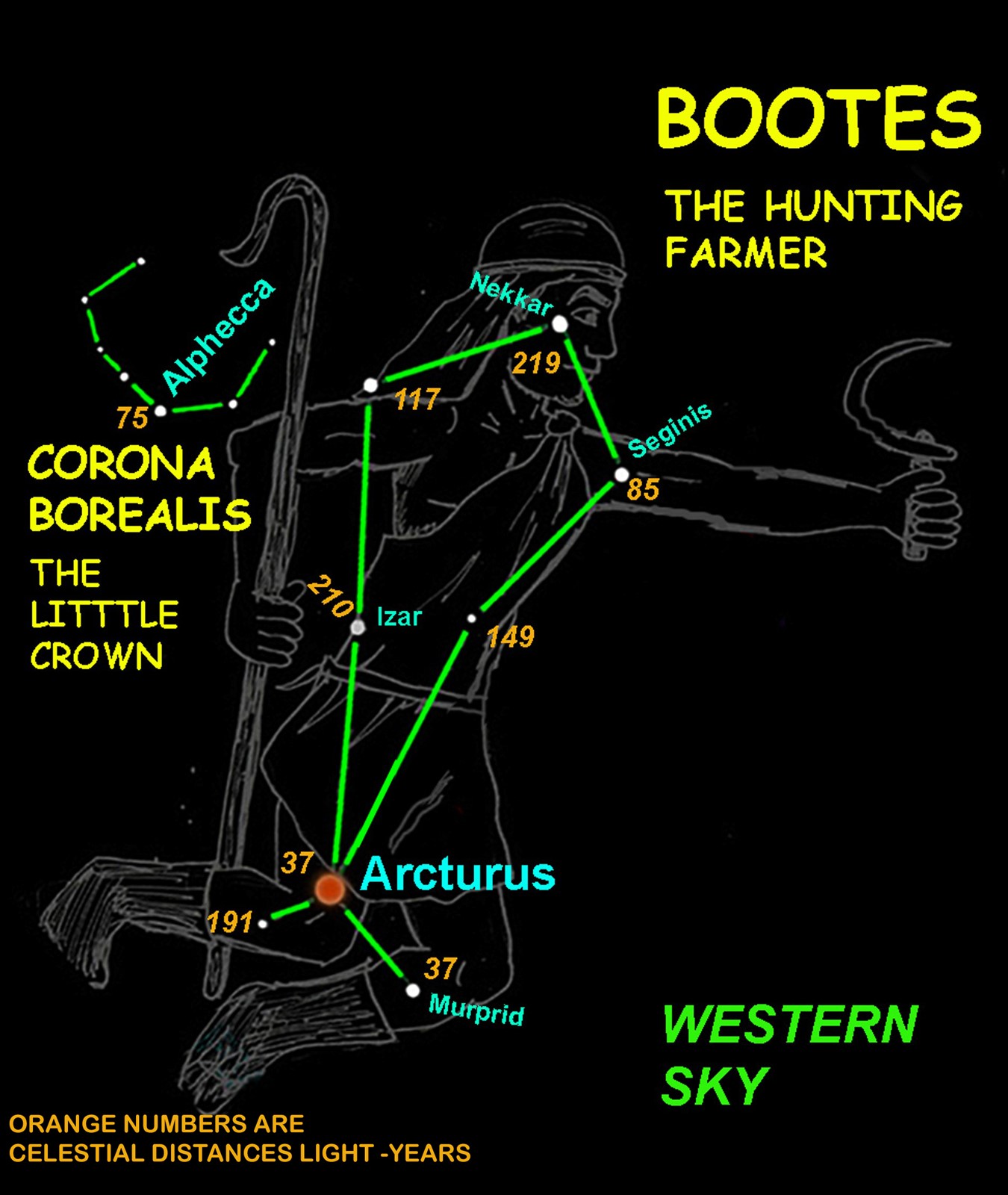


Since early spring, the constellation Bootes the Herdsman has graced our Pottsville night skies, but now it’s well into its gradual farewell in the western heavens. The correct pronunciation is BOO-OAT-TEES. No matter how you say it, Bootes doesn’t really look that much like a herdsman, but resembles a giant kite flying high in the western skies. Finding Bootes early in the evening is easy. Just look for the brightest star after evening twilight in the western sky. That’s Arcturus, not only the brightest star in Bootes, but the second brightest star we see in our entire night sky any time of the year. It’s certainly the brightest star of summer.
If you need confirmation that you’re seeing Arcturus, use the old stargazing rule “arc to Arcturus”. Look at the nearby Big Dipper in the northwestern sky and follow the curve, or arc of its handle beyond the end of the handle, and you’ll run right into the bright orange-red-tinted star. Arcturus appears to be at the tail of a giant upright celestial kite. Just look above Arcturus and you should see the rest of the kite. Some folks also see Bootes as an overloaded ice cream cone.
Arcturus’s orange-red glow is typical of stars classified as red giants. Even though Arcturus is 25 times the diameter of our sun, it’s only 1.5 times as massive. Arcturus is running out of hydrogen fuel in its core. When that happens stars puff out into red giants. That’ll happen to our own sun in about five billion years. Arcturus is just about 37 light-years away, or about 214 trillion miles, and that’s considered a nearby star. Arcturus is so far away that the light we see from it tonight left that star in 1988 when the price of a movie ticket was only around $4.
Take a good look at Bootes now because as September rolls into October, Arcturus and Bootes will start out the evening lower and lower in the western sky. By early November, Bootes will already be below the horizon at the end of evening twilight. That’s because of the never-ending orbit of our Earth around the sun. Our early evening view is gradually turning away from the direction of space occupied by Bootes. The Herdsman will return next spring when we’ll see him in the early evening eastern skies.
As it is with many constellations, there are many mythological stories about how the constellation Bootes got in to the sky. Probably the one that’s best known is the one about how Philomelus, a young, impoverished farmer and herdsman, struggled to push his plow through his fields. Out of desperation, he invented a plow that could be pulled by oxen. That changed everything. Demeter, the Greek goddess of agriculture, was so impressed with Philomelus that when he died, she transformed his body into the constellation we call Bootes. Bootes is a Greek word that means “plowman.” Philomelus, with all his extra time after he invented his new plow, took up the sport of hunting, so it’s only appropriate that Demeter has Philomelus right on the heels of the Big Dipper and Ursa Major, the Big Bear.
By the way, in Great Britain, the Big Dipper is known as the plow, so how appropriate is it to have Bootes right next to the plow. It’s as if he’s guiding it.
That’s a nice story, but the one I love involves Dionysus, the Greek god of wine, and Icarius, the proprietor of a large vineyard. Icarius grew the grapes in all the land and Dionysus was so impressed with that he revealed the secret of winemaking to him. One night Icarius got all his friends together for a wine tasting party that quickly got out of hand. Most of the guests passed out and they all woke up the next day with massive hangovers. Not knowing about the intoxicating effects of wine, many of them thought that Icarius was trying to poison them and stoned him to death. When Dionysus heard about this he took pity on his prize student and transformed his body into stars. So the next time you’re out there in the evening, raise your glass to the constellation Bootes. Icarius gave his life for you!
Mike Lynch is an amateur astronomer and retired broadcast meteorologist for WCCO Radio in Minneapolis/St. Paul. Contact him at mikewlynch@comcast.net.
 PREVIOUS ARTICLE

